

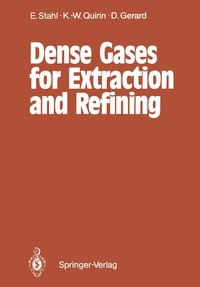
Dense Gases for Extraction and Refining
Published on 10. January 2012
Book
Paperback/Softback
XII, 237 pages
978-3-642-72894-5 (ISBN)
Description
Procedures for extracting or refining sensitive substances using dense gases have been developed for numerous purposes. Dense carbon dioxide is already being used industrially for decaffeination of coffee and extraction of hops. Further possible applications have been tested on the laboratory or pilot plant scales and shown to be mostly economical. Uses as varied as the non-aggressive extraction of spice, extraction of polymers, refining of spent oil, pyrolysis/extraction of wood and liquefaction of coal show the extremely wide range of application. The book comprehensively reviews the present state of development and features examples of application of this new technique.
More details
Edition
Softcover reprint of the original 1st ed. 1988
Language
English
Place of publication
Berlin
Germany
Publishing group
Springer Berlin
Target group
Professional and scholarly
Research
Illustrations
XII, 237 p.
Dimensions
Height: 244 mm
Width: 170 mm
Thickness: 15 mm
Weight
448 gr
ISBN-13
978-3-642-72894-5 (9783642728945)
DOI
10.1007/978-3-642-72892-1
Schweitzer Classification
Other editions
Additional editions
Egon Stahl | Karl-Werner Quirin | Dieter Gerard
Dense Gases for Extraction and Refining
Book
12/1987
1st Edition
Springer
€85.55
Article exhausted; check different version
Persons
Content
I. General Picture of Separation Procedures.- I.1 Principles of Substance Separation.- I.2 Conventional Methods of Extraction.- II. Basic Principles of Extraction with Dense Gases.- II.1 Historical Review.- II.2 Definition of Terms.- II.3 Special Features of Dense Gases.- II.4 Thermodynamic Fundamentals.- II.4.a Description of the Solvent Circulation.- II.4.b Considerations of Phase Equilibria.- II.4.c Calculations of Phase Equilibria.- III. Methods, Apparatus and Plants.- III.1 Procedures for Determining Phase Equilibria.- III.1.a The Synthetic Method.- III.1.b The Analytical Method.- III.1.c The Dynamic Method.- III.2 Extraction of Solids.- III.2.a Microextraction.- III.2.b High Pressure Soxhlet Extraction.- III.2.c Preparative Extraction.- III.3 Extraction Using Entrainers.- III.4 Continuous Extraction of Liquids.- III.4.a Fundamentals.- III.4.b Stepwise Separation.- III.4.c Counter-current Extraction.- III.4.d High Pressure Jet Extraction.- IV. Applications of Dense Gases to Extraction and Refining.- IV.1 General Survey.- IV.2 Fatty Oils and Waxes.- IV.2.a Solubility Behaviour.- IV.2.b Extraction of Oil Seeds.- IV.2.c Extraction of Waxes.- IV.2.d Influence on the Seed Proteins.- IV.2.e Fractionation of Fatty Oils and Waxes.- IV.2.f Removal of Oil from Crude Lecithin.- IV.3 Essential Oils and Flavours.- IV.3.a Solubility Behaviour.- IV.3.b Deterpenation.- IV.3.c Extraction of Pharmaceutically Active Components.- IV.3.d Extraction of Spices.- IV.3.e Extraction of Fragrances.- IV.3.f Prior Separation of Vegetable Waxes.- IV.4 Further Isoprenoids.- IV.4.a Extraction of Hops.- IV.4.b Steroids.- IV.4.c Carotinoids.- IV.5 Alkaloids.- IV.5.a Extraction of Alkaloids Used in Medicine.- IV.5.b Decaffeination of Coffee and Tea.- IV.5.c Extraction of Nicotine from Tobacco.- IV.6Oils of Law Volatility and Polymers.- IV.7 Extraction of Petroleum Products.- IV.7.a Deasphaltation of Heavy Oils.- IV.7.b Particle Separation from Viscous Oils.- IV.7.c Extraction of Oil-Containing Minerals and Residues.- IV.7.d Analytical Investigations.- IV.8 Extraction of Wood, Peat and Lignite.- IV.9 Extraction of Coal.- IV.10 Miscellaneous.- IV.10.a Extraction of Aqueous Solutions.- IV.10.b Adsorbents.- IV.10.c Decontamination of Drugs.- V. Non-Extractive Applications.- V.1 Pest Control.- V.2 Sterilisation.- V.3 Inflation, Disruption and Comminution.- V.4 High Pressure Micronising.- V.5 Fluid Chromatography.