

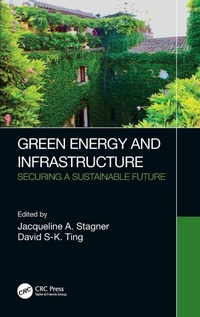
Green Energy and Infrastructure
Securing a Sustainable Future
1st Edition
Published on 13. October 2020
Book
Hardback
348 pages
978-0-367-55949-6 (ISBN)
Description
C. S. Lewis rightly instructed, "The task of the modern educator is not to cut down jungles, but to irrigate deserts." This book aims to achieve this task by pushing the frontiers of scholarship for securing a sustainable future through green energy and infrastructure. This encompasses the notion that what we create is in harmony and integration with both the spatial and temporal domains.
Through numerous practical examples and illustrations, this book examines a comprehensive review of the latest science on indoor environmental health, energy requirements for buildings, and the "greening" of infrastructure. Also, it provides a discussion on the underlying properties of biomass and its influence on furthering energy conversion technologies. Energy storage is essential for driving the integration of renewable energy, and different storage approaches are discussed in terms of power balancing, grid stability, and reliability.
Features:
Focuses on the importance of coupling green energy with green infrastructure
Provides an unbiased update of the state-of-the-art of sustainability science
Discusses utilizing sustainable building materials for simultaneous improvement in energy, economic, and environmental bottom lines for industry
Illuminates practical steps that need to be undertaken to achieve a greener infrastructure
Green Energy and Infrastructure: Securing a Sustainable Future is appropriate for researchers, students, and decision-makers seeking the latest, practical information on environmental sustainability.
Through numerous practical examples and illustrations, this book examines a comprehensive review of the latest science on indoor environmental health, energy requirements for buildings, and the "greening" of infrastructure. Also, it provides a discussion on the underlying properties of biomass and its influence on furthering energy conversion technologies. Energy storage is essential for driving the integration of renewable energy, and different storage approaches are discussed in terms of power balancing, grid stability, and reliability.
Features:
Focuses on the importance of coupling green energy with green infrastructure
Provides an unbiased update of the state-of-the-art of sustainability science
Discusses utilizing sustainable building materials for simultaneous improvement in energy, economic, and environmental bottom lines for industry
Illuminates practical steps that need to be undertaken to achieve a greener infrastructure
Green Energy and Infrastructure: Securing a Sustainable Future is appropriate for researchers, students, and decision-makers seeking the latest, practical information on environmental sustainability.
More details
Language
English
Place of publication
London
United Kingdom
Publishing group
Taylor & Francis Ltd
Target group
Professional and scholarly
Academic and Professional Practice & Development
Illustrations
169 s/w Abbildungen, 64 s/w Tabellen
64 Tables, black and white; 169 Illustrations, black and white
Dimensions
Height: 240 mm
Width: 161 mm
Thickness: 24 mm
Weight
716 gr
ISBN-13
978-0-367-55949-6 (9780367559496)
Copyright in bibliographic data and cover images is held by Nielsen Book Services Limited or by the publishers or by their respective licensors: all rights reserved.
Schweitzer Classification
Other editions
Additional editions
Jacqueline A. Stagner | David S-K. Ting
Green Energy and Infrastructure
Securing a Sustainable Future
E-Book
10/2020
1st Edition
CRC Press
€65.99
Available for download
Jacqueline A. Stagner | David S-K. Ting
Green Energy and Infrastructure
Securing a Sustainable Future
E-Book
10/2020
1st Edition
CRC Press
€65.99
Available for download
Persons
Dr. Jacqueline A. Stagner is the Undergraduate Programs Coordinator of Engineering at the University of Windsor. She has a PhD in Materials Science and Engineering, a Master of Business Administration, and a bachelor's degree in Mechanical Engineering. She worked as a release engineer in the automotive industry prior to joining the University of Windsor. As an adjunct graduate faculty member in the Department of Mechanical, Automotive and Materials Engineering, she co-advises students in the sustainability and renewable energy areas, in the Turbulence & Energy Laboratory.
Dr. David S-K. Ting is the founder of the Turbulence & Energy Laboratory, University of Windsor. As a professor in the Department of Mechanical, Automotive and Materials Engineering, he supervises students on a wide range of research projects in the thermofluids, flow turbulence, energy conversion and conservation, and renewable energy areas. To date, he has co/supervised over seventy-five graduate students and co-authored more than one hundred and thirty journal papers.
Dr. David S-K. Ting is the founder of the Turbulence & Energy Laboratory, University of Windsor. As a professor in the Department of Mechanical, Automotive and Materials Engineering, he supervises students on a wide range of research projects in the thermofluids, flow turbulence, energy conversion and conservation, and renewable energy areas. To date, he has co/supervised over seventy-five graduate students and co-authored more than one hundred and thirty journal papers.
Content
Energy for Buildings: Practises, Policies and Prospects. Green design effectiveness for a mini automotive-repair facility. Green hospitals and sustainability: case of companion house of a research hospital. Sustainable development and indoor air quality. What is priority: energy saving or people wellbeing?. Properties and conversion technologies of biomass. Wind resource forecasting error in flat and complex terrains. Wind Power Forecasting via Deep Learning Methods. Green Energy: Solar, Wind, Geothermal, Tidal Storage. New Energy Mining: Compressed Air Energy Storage in Abandoned Mines. Hydrostatically Compensated Energy Storage Technology. Bioconstruction and Harmonic Complexity of Biomimicry Organism. Back to the Basics: Return to Origin, Gaudi and Nature. Triple Bottom Line Analysis, Methodology and Its Implementation.