

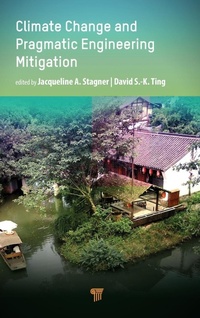
Climate Change and Pragmatic Engineering Mitigation
1st Edition
Published on 31. January 2022
Book
Hardback
318 pages
978-981-4877-97-8 (ISBN)
Description
This volume brings together 18 experts with diverse backgrounds and expertise from around the globe to tackle climate change from multiple angles. A comprehensive exposition of the interconnection between ocean, weather, and climate variability is a pre-requisite for understanding the challenge. The solution approach encompasses a better appreciation of the roof, refined solar energy estimation, heightened heat exchange effectiveness, improved understanding of photovoltaic operation in the Arctic, and integration of thermoelectric with photovoltaic. Adaptation is an essential and immediate remedy that every individual must take part in, understanding that men and women respond to the thermal environment differently. Imagine future buildings made from appetizing materials, closing a sustainable design process with self-sufficient communities. Would hydrogen become a crucial part of the mitigation?
More details
Language
English
Place of publication
Singapore
Target group
College/higher education
Professional and scholarly
Academic and Postgraduate
Illustrations
109 s/w Abbildungen, 16 farbige Abbildungen, 23 s/w Tabellen
23 Tables, black and white; 16 Illustrations, color; 109 Illustrations, black and white
Dimensions
Height: 235 mm
Width: 157 mm
Thickness: 23 mm
Weight
641 gr
ISBN-13
978-981-4877-97-8 (9789814877978)
Copyright in bibliographic data and cover images is held by Nielsen Book Services Limited or by the publishers or by their respective licensors: all rights reserved.
Schweitzer Classification
Other editions
Additional editions
Jacqueline A. Stagner | David S.-K. Ting
Climate Change and Pragmatic Engineering Mitigation
E-Book
01/2022
1st Edition
Pan Stanford Publishing Pte Ltd
€132.99
Available for download
Jacqueline A. Stagner | David S.-K. Ting
Climate Change and Pragmatic Engineering Mitigation
E-Book
01/2022
1st Edition
Pan Stanford Publishing Pte Ltd
€132.99
Available for download
Persons
Jacqueline A. Stagner is the Engineering Undergraduate Programs Coordinator at the University of Windsor, Canada. She worked as a release engineer in the automotive industry after her bachelor's degree, attained an MBA, and a PhD in materials science and engineering, before her tenure at the University of Windsor. Dr. Stagner's research interest is primarily in renewable energy. She has edited two volumes on sustainability.
David S.-K. Ting researched on combustion, turbulence, convection heat transfer, and fluid-structure interactions, before joining the University of Windsor. He is the founder of the Turbulence & Energy Laboratory. Prof. Ting has co-supervised more than 80 graduate students, co-authored more than 140 journal papers, authored 4 textbooks, and co-edited 12 volumes.
David S.-K. Ting researched on combustion, turbulence, convection heat transfer, and fluid-structure interactions, before joining the University of Windsor. He is the founder of the Turbulence & Energy Laboratory. Prof. Ting has co-supervised more than 80 graduate students, co-authored more than 140 journal papers, authored 4 textbooks, and co-edited 12 volumes.
Content
1. Ocean, Weather, and Climate Change 2. Environmental Impact Assessment of the Roof Insulation Materials during Life Cycle 3. Mathematical Radiation Models for Sustainable Innovation in Smart and Clean Cities 4. Improving Heat Transfer Efficiency with Innovative Turbulence Generators 5. Effect of Ambient Temperature and Wind on Solar PV Efficiency in a Cold Arctic Climate 6. A Review of Current Development in Photovoltaic-Thermoelectric Hybrid Power Systems 7. Low-Risk Engineering Adaptation Strategies to Climate Change Impacts at Individual Level in Urban Areas: A Developing Country's Viewpoint 8. Analysis of Gender Differences in Thermal Sensations in Outdoor Thermal Comfort: A Field Survey in Northern India 9. Urbanization and Food in the Biodigital Age 10. How Hydrogen Can Become a Low-Risk Solution for a Climate-Neutral Denmark by 2050