

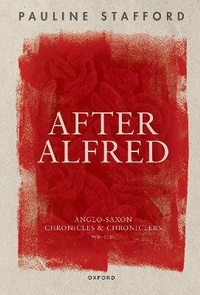
After Alfred
Anglo-Saxon Chronicles and Chroniclers, 900-1150
Published on 15. July 2022
Book
Paperback/Softback
400 pages
978-0-19-287136-7 (ISBN)
Description
The vernacular Anglo-Saxon Chronicles cover the centuries which saw the making of England and its conquest by Scandinavians and Normans. After Alfred traces their development from their genesis at the court of King Alfred to the last surviving chronicle produced at the Fenland monastery of Peterborough. These texts have long been part of the English national story. Pauline Stafford considers the impact of this on their study and editing since the sixteenth century, addressing all surviving manuscript chronicles, identifying key lost ones, and reconsidering these annalistic texts in the light of wider European scholarship on medieval historiography.
The study stresses the plural 'chronicles', whilst also identifying a tradition of writing vernacular history which links them. It argues that that tradition was an expression of the ideology of a southern elite engaged in the conquest and assimilation of old kingdoms north of the Thames, Trent, and Humber. Vernacular chronicling is seen, not as propaganda, but as engaged history-writing closely connected to the court, whose networks and personnel were central to the production and continuation of these chronicles. In particular, After Alfred connects many chronicles to bishops and especially to the Archbishops of York and Canterbury.
The disappearance of the English-speaking elite after the Norman Conquest had profound impacts on these texts. It repositioned their authors in relation to the court and royal power, and ultimately resulted in the end of this tradition of vernacular chronicling.
The study stresses the plural 'chronicles', whilst also identifying a tradition of writing vernacular history which links them. It argues that that tradition was an expression of the ideology of a southern elite engaged in the conquest and assimilation of old kingdoms north of the Thames, Trent, and Humber. Vernacular chronicling is seen, not as propaganda, but as engaged history-writing closely connected to the court, whose networks and personnel were central to the production and continuation of these chronicles. In particular, After Alfred connects many chronicles to bishops and especially to the Archbishops of York and Canterbury.
The disappearance of the English-speaking elite after the Norman Conquest had profound impacts on these texts. It repositioned their authors in relation to the court and royal power, and ultimately resulted in the end of this tradition of vernacular chronicling.
Reviews / Votes
Showing both depth of knowledge and fine analysis of the evidence, this book is unquestionably essential reading for anyone interested in chronicle-writing and its links with contemporary politics and ideologies. * SUSAN IRVINE, Early Medieval Europe * In After Alfred, Pauline Stafford's superb new history of the several vernacular chronicles (emphasis on the plural) spawned by Alfred's, she shows how these copies and continuations were embellished and edited in different times and places over the following 250 years. Stafford has acquired a depth of knowledge that allows her artfully to fathom the dark waters that crash about her material. Hers is a reminder -- of major significance -- of how these unutterably complex manuscripts should be read: with caution and context in equal measure. * Alex Burghart, Times Literary Supplement *More details
Language
English
Place of publication
Oxford
United Kingdom
Target group
Professional and scholarly
Illustrations
10 black and white figures/illustrations
Dimensions
Height: 232 mm
Width: 154 mm
Thickness: 21 mm
Weight
580 gr
ISBN-13
978-0-19-287136-7 (9780192871367)
Copyright in bibliographic data and cover images is held by Nielsen Book Services Limited or by the publishers or by their respective licensors: all rights reserved.
Schweitzer Classification
Person
Pauline Stafford studied at the University of Oxford. She taught medieval history at the University of Huddersfield, before becoming Professor of Medieval History at the University of Liverpool, where she remained until her retirement. She was also a visiting professor at the Institute of Medieval Studies at the University of Leeds, and is Honorary Vice-President of the Royal Historical Society.
Content
- Chapter 1 Introduction
- Chapter 2 The Study and Editing of the Vernacular Chronicles
- Chapter 3 Alfred's Chronicle and the First Continuations
- Chapter 4 Chronicle A and the Early Tenth Century
- Chapter 5 BC, B, and the Mid Tenth Century
- Chapter 6 The 'Northern Recension'
- Chapter 7 The Lost Worcester Chronicle
- Chapter 8 Vernacular Chronicles c 1000
- Chapter 9 The Annals of Æthelred and the early years of Cnut
- Chapter 10 The Making of Chronicle C and Mid Eleventh-Century Chronicling
- Chapter 11 The Continuations of Chronicle C and the Development of Chronicles in the Mid Eleventh Century
- Chapter 12 Chronicle D, Crossing Conquest
- Chapter 13 Chronicle F and Canterbury post 1066
- Chapter 14 Chronicle E, /E and H: the End of the Tradition?
- Chapter 2 The Study and Editing of the Vernacular Chronicles
- Chapter 3 Alfred's Chronicle and the First Continuations
- Chapter 4 Chronicle A and the Early Tenth Century
- Chapter 5 BC, B, and the Mid Tenth Century
- Chapter 6 The 'Northern Recension'
- Chapter 7 The Lost Worcester Chronicle
- Chapter 8 Vernacular Chronicles c 1000
- Chapter 9 The Annals of Æthelred and the early years of Cnut
- Chapter 10 The Making of Chronicle C and Mid Eleventh-Century Chronicling
- Chapter 11 The Continuations of Chronicle C and the Development of Chronicles in the Mid Eleventh Century
- Chapter 12 Chronicle D, Crossing Conquest
- Chapter 13 Chronicle F and Canterbury post 1066
- Chapter 14 Chronicle E, /E and H: the End of the Tradition?