

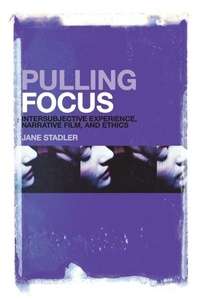
Pulling Focus
Intersubjective Experience, Narrative Film, and Ethics
Published on 22. March 2012
Book
Paperback/Softback
288 pages
978-1-4411-6302-8 (ISBN)
Description
The most powerful films have an afterlife. Their sensory appeal and their capacity to elicit involvement in story, character and conflict reaches beyond the screen to subtly reframe the way spectators view ethical issues and agents within the narrative, and in the world outside the cinema. Pulling Focus: Intersubjective Experience and Narrative Film questions how cinematic narratives relate to and affect ethical life. Extending Martha Nussbaum and Wayne Booth's work on moral philosophy and literature to consider cinema, Dr. Stadler shows that film spectatorship can be understood as a model for ethical attention that engages the audience in an affective relationship with characters and their values. Building on Vivian Sobchack's Address of the Eye and Carnal Thoughts, she uses a phenomenological approach to analyse ethical dimensions of film extending beyond narrative content, arguing that the camera describes experience and views screen characters with an evaluative form of perception: an ethical gaze in which spectators participate. Films discussed include Dead Man Walking, Lost Highway, Batman Begins, Nil By Mouth, and Eternal Sunshine of the Spotless Mind.
Reviews / Votes
Mention -Chronicle of Higher Education, December 19, 2008 First published when the ethical implication of viewer and film was not on the agenda of contemporary film studies, Pulling Focus: Intersubjective Experience, Narrative Film, and Ethics was a courageous exploration of how narrative cinema both presents and solicits an ethical gaze. Now in paperback, Stadler's groundbreaking work can take its proper place at the forefront of a growing body of literature that recognizes that any axiology of cinema entails ethics as well as aesthetics. Moreover, the book's accessible and graceful prose and its convincing phenomenologoical interperetations of a range of well-known films make it an ideal text for the undergraduate and graduate classroom. --Vivian Sobchack, UCLA, School of Theater, Film and Television "The author is interested in the camera as a narrator that guides spectators to judgment and engages their sensory apparatus and capacity for affect in reshaping what might otherwise by abstract and rational judgment....Stadler interprets several films, doing especially well with David Lynch's enigmatic Lost Highway, which unsettles notions of narrative genre, identity, and morality. SUMMING UP: Recommended."- Choice * Choice *More details
Language
English
Place of publication
New York
United States
Target group
Professional and scholarly
Illustrations
42
Dimensions
Height: 234 mm
Width: 156 mm
Thickness: 16 mm
Weight
445 gr
ISBN-13
978-1-4411-6302-8 (9781441163028)
Copyright in bibliographic data and cover images is held by Nielsen Book Services Limited or by the publishers or by their respective licensors: all rights reserved.
Schweitzer Classification
Other editions
Additional editions
E-Book
09/2008
1st Edition
Bloomsbury Continuum
€47.49
Available for download
Person
Dr Stadler is Lecturer in Film and Television Studies at the University of Queensland, Australian, and is on the editorial advisory board of the online journal IM: Interactive Media. She was Convenor of the Film Studies Major at the University of Cape Town (2002-2005), and is the recipient of the Murdoch University Vice Chancellor's Teaching Excellence Award (2000) and the University of Cape Town Teaching Merit Award (2004, 2005). She is co-author of Media and Society, Oxford University Press: 2005 (with Michael O'Shaughnessy).
Content
Chapter 1: Ethics in Narrative Form and Content; Chapter 2: A Phenomenological Approach to the Ethics of Film; Chapter 3: Losing the Plot: Narrative Structure and Ethical Identity; Chapter 4: Under the Influence: Vice, Violence and Villainy; Chapter 5: Resistance and Responsiveness: Emotion and Character Engagement; Chapter 6: Imagination: Inner Sight and Silent Voices; Chapter 7: Seeing in the Dark: Cinema, Ethics, and Alternative Engagement.