

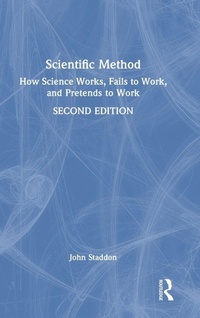
Scientific Method
How Science Works, Fails to Work, and Pretends to Work
2nd Edition
Published on 7. June 2024
Book
Hardback
210 pages
978-1-032-68389-8 (ISBN)
Description
This expanded second edition of Scientific Method shows how science works, fails to work or pretends to work by looking at examples from physics, biomedicine, psychology, sociology and economics.
Scientific Method aims to help curious readers understand the idea of science, not by learning a list of techniques but through examples both historical and contemporary. Staddon affirms that if the reader can understand successful studies as well as studies that appear to be scientific but are not, they will become a better judge of the "science" in circulation today. To this end, this new edition includes a new chapter, What is Science?, which points out that science, like any human activity, has its own set of values, with truth being the core. Other new chapters focus on the emergence of AI and machine learning, science and diversity, and behavioral economics. The book also includes textual features such as bullet-points and text boxes on topical issues.
Scientific Method is essential reading for students and professionals trying to make sense of the role of science in society, and of the meaning, value and limitations of scientific methodology.
Scientific Method aims to help curious readers understand the idea of science, not by learning a list of techniques but through examples both historical and contemporary. Staddon affirms that if the reader can understand successful studies as well as studies that appear to be scientific but are not, they will become a better judge of the "science" in circulation today. To this end, this new edition includes a new chapter, What is Science?, which points out that science, like any human activity, has its own set of values, with truth being the core. Other new chapters focus on the emergence of AI and machine learning, science and diversity, and behavioral economics. The book also includes textual features such as bullet-points and text boxes on topical issues.
Scientific Method is essential reading for students and professionals trying to make sense of the role of science in society, and of the meaning, value and limitations of scientific methodology.
Reviews / Votes
Praise for the first edition:"John Staddon's aim in this highly readable book is to provide a guide through the 'blizzard of scientific and pseudo-scientific information that rains on the public every day.' He starts by taking a critical look at sciences such as biology and physics and then provides a fascinating and thought-provoking critique of the social sciences, particularly psychology and economics, where he argues that fashionable ideas are often based on untested and untestable theories. Staddon jolts us out of complacent acceptance of how the media often present science."
Marian Stamp Dawkins, University of Oxford, UK
"John Staddon does not take prisoners. In this new book he displays his erudition and sharp critical intelligence to discuss what he sees as the main weaknesses of social sciences today, and especially of mainstream economics. If you are a social scientist, and especially an economist, pray your work has not been cho-sen as an example. If you are not, the book will provide you with an illuminating survey of real and potential pitfalls of current work in social sciences."
Alex Kacelnik, University of Oxford, UK
"In a digital world where many struggle to tell fake news from scientific facts, Scientific Method provides an easy-to-read primer for scientific thinking. The book lives from John Staddon's masterly use of examples that clarify problem-atic methods plaguing the social sciences, such as the proliferation of math-ematical formulas without well-defined or measurable terms, near-unfalsifiable theories that are defended with confidence, and the ritualistic testing of null hypotheses. Science affects our lives, and this short, clear, and enjoyable book will affect how its readers think about science."
Gerd Gigerenzer, Max Planck Institute for Human Development, Germany
"Staddon demonstrates scientific method in action, applying his analytic/critical skill to dozens of applications in epidemiology/biomedicine, animal behavior, social psychology, and the ever-dismal science of economics. He shows that both correlational data and 'gold-standard' multi-group designs may suggest hypoth-eses, but not explanations, which require the discovery of causes across time."
John C. Malone, University of Tennessee, Knoxville, USA
More details
Edition
2nd edition
Language
English
Place of publication
London
United Kingdom
Publishing group
Taylor & Francis Ltd
Target group
College/higher education
General and Undergraduate Core
Illustrations
31 s/w Abbildungen, 4 s/w Photographien bzw. Rasterbilder, 27 s/w Zeichnungen, 6 s/w Tabellen
6 Tables, black and white; 27 Line drawings, black and white; 4 Halftones, black and white; 31 Illustrations, black and white
Dimensions
Height: 235 mm
Width: 157 mm
Thickness: 17 mm
Weight
487 gr
ISBN-13
978-1-032-68389-8 (9781032683898)
Copyright in bibliographic data and cover images is held by Nielsen Book Services Limited or by the publishers or by their respective licensors: all rights reserved.
Schweitzer Classification
Other editions
Additional editions

Book
06/2024
2nd Edition
Routledge
€51.00
Shipment within 10-20 days

E-Book
06/2024
2nd Edition
Routledge
€44.99
Available for download

E-Book
06/2024
2nd Edition
Routledge
€44.99
Available for download
Previous edition
Book
12/2017
1st Edition
Routledge
€183.50
Article exhausted; check for reprint
Person
John Staddon is James B. Duke Professor of Psychology and Professor of Biology and Neurobiology, Emeritus at Duke University. He does research on adaptive behavior, economics and the history and philosophy of science.
Content
1. What is Science? 2. Some Science History 3. Experiment 4. Null Hypothesis Statistical Testing 5. Models and Incentives 6. Social Science 7. Science and AI 8. Science and Diversity 9. Social science: What is the problem? 10. Economics and Equilibria 11. Behavioral Economics 12. Animal Economics 13. The Object of Inquiry Problem 14. Efficient Markets, I 15. Efficient Markets, II Event Studies and the CAPM 16. Summing Up