

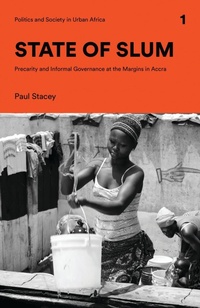
State of Slum
Precarity and Informal Governance at the Margins in Accra
Published on 15. April 2019
Book
Hardback
240 pages
978-1-78699-204-8 (ISBN)
Description
Home to eighty thousand people, Accra's Old Fadama neighbourhood is the largest illegal slum in Ghana. Though almost all its inhabitants are Ghanaian born, their status as illegal 'squatters' means that they live a precarious existence, marginalised within Ghanaian society and denied many of the rights to which they are entitled as citizens.
The case of Old Fadama is far from unique. Across Africa, over half the population now lives in cities, and a lack of affordable housing means that growing numbers live in similar illegal slum communities, often in appalling conditions. Drawing on rich, ethnographic fieldwork, the book takes as its point of departure the narratives that emerge from the everyday lives and struggles of these people, using the perspective offered by Old Fadama as a means of identifying wider trends and dynamics across African slums.
Central to Stacey's argument is the idea that such slums possess their own structures of governance, grounded in processes of negotiation between slum residents and external actors. In the process, Stacey transforms our understanding not only of slums, but of governance itself, moving us beyond prevailing state-centric approaches to consider how even a society's most marginal members can play a key role in shaping and contesting state power.
The case of Old Fadama is far from unique. Across Africa, over half the population now lives in cities, and a lack of affordable housing means that growing numbers live in similar illegal slum communities, often in appalling conditions. Drawing on rich, ethnographic fieldwork, the book takes as its point of departure the narratives that emerge from the everyday lives and struggles of these people, using the perspective offered by Old Fadama as a means of identifying wider trends and dynamics across African slums.
Central to Stacey's argument is the idea that such slums possess their own structures of governance, grounded in processes of negotiation between slum residents and external actors. In the process, Stacey transforms our understanding not only of slums, but of governance itself, moving us beyond prevailing state-centric approaches to consider how even a society's most marginal members can play a key role in shaping and contesting state power.
More details
Series
Language
English
Place of publication
United Kingdom
Publishing group
Bloomsbury Publishing PLC
Target group
College/higher education
Product notice
Paper over boards
Illustrations
1 bw map, 9 bw illus
Dimensions
Height: 222 mm
Width: 145 mm
Thickness: 17 mm
Weight
466 gr
ISBN-13
978-1-78699-204-8 (9781786992048)
Copyright in bibliographic data and cover images is held by Nielsen Book Services Limited or by the publishers or by their respective licensors: all rights reserved.
Schweitzer Classification
Other editions
Additional editions
E-Book
04/2019
1st Edition
Zed Books Ltd
€36.49
Available for download
E-Book
04/2019
1st Edition
Zed Books Ltd
€36.49
Available for download
Person
Paul Stacey is a postdoctoral researcher in global development at the Institute for Food and Resource Economics, University of Copenhagen. He has undertaken research projects for Oxfam America, the Danish Institute for International Studies, and the Bill and Melinda Gates Foundation. This is his first book.
Content
Introduction
1. Origins and Destinations
2. Seeking Shelter and Freedom
3. Gaining and Losing Land, and Soft Property
4. Shifting Yam, and Market Place Citizenship
5. Solving Problems and Emerging Authority
Conclusions and Policy Perspectives
1. Origins and Destinations
2. Seeking Shelter and Freedom
3. Gaining and Losing Land, and Soft Property
4. Shifting Yam, and Market Place Citizenship
5. Solving Problems and Emerging Authority
Conclusions and Policy Perspectives