

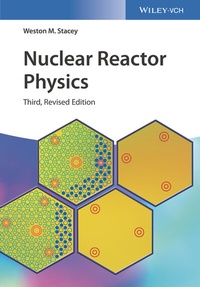
Nuclear Reactor Physics
3rd Edition
Published on 18. April 2018
Book
Hardback
766 pages
978-3-527-41366-9 (ISBN)
Description
The third, revised edition of this popular textbook and reference, which has been translated into Russian and Chinese, expands the comprehensive and balanced coverage of nuclear reactor physics to include recent advances in understanding of this topic.
The first part of the book covers basic reactor physics, including, but not limited to nuclear reaction data, neutron diffusion theory, reactor criticality and dynamics, neutron energy distribution, fuel burnup, reactor types and reactor safety.
The second part then deals with such physically and mathematically more advanced topics as neutron transport theory, neutron slowing down, resonance absorption, neutron thermalization, perturbation and variational methods, homogenization, nodal and synthesis methods, and space-time neutron dynamics.
For ease of reference, the detailed appendices contain nuclear data, useful mathematical formulas, an overview of special functions as well as introductions to matrix algebra and Laplace transforms.
With its focus on conveying the in-depth knowledge needed by advanced student and professional nuclear engineers, this text is ideal for use in numerous courses and for self-study by professionals in basic nuclear reactor physics, advanced nuclear reactor physics, neutron transport theory, nuclear reactor dynamics and stability, nuclear reactor fuel cycle physics and other important topics in the field of nuclear reactor physics.
The first part of the book covers basic reactor physics, including, but not limited to nuclear reaction data, neutron diffusion theory, reactor criticality and dynamics, neutron energy distribution, fuel burnup, reactor types and reactor safety.
The second part then deals with such physically and mathematically more advanced topics as neutron transport theory, neutron slowing down, resonance absorption, neutron thermalization, perturbation and variational methods, homogenization, nodal and synthesis methods, and space-time neutron dynamics.
For ease of reference, the detailed appendices contain nuclear data, useful mathematical formulas, an overview of special functions as well as introductions to matrix algebra and Laplace transforms.
With its focus on conveying the in-depth knowledge needed by advanced student and professional nuclear engineers, this text is ideal for use in numerous courses and for self-study by professionals in basic nuclear reactor physics, advanced nuclear reactor physics, neutron transport theory, nuclear reactor dynamics and stability, nuclear reactor fuel cycle physics and other important topics in the field of nuclear reactor physics.
More details
Edition
3. überarbeitete Auflage
Language
English
Place of publication
Berlin
Germany
Target group
College/higher education
Illustrations
219
166 s/w Abbildungen, 1 farbige Abbildung, 52 s/w Tabellen
Dimensions
Height: 24.4 cm
Width: 17 cm
Thickness: 4 cm
Weight
1488 gr
ISBN-13
978-3-527-41366-9 (9783527413669)
Schweitzer Classification
Other editions
Additional editions
Weston M. Stacey
Nuclear Reactor Physics
E-Book
02/2018
3rd Edition
Wiley-VCH
€174.99
Available for download
Weston M. Stacey
Nuclear Reactor Physics
E-Book
02/2018
3rd Edition
Wiley-VCH
€174.99
Available for download
Previous edition
Weston M. Stacey
Nuclear Reactor Physics
Book
05/2007
2nd Edition
Wiley-VCH
€175.00
Article exhausted; check for reprint
Person
Weston M. Stacey is Professor of Nuclear Engineering at the Georgia Institute of Technology. His career spans more than 50 years of research and teaching in nuclear reactor physics, fusion plasma physics and fusion and fission reactor conceptual design. He led the IAEA INTOR Workshop (1979-88) that led to the present ITER project, for which he was awarded the US Department of Energy Distinguished Associate Award and the Department of Energy Certificates of Appreciation. Professor Stacey is a Fellow of the American Nuclear Society and of the American Physical Society. He is the recipient of several prizes, among them the American Nuclear Society Seaborg Medal for Nuclear Research and the Wigner Reactor Physicists Award, and the author of ten previous books and numerous research papers.
Content
Preface
PART I: BASIC REACTOR PHYSICS
1. Neutron Nuclear Reactions
2. Neutron Chain Fission Reactors
3. Neutron Diffusion Theory
4. Neutron Energy Distribution
5. Nuclear Reactor Dynamics
6. Fuel Burnup
7. Nuclear Power Reactors
8. Reactor Safety
PART II: ADVANCED REACTOR PHYSICS
9. Neutron Transport Theory
10. Neutron Slowing Down
11. Resonance Absorption
12. Neutron Thermalization
13. Perturbation and Variational Methods
14. Homogenization
15. Nodal and Synthesis Methods
16. Space-Time Neutron Kinetics
APPENDICES
A. Some Useful Nuclear Data
B. Some Useful Mathematical Formulas
C. Step Functions, Delta Functions, and Other Exotic Beasts
D. Some Properties of Special Functions
E. Introduction to Matrices and Matrix Algebra
F. Introduction to Laplace Transforms
PART I: BASIC REACTOR PHYSICS
1. Neutron Nuclear Reactions
2. Neutron Chain Fission Reactors
3. Neutron Diffusion Theory
4. Neutron Energy Distribution
5. Nuclear Reactor Dynamics
6. Fuel Burnup
7. Nuclear Power Reactors
8. Reactor Safety
PART II: ADVANCED REACTOR PHYSICS
9. Neutron Transport Theory
10. Neutron Slowing Down
11. Resonance Absorption
12. Neutron Thermalization
13. Perturbation and Variational Methods
14. Homogenization
15. Nodal and Synthesis Methods
16. Space-Time Neutron Kinetics
APPENDICES
A. Some Useful Nuclear Data
B. Some Useful Mathematical Formulas
C. Step Functions, Delta Functions, and Other Exotic Beasts
D. Some Properties of Special Functions
E. Introduction to Matrices and Matrix Algebra
F. Introduction to Laplace Transforms