

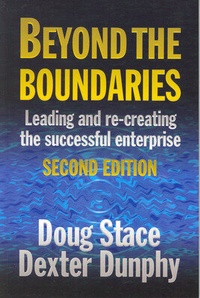
Beyond the Boundaries
2nd Edition
Will be published approx. on 30. December 2000
Book
Paperback/Softback
304 pages
978-0-07-470841-5 (ISBN)
Description
'How do organisations chart a path of change to help them thrive-not merely survive-in the fast moving twenty-first century economy?'
This is the central question posed and answered in Beyond the Boundaries, an insightful, groundbreaking book on strategic change management by leading authors in the field, Doug Stace and Dexter Dunphy.
The striking feature of the twenty-first century business environment is the phenomenon of 'new adventurers'-organisations and people bold enough to chart new territory, transform current industries, or create totally new industries. This book looks at how change can be charted and led as an energising, productive force at a time when organisations in every sector of the economy, new and old, must reshape to stay ahead of the game-change is the steady state. In this thoroughly updated new edition, the authors explore the new factors of success: speed, flexibility and dexterity in the middle of what is not only an economic revolution, but a social revolution as well.
Beyond the Boundaries provides practical frameworks to map your organisation's path of change-drawn from the authors' extensive organisational research-and examines the conditions under which a change in strategy will be effective in one organisation, but not in another.
This comprehensive, pivotal book covers:
the dilemmas of change
an organisational renaissance
choosing the strategy and structures
translating business strategy into action
taking charge of change
the new flexible work order; and
choosing change intervention tools.
The book is liberally illustrated with case examples from Australian and global enterprises. It is an essential guide for those who lead, manage and participate in the revolution sweeping our organisations.
This is the central question posed and answered in Beyond the Boundaries, an insightful, groundbreaking book on strategic change management by leading authors in the field, Doug Stace and Dexter Dunphy.
The striking feature of the twenty-first century business environment is the phenomenon of 'new adventurers'-organisations and people bold enough to chart new territory, transform current industries, or create totally new industries. This book looks at how change can be charted and led as an energising, productive force at a time when organisations in every sector of the economy, new and old, must reshape to stay ahead of the game-change is the steady state. In this thoroughly updated new edition, the authors explore the new factors of success: speed, flexibility and dexterity in the middle of what is not only an economic revolution, but a social revolution as well.
Beyond the Boundaries provides practical frameworks to map your organisation's path of change-drawn from the authors' extensive organisational research-and examines the conditions under which a change in strategy will be effective in one organisation, but not in another.
This comprehensive, pivotal book covers:
the dilemmas of change
an organisational renaissance
choosing the strategy and structures
translating business strategy into action
taking charge of change
the new flexible work order; and
choosing change intervention tools.
The book is liberally illustrated with case examples from Australian and global enterprises. It is an essential guide for those who lead, manage and participate in the revolution sweeping our organisations.
More details
Persons
Doug Stace is one of Australia's leading strategists, management authors and facilitators of strategic change. He is both Visiting Professor at Macquarie Graduate School of Management, Sydney and Visiting Senior Fellow at City University Business School, London, having previously spent ten years as Visiting Senior Research Fellow at the Australian Graduate School of Management, University of New South Wales. His strategy and change consultancy business spans global, national and regional corporations, public sector enterprises and professional bodies-working with change leaders, managers, executive teams and boards.He has published extensively in the area of strategic change and organisational transformation, with his current research focusing on the effective introduction of e-Change to corporations and on the leadership of global growth strategies and international competitiveness. He has also had extensive experience as a senior executive-giving his consultancies and teaching a refreshing blend of practical experience linked with leading edge research. Doug holds the degrees of Bachelor of Arts, Master of Letters and Master of Educational Administration from the University of New England, and a PhD from the Australian Graduate School of Management. He is a member of the international Strategic Management Society.
Dexter Dunphy is Distinguished Professor, University of Technology, Sydney-a position he took up in January 2000 after 17 years as Professor of Management at the Australian Graduate School of Management. Dexter has been a leading change theorist, researcher and consultant for 30 years. His research is published in about 60 articles and 16 books; he has consulted to over 150 private sector organisations in Australia and overseas advising on major organisational transformations, the design of human resource strategies and systems, troubleshooting and conflict resolution. He has also worked extensively with senior executives, managers and other professionals in enhancing their skills through executive workshops, mentoring and counselling. Dexter was Foundation Director of The Centre for Corporate Change at the AGSM from 1990-1997.Dexter has held visiting professorships at Harvard University (USA), Keio University (Japan), Shanghai First Medical College (PRC), The National University of Singapore and the Helsinki School of Economics and Business Administration (Finland). He has been a recipient of a Fulbright Senior Scholar Award, the University of NSW Vice-Chancellor's Award for Teaching Excellence, the Australian Human Resources Institute's Mike Pontifex Award for Outstanding Contribution to the Human Resources Profession, and the Australia and New Zealand Academy of Management's Distinguished Member Award for contributions to management research, scholarship, education and leadership. Dexter holds the degrees of BA (Hons) MEd (Hons) and DipEd from Sydney University and PhD in Sociology from Harvard University.
Dexter Dunphy is Distinguished Professor, University of Technology, Sydney-a position he took up in January 2000 after 17 years as Professor of Management at the Australian Graduate School of Management. Dexter has been a leading change theorist, researcher and consultant for 30 years. His research is published in about 60 articles and 16 books; he has consulted to over 150 private sector organisations in Australia and overseas advising on major organisational transformations, the design of human resource strategies and systems, troubleshooting and conflict resolution. He has also worked extensively with senior executives, managers and other professionals in enhancing their skills through executive workshops, mentoring and counselling. Dexter was Foundation Director of The Centre for Corporate Change at the AGSM from 1990-1997.Dexter has held visiting professorships at Harvard University (USA), Keio University (Japan), Shanghai First Medical College (PRC), The National University of Singapore and the Helsinki School of Economics and Business Administration (Finland). He has been a recipient of a Fulbright Senior Scholar Award, the University of NSW Vice-Chancellor's Award for Teaching Excellence, the Australian Human Resources Institute's Mike Pontifex Award for Outstanding Contribution to the Human Resources Profession, and the Australia and New Zealand Academy of Management's Distinguished Member Award for contributions to management research, scholarship, education and leadership. Dexter holds the degrees of BA (Hons) MEd (Hons) and DipEd from Sydney University and PhD in Sociology from Harvard University.
Content
PrefaceAcknowledgments
Chapter 1 The dilemmas of change
An organisational metaphor
Dilemmas in change
A place of no return
Learning to live with dilemmas
Embracing the dilemmas: Towards workable complexity
After the transformation, what?
References
Chapter 2 An organisational renaissance
Boundaries under challenge
Imperatives for organisational renaissance
Deconstruction, or a renaissance?
References
Chapter 3 Choosing the strategy and structures
Strategy: Creating the change agenda
Strategy, not just planning
A framework for strategy
Recreating organisational structures
Making intelligent choices
References
Chapter 4 Translating business strategy into action: Transitions, Transformations and Turnarounds
Qantas: A decade of renewal
Situational strategies for change
Transitions, Transformations or Turnarounds: Which approach to corporate change?
Linking business strategy and change
We need a theory of change
References
Appendix 4: Case studies in change
A: Going global to grow: The case of Lend Lease Corporation
B: Innovative twenty-first century workplaces
C: Transforming a traditional workplace: The case of ICI Botany
References
Chapter 5 Taking charge of change: Coaches, Captains, Charismatics and Commanders
Leadership: Sustaining and shaping corporate success
Leadership, communication and culture
Change takes time
Four types of change leaders
Beyond 'strategic dithering'
References
Chapter 6 The new flexible work order: Managing change where it matters most
The workplace: Focus of change
The traditional mass production system
Transforming the old work order
A changed work order
New leadership roles at the workface
Introducing self-managing teams
Beyond the single organisation: The importance of supplier networks
The new virtual work order
Conclusion
References
Chapter 7 Choosing change intervention tools
Strategies or fads?
Levels and depth of change intervention
Some current change intervention tools
Integrating change strategies and change intervention tools
The dynamics of change interventions
An Australasian model of change?
References
Chapter 8 Beyond the boundaries
Adventuring across boundaries
Leadership issues for the twenty-first century
Leading and recreating our enterprises
Change is the steady state
References
Appendix 8A: Four approaches to change: An overview
Index
Chapter 1 The dilemmas of change
An organisational metaphor
Dilemmas in change
A place of no return
Learning to live with dilemmas
Embracing the dilemmas: Towards workable complexity
After the transformation, what?
References
Chapter 2 An organisational renaissance
Boundaries under challenge
Imperatives for organisational renaissance
Deconstruction, or a renaissance?
References
Chapter 3 Choosing the strategy and structures
Strategy: Creating the change agenda
Strategy, not just planning
A framework for strategy
Recreating organisational structures
Making intelligent choices
References
Chapter 4 Translating business strategy into action: Transitions, Transformations and Turnarounds
Qantas: A decade of renewal
Situational strategies for change
Transitions, Transformations or Turnarounds: Which approach to corporate change?
Linking business strategy and change
We need a theory of change
References
Appendix 4: Case studies in change
A: Going global to grow: The case of Lend Lease Corporation
B: Innovative twenty-first century workplaces
C: Transforming a traditional workplace: The case of ICI Botany
References
Chapter 5 Taking charge of change: Coaches, Captains, Charismatics and Commanders
Leadership: Sustaining and shaping corporate success
Leadership, communication and culture
Change takes time
Four types of change leaders
Beyond 'strategic dithering'
References
Chapter 6 The new flexible work order: Managing change where it matters most
The workplace: Focus of change
The traditional mass production system
Transforming the old work order
A changed work order
New leadership roles at the workface
Introducing self-managing teams
Beyond the single organisation: The importance of supplier networks
The new virtual work order
Conclusion
References
Chapter 7 Choosing change intervention tools
Strategies or fads?
Levels and depth of change intervention
Some current change intervention tools
Integrating change strategies and change intervention tools
The dynamics of change interventions
An Australasian model of change?
References
Chapter 8 Beyond the boundaries
Adventuring across boundaries
Leadership issues for the twenty-first century
Leading and recreating our enterprises
Change is the steady state
References
Appendix 8A: Four approaches to change: An overview
Index