

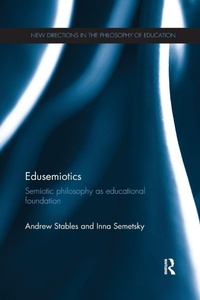
Edusemiotics
Semiotic philosophy as educational foundation
1st Edition
Published on 3. March 2017
Book
Paperback/Softback
170 pages
978-1-138-70340-7 (ISBN)
Description
Edusemiotics addresses an emerging field of inquiry, educational semiotics, as a philosophy of and for education. Using "sign" as a unit of analysis, educational semiotics amalgamates philosophy, educational theory and semiotics. Edusemiotics draws on the intellectual legacy of such philosophers as John Dewey, Charles Sanders Peirce, Gilles Deleuze and others across Anglo-American and continental traditions.
This volume investigates the specifics of semiotic knowledge structures and processes, exploring current dilemmas and debates regarding self-identity, learning, transformative and lifelong education, leadership and policy-making, and interrogating an important premise that still haunts contemporary educational philosophy: Cartesian dualism. In defiance of substance dualism and the fragmentation of knowledge that still inform education, the book offers a unifying paradigm for education as edusemiotics and emphasises ethical education in compliance with the semiotic unity between knowledge and action.
Chapters contain accessible discussions in the context of educational philosophy and theory, crossing the borders between logic, art, and science together with a provocative theoretical critique. Recently awarded a PESA book award for its contribution to the philosophy of education, Edusemiotics will appeal to an academic readership in education, philosophy and cultural studies, while also being an inspiring resource for students.
This volume investigates the specifics of semiotic knowledge structures and processes, exploring current dilemmas and debates regarding self-identity, learning, transformative and lifelong education, leadership and policy-making, and interrogating an important premise that still haunts contemporary educational philosophy: Cartesian dualism. In defiance of substance dualism and the fragmentation of knowledge that still inform education, the book offers a unifying paradigm for education as edusemiotics and emphasises ethical education in compliance with the semiotic unity between knowledge and action.
Chapters contain accessible discussions in the context of educational philosophy and theory, crossing the borders between logic, art, and science together with a provocative theoretical critique. Recently awarded a PESA book award for its contribution to the philosophy of education, Edusemiotics will appeal to an academic readership in education, philosophy and cultural studies, while also being an inspiring resource for students.
Reviews / Votes
"The book Edusemiotics: Semiotic Philosophy As Educational Foundation is a comprehensive synthesis on and an outcome of the one decade of semiotic research aiming to, eventually, bring a semiotic turn in philosophy of education (156-157)."-Alin Olteanu, Univerity of Roehampton, Social SemioticsMore details
Series
Language
English
Place of publication
London
United Kingdom
Publishing group
Taylor & Francis Ltd
Target group
College/higher education
Professional and scholarly
Postgraduate and Professional
Illustrations
4 s/w Zeichnungen, 1 s/w Tabelle, 7 s/w Abbildungen, 3 s/w Photographien bzw. Rasterbilder
1 Tables, black and white; 4 Line drawings, black and white; 3 Halftones, black and white; 7 Illustrations, black and white
Dimensions
Height: 234 mm
Width: 156 mm
Thickness: 10 mm
Weight
289 gr
ISBN-13
978-1-138-70340-7 (9781138703407)
Copyright in bibliographic data and cover images is held by Nielsen Book Services Limited or by the publishers or by their respective licensors: all rights reserved.
Schweitzer Classification
Other editions
Additional editions
E-Book
10/2014
1st Edition
Routledge
€69.99
Available for download
E-Book
10/2014
1st Edition
Routledge
€69.99
Available for download
Book
10/2014
1st Edition
Routledge
€241.40
Shipment within 15-20 days
Persons
Andrew Stables is Professor of Education and Philosophy and Head of Research in the School of Education, University of Roehampton, UK.
Inna Semetsky is Adjunct Professor at the Centre for Global Studies in Education, University of Waikato, New Zealand, and Professor at Russian New University (RosNOU), Moscow, Russia.
Inna Semetsky is Adjunct Professor at the Centre for Global Studies in Education, University of Waikato, New Zealand, and Professor at Russian New University (RosNOU), Moscow, Russia.
Content
1. Introducing Edusemiotics: A Philosophy of/for Education 2. Semiotic Reasoning and the Learning Paradox 3. Semiosis and the Myth of Learning 4. Apprenticeship in Signs: Towards Experimental Philosophy of Education 5. Semiosis, Dewey and Difference: Implications for Pragmatic Philosophy of Education 6. The Problem of Coordination: Developing Posthuman Intelligence 7. Semiotics as Rich Empiricism 8. Subjects in Process: Lifelong Education and the Ethics of Integration 9. The Semiotics of Organisational Landscape: School as Design 10. An Argument from Images: Educational, Existential, and Feminine Functions 11. From Semiosis to Social Policy: The Less Trodden Path 12. Understanding Edusemiotics: Exploring Educational Futures