

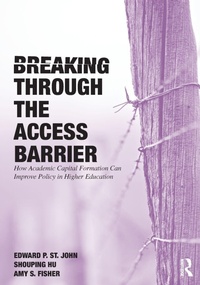
Breaking Through the Access Barrier
How Academic Capital Formation Can Improve Policy in Higher Education
1st Edition
Published on 12. October 2010
Book
Paperback/Softback
296 pages
978-0-415-80033-4 (ISBN)
Description
Breaking Through the Access Barrier argues that the policies designed to address inequalities in college access are failing to address underlying issues of inequality. This book introduces academic capital formation (ACF), a groundbreaking new theory defined by family knowledge of educational options and the opportunities for pursuing them. The authors suggest focusing on intervention programs and public policy to promote improvement in academic preparation, college information, and student aid.
This textbook offers:
a new construct-academic capital-that integrates and draws upon existing literature on influencing access to college
practical advice for better preparation and intervention
real student outcomes, databases, and interviews taken from exemplary intervention programs
empirical research illuminating the role of class reproduction in education and how interventions (financial, academic, and networking) can reduce student barriers
quantitative and qualitative analysis of the importance and effectiveness of several major policy interventions.
Written for courses on higher education policy and policy analysis, readers will find Breaking Through the Access Barrier offers valuable advice for working within new policy frameworks and reshaping the future of educational opportunities and access for under-represented students from disadvantaged backgrounds.
This textbook offers:
a new construct-academic capital-that integrates and draws upon existing literature on influencing access to college
practical advice for better preparation and intervention
real student outcomes, databases, and interviews taken from exemplary intervention programs
empirical research illuminating the role of class reproduction in education and how interventions (financial, academic, and networking) can reduce student barriers
quantitative and qualitative analysis of the importance and effectiveness of several major policy interventions.
Written for courses on higher education policy and policy analysis, readers will find Breaking Through the Access Barrier offers valuable advice for working within new policy frameworks and reshaping the future of educational opportunities and access for under-represented students from disadvantaged backgrounds.
Reviews / Votes
Overall, the book is comprehensive and detailed, providing needed insights into the human aspects of policy implementation, illuminating what interventions mean for students and their families and how deeply inter-related these processes are. This book will certainly be of value for education scholars, sociologists, and others interested in higher education policy.-Teachers College RecordMore details
Language
English
Place of publication
London
United Kingdom
Publishing group
Taylor & Francis Ltd
Target group
College/higher education
Illustrations
10 s/w Abbildungen, 43 s/w Tabellen
43 Tables, black and white; 10 Illustrations, black and white
Dimensions
Height: 254 mm
Width: 178 mm
Thickness: 16 mm
Weight
565 gr
ISBN-13
978-0-415-80033-4 (9780415800334)
Copyright in bibliographic data and cover images is held by Nielsen Book Services Limited or by the publishers or by their respective licensors: all rights reserved.
Schweitzer Classification
Other editions
Additional editions
Edward P. St. John | Shouping Hu | Amy S. Fisher
Breaking Through the Access Barrier
How Academic Capital Formation Can Improve Policy in Higher Education
E-Book
10/2010
Routledge
€68.49
Available for download
Edward P. St. John | Shouping Hu | Amy S. Fisher
Breaking Through the Access Barrier
How Academic Capital Formation Can Improve Policy in Higher Education
E-Book
10/2010
Routledge
€68.49
Available for download

Edward P. St. John | Shouping Hu | Amy S. Fisher
Breaking Through the Access Barrier
How Academic Capital Formation Can Improve Policy in Higher Education
Book
10/2010
1st Edition
Routledge
€230.40
Shipment within 15-20 days
Persons
Edward P. St. John is Algo D. Henderson Collegiate Professor of Higher Education at the University of Michigan.
Shouping Hu is Professor of Higher Education at Florida State University.
Amy S. Fisher is a doctoral candidate at the Center for the Study of Higher and Postsecondary Education, the University of Michigan.
Shouping Hu is Professor of Higher Education at Florida State University.
Amy S. Fisher is a doctoral candidate at the Center for the Study of Higher and Postsecondary Education, the University of Michigan.
Content
Preface
Acknowledgements
1. Introduction
Part I. Academic Capital Formation
2. Reframing
3. Family and Community Engagement
4. Academic Preparation
5. College Transitions
6. Engaged Learning
7. College Success and Commitment to Uplift
Part II. Improving Public Policy
8. Academic Capital Formation
9. Informing Public Policy
References
Acknowledgements
1. Introduction
Part I. Academic Capital Formation
2. Reframing
3. Family and Community Engagement
4. Academic Preparation
5. College Transitions
6. Engaged Learning
7. College Success and Commitment to Uplift
Part II. Improving Public Policy
8. Academic Capital Formation
9. Informing Public Policy
References