

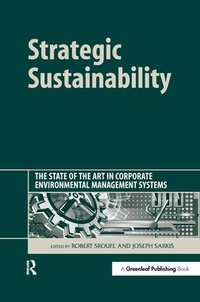
Strategic Sustainability
The State of the Art in Corporate Environmental Management Systems
1st Edition
Published on 1. April 2007
Book
Hardback
288 pages
978-1-874719-61-8 (ISBN)
Description
The last decade has seen increasing awareness of the importance of understanding corporate environmental management systems (EMSs) and their relationships with sustainability, competitiveness and institutional practice. It is now assumed that most large companies have some version of an EMS in place with systems ranging from informal policies and practices to formalised third-party certified systems that are widely publicized by companies and are now integral to their strategic direction. No matter what level and type of system a firm chooses, both practitioners and researchers wish to examine and better understand the extent to which these systems are cross-functional, how they impact on performance evaluation, their capability to monitor supply chains and the life-cycles of products and services and, most importantly, whether these systems actually make a contribution to better environmental performance.
This book provides intriguing insights into strategic and sustainable EMSs. It provides clear evidence of benefits that should exceed the costs (tangible and otherwise), and help practitioners understand the attributes of well-developed and strategically focused EMSs. It also demonstrates the link to performance measures such as reputation, improved position in the marketplace, cost, quality, waste reduction and numerous sustainable development-based metrics and issues. The comprehensive scope of topics spans several industries and provides environmental systems insight involving sustainable management systems, strategic and operational impacts of environmental systems, cross-country comparisons of EMS design processes and results, product-based environmental systems, EMS impacts at innovative organisations and environmental systems integration within specific industries.
The book is split into three sections. First, the book covers the broad issues of planning and designing an EMS and includes topics such as performance evaluation, comparisons between multinational environmental systems, sustainable development and links between already established quality systems and an EMS. The second section focuses on EMS implementation and operation and incorporates some corporate or industry-specific case studies. The third and final category of the book highlights the use of an EMS to evaluate business processes.
Strategic Sustainability will be essential reading for both managers faced with decisions regarding their own EMSs and to researchers seeking additional insights from state-of-the-art examples for further theoretical development and testing.
This book provides intriguing insights into strategic and sustainable EMSs. It provides clear evidence of benefits that should exceed the costs (tangible and otherwise), and help practitioners understand the attributes of well-developed and strategically focused EMSs. It also demonstrates the link to performance measures such as reputation, improved position in the marketplace, cost, quality, waste reduction and numerous sustainable development-based metrics and issues. The comprehensive scope of topics spans several industries and provides environmental systems insight involving sustainable management systems, strategic and operational impacts of environmental systems, cross-country comparisons of EMS design processes and results, product-based environmental systems, EMS impacts at innovative organisations and environmental systems integration within specific industries.
The book is split into three sections. First, the book covers the broad issues of planning and designing an EMS and includes topics such as performance evaluation, comparisons between multinational environmental systems, sustainable development and links between already established quality systems and an EMS. The second section focuses on EMS implementation and operation and incorporates some corporate or industry-specific case studies. The third and final category of the book highlights the use of an EMS to evaluate business processes.
Strategic Sustainability will be essential reading for both managers faced with decisions regarding their own EMSs and to researchers seeking additional insights from state-of-the-art examples for further theoretical development and testing.
Reviews / Votes
...The book presents many intriguing findings and ideas ... For instance, professors from the Politecnico di Milano describe the application of an environmental performance evaluation tool at Coca-Cola and Nestle in Italy ... It is a tribute to the expertise of the authors that the book confirms precisely what the drafters of the international standard [ISO 14001] intended when they wrote it. * www.crosslandsbulletin.com, August 2007 *More details
Language
English
Place of publication
Saltaire
United Kingdom
Publishing group
Taylor & Francis Ltd
Dimensions
Height: 234 mm
Width: 156 mm
Weight
620 gr
ISBN-13
978-1-874719-61-8 (9781874719618)
Copyright in bibliographic data and cover images is held by Nielsen Book Services Limited or by the publishers or by their respective licensors: all rights reserved.
Schweitzer Classification
Other editions
Additional editions
Robert Sroufe | Sarkis Joseph
Strategic Sustainability
The State of the Art in Corporate Environmental Management Systems
E-Book
09/2017
Routledge
€86.99
Available for download
Robert Sroufe | Sarkis Joseph
Strategic Sustainability
The State of the Art in Corporate Environmental Management Systems
E-Book
09/2017
Routledge
€86.99
Available for download
Persons
ROBERT SROUFE is the Murrin Chair of Global Competitiveness at Duquesne University, USA. JOSEPH SARKIS is currently a Professor of Operations and Environmental Management in the Graduate School of Management at Clark University, USA.
Content
Introduction
Robert Sroufe, Duquesne University, USA, and Joseph Sarkis, Clark University, USA
Part I: EMS planning and design
1. EPI Design: Integrating corporate strategies into the development process of an environmental performance evaluation system
Enrico Cagno, Lorenzo Tardini and Paolo Trucco, Politecnico di Milano, Italy
2. A comparison of environmental management system components and practices
Gwen Christini, Montgomery Watson Harza, USA, and Deanna H. Matthews and Chris Hendrickson, Carnegie Mellon University, USA
3. EMS and sustainable development: A model and comparative studies of integration
Ulku Oktem, The Wharton School, University of Pennsylvania, USA, Phil Lewis, Rohm and Haas Corporation, USA, Deborah Donovan, Sunoco, USA, James R. Hagan, GlaxoSmithKline, UK, and Thomas Pace, Burlington Northern and Santa Fe Railway Co., USA
4. Designing a sustainability management system at BMW Group: The Designworks/USA case study
Kellie A. McElhaney and Michael W. Toffel, Haas School of Business, University of California, Berkeley, USA, and Natalie Hill, Human Rights Center, University of California, Berkeley, USA
5. Core values and environmental management: A strong inference approach
John D. Hanson, Steven A. Melnyk and Roger J. Calantone, The Eli Broad Graduate School of Management, Michigan State University, USA
Part II: Implementation and operation
6. A product-based environmental management system
Kathleen Donnelly, Arjen Salemink, Frederick Blechinger, Albrecht Schuh and Theresa Boehm, Lucent Technologies, Inc.
7. Environmental reporting on the internet: From a technical tool to a strategic necessity
Ralf Isenmann, University of Bremen, Germany, and Christoph Bey, ESCEM School of Business and Management Tours-Poitiers, France
8. Web-based environmental management systems for SMEs
Adeline Maijala, Lassi Linnanen and Tuula Pohjola, Helsinki University of Technology, Finland
9. Integrating sustainability practices into power generation operations
Teresa DeBono, Pacific Gas and Electric Company, USA
10. The environmental management system of the Environmental Services Department of Athens International Airport
Eleftherios Venizelos, Calliopi Raftopoulou, Charalampos N. Kavouras and Panagiotis Karamanos, Environmental Services Department, Athens International Airport, Greece
Part III: Environmental management system evaluation
11. Factors influencing the implementation of environmental management systems, practices and performance
Olaf Weber, Department of Environmental Sciences and GOE, Zurich, Switzerland
12. Environmental management systems in the US and Thailand: A case comparison
Deborah Rigling Gallagher, Duke University, USA, Richard N.L. Andrews, University of North Carolina at Chapel Hill, USA, Achara Chandrachai, Chulalongkorn University, Thailand, and Kaewta Rohitratana, Thammasat University, Thailand
13. Change management: Sustainable development via an augmented EMS
Martin Callinan, University of Melbourne, Australia
14. Environmental management systems and environmental performance
Jonas Ammenberg, Link
Robert Sroufe, Duquesne University, USA, and Joseph Sarkis, Clark University, USA
Part I: EMS planning and design
1. EPI Design: Integrating corporate strategies into the development process of an environmental performance evaluation system
Enrico Cagno, Lorenzo Tardini and Paolo Trucco, Politecnico di Milano, Italy
2. A comparison of environmental management system components and practices
Gwen Christini, Montgomery Watson Harza, USA, and Deanna H. Matthews and Chris Hendrickson, Carnegie Mellon University, USA
3. EMS and sustainable development: A model and comparative studies of integration
Ulku Oktem, The Wharton School, University of Pennsylvania, USA, Phil Lewis, Rohm and Haas Corporation, USA, Deborah Donovan, Sunoco, USA, James R. Hagan, GlaxoSmithKline, UK, and Thomas Pace, Burlington Northern and Santa Fe Railway Co., USA
4. Designing a sustainability management system at BMW Group: The Designworks/USA case study
Kellie A. McElhaney and Michael W. Toffel, Haas School of Business, University of California, Berkeley, USA, and Natalie Hill, Human Rights Center, University of California, Berkeley, USA
5. Core values and environmental management: A strong inference approach
John D. Hanson, Steven A. Melnyk and Roger J. Calantone, The Eli Broad Graduate School of Management, Michigan State University, USA
Part II: Implementation and operation
6. A product-based environmental management system
Kathleen Donnelly, Arjen Salemink, Frederick Blechinger, Albrecht Schuh and Theresa Boehm, Lucent Technologies, Inc.
7. Environmental reporting on the internet: From a technical tool to a strategic necessity
Ralf Isenmann, University of Bremen, Germany, and Christoph Bey, ESCEM School of Business and Management Tours-Poitiers, France
8. Web-based environmental management systems for SMEs
Adeline Maijala, Lassi Linnanen and Tuula Pohjola, Helsinki University of Technology, Finland
9. Integrating sustainability practices into power generation operations
Teresa DeBono, Pacific Gas and Electric Company, USA
10. The environmental management system of the Environmental Services Department of Athens International Airport
Eleftherios Venizelos, Calliopi Raftopoulou, Charalampos N. Kavouras and Panagiotis Karamanos, Environmental Services Department, Athens International Airport, Greece
Part III: Environmental management system evaluation
11. Factors influencing the implementation of environmental management systems, practices and performance
Olaf Weber, Department of Environmental Sciences and GOE, Zurich, Switzerland
12. Environmental management systems in the US and Thailand: A case comparison
Deborah Rigling Gallagher, Duke University, USA, Richard N.L. Andrews, University of North Carolina at Chapel Hill, USA, Achara Chandrachai, Chulalongkorn University, Thailand, and Kaewta Rohitratana, Thammasat University, Thailand
13. Change management: Sustainable development via an augmented EMS
Martin Callinan, University of Melbourne, Australia
14. Environmental management systems and environmental performance
Jonas Ammenberg, Link