

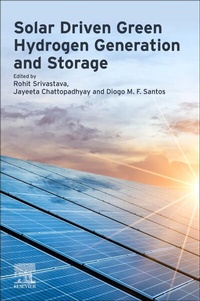
Solar-Driven Green Hydrogen Generation and Storage
Published on 22. May 2023
Book
Paperback/Softback
582 pages
978-0-323-99580-1 (ISBN)
Description
Solar-Driven Green Hydrogen Generation and Storage presents the latest research and technologies in hydrogen generation through solar energy. With in-depth coverage of three key topics, the book discusses green hydrogen technologies, solid hydrogen storage, and hydrogen energy applications.
The book begins with a deep dive into photoelectrochemical water splitting, examining different catalysts, such as perovskite-based, phosphorene-based, polymer-based, transition metal-based single atom, blue-titania, carbon-based, Mxene and semiconductor-based catalysts. Subsequent chapters
analyze hydrogen production techniques, including electrolysis, photobiological, thermochemical, and biomass gasification methods. After reviewing key hydrogen storage technologies, the book concludes
with a summary of the applications of hydrogen in various industry sectors.
This book is an essential resource for students, researchers, and engineers interested in renewable energy, hydrogen production, and energy storage.
The book begins with a deep dive into photoelectrochemical water splitting, examining different catalysts, such as perovskite-based, phosphorene-based, polymer-based, transition metal-based single atom, blue-titania, carbon-based, Mxene and semiconductor-based catalysts. Subsequent chapters
analyze hydrogen production techniques, including electrolysis, photobiological, thermochemical, and biomass gasification methods. After reviewing key hydrogen storage technologies, the book concludes
with a summary of the applications of hydrogen in various industry sectors.
This book is an essential resource for students, researchers, and engineers interested in renewable energy, hydrogen production, and energy storage.
More details
Language
English
Place of publication
Philadelphia
United States
Target group
Professional and scholarly
Dimensions
Height: 229 mm
Width: 152 mm
Weight
930 gr
ISBN-13
978-0-323-99580-1 (9780323995801)
Copyright in bibliographic data and cover images is held by Nielsen Book Services Limited or by the publishers or by their respective licensors: all rights reserved.
Schweitzer Classification
Other editions
Additional editions
Rohit Srivastava | Jayeeta Chattopadhyay | Diogo M. F. Santos
Solar-Driven Green Hydrogen Generation and Storage
E-Book
05/2023
Elsevier
€170.00
Available for download
Persons
Rohit Srivastava is a Senior Assistant Professor at the Department of Petroleum Engineering, Pandit Deendayal Energy University, Gandhinagar, India. His research focuses on green hydrogen and carbon dioxide reduction into green fuels.
Jayeeta Chattopadhyay is a Professor and Deputy Director (R&D) at Amity University Jharkhand, Ranchi, India.
Diogo M.F. Santos currently works as an Associate Researcher in the Center of Physics and Engineering of Advanced Materials (CeFEMA) of Instituto Superior Tecnico (IST, Universidade de Lisboa) studying electrodes and membranes for application in direct liquid fuel cells. D.M.F. Santos was born in Torres Vedras, Portugal, in 1977 and graduated in chemical engineering at IST in 2001. He received an M.Sc. degree in 2006 and a Ph.D. degree in electrochemistry in 2009. His Ph.D. thesis was devoted to the development of the direct borohydride fuel cell. He did a 3-year post-doc in Chemical Engineering in FEUP (Porto University) and IST studying new electrocatalytic materials for hydrogen production by alkaline water electrolysis. Afterwards, he did a 2-year post-doc in Materials Science & Engineering developing cathodes for direct borohydride fuel cells in IST and CICECO (Aveiro University). As an Investigador FCT in CeFEMA (2015-20) he developed low-cost electrocatalysts for low-temperature fuel cells. D.M.F. Santos has authored over 120 journal papers and 90 conference proceedings.
Jayeeta Chattopadhyay is a Professor and Deputy Director (R&D) at Amity University Jharkhand, Ranchi, India.
Diogo M.F. Santos currently works as an Associate Researcher in the Center of Physics and Engineering of Advanced Materials (CeFEMA) of Instituto Superior Tecnico (IST, Universidade de Lisboa) studying electrodes and membranes for application in direct liquid fuel cells. D.M.F. Santos was born in Torres Vedras, Portugal, in 1977 and graduated in chemical engineering at IST in 2001. He received an M.Sc. degree in 2006 and a Ph.D. degree in electrochemistry in 2009. His Ph.D. thesis was devoted to the development of the direct borohydride fuel cell. He did a 3-year post-doc in Chemical Engineering in FEUP (Porto University) and IST studying new electrocatalytic materials for hydrogen production by alkaline water electrolysis. Afterwards, he did a 2-year post-doc in Materials Science & Engineering developing cathodes for direct borohydride fuel cells in IST and CICECO (Aveiro University). As an Investigador FCT in CeFEMA (2015-20) he developed low-cost electrocatalysts for low-temperature fuel cells. D.M.F. Santos has authored over 120 journal papers and 90 conference proceedings.
Editor
Senior Assistant Professor, Department of Petroleum Engineering, Pandit Deendayal Energy University, Gandhinagar, India
Associate Professor and Assistant Director, Chemistry Department, Amity Institute of Applied Sciences, Amity University Jharkhand, Niwaranpur, Ranchi, Jharkhand, India
Assistant Professor at Instituto Superior Tecnico (IST, Universidade de Lisboa, Portugal), Researcher at Center of Physics and Engineering of Advanced Materials (CeFEMA)
Content
1. Exploring the hydrogen evolution reaction (HER) side of perovskite-based materials during photoelectrochemical water splitting
2. Phosphorene-based functional nanomaterials for photoelectrochemical water splitting
3. Polymer-based catalyst for photoelectrochemical water splitting
4. Transition metal-based single-atom catalyst for photoelectrochemical water splitting
5. Clathrate hydrate as a potential medium for hydrogen storage application
6. Advanced carbon-based nanomaterials for photoelectrochemical water splitting
7. MXene-transition metal compound sulfide and phosphide hetero-nanostructures for photoelectrochemical water splitting
8. Design and advances of semiconductors for photoelectrochemical water-splitting
9. Dye-sensitized photoelectrochemical cells in water splitting
10. Photobiological hydrogen production: Introduction and fundamental concept
11. Biological hydrogen production driven by photo-fermentation processes
12. Photobiological hydrogen production by microorganisms
13. Photobiological production of hydrogen from biomass
14. Challenges in scaling low-carbon hydrogen production in Europe
15. Photobioreactor for hydrogen production
16. Thermochemical hydrogen production
17. Hydrogen production driven by nuclear energy
18. Hydrogen production driven by seawater electrolysis
19. Prospects and challenges for the green hydrogen market
20. Hydrogen production from biomass gasification
21. Approach toward economical hydrogen storage
22. Power-paste hydrogen storage technologies
23. Advanced nanomaterials for hydrogen storage
24. Application of hydrogen in various sectors
25. Application of machine learning approach for green hydrogen
2. Phosphorene-based functional nanomaterials for photoelectrochemical water splitting
3. Polymer-based catalyst for photoelectrochemical water splitting
4. Transition metal-based single-atom catalyst for photoelectrochemical water splitting
5. Clathrate hydrate as a potential medium for hydrogen storage application
6. Advanced carbon-based nanomaterials for photoelectrochemical water splitting
7. MXene-transition metal compound sulfide and phosphide hetero-nanostructures for photoelectrochemical water splitting
8. Design and advances of semiconductors for photoelectrochemical water-splitting
9. Dye-sensitized photoelectrochemical cells in water splitting
10. Photobiological hydrogen production: Introduction and fundamental concept
11. Biological hydrogen production driven by photo-fermentation processes
12. Photobiological hydrogen production by microorganisms
13. Photobiological production of hydrogen from biomass
14. Challenges in scaling low-carbon hydrogen production in Europe
15. Photobioreactor for hydrogen production
16. Thermochemical hydrogen production
17. Hydrogen production driven by nuclear energy
18. Hydrogen production driven by seawater electrolysis
19. Prospects and challenges for the green hydrogen market
20. Hydrogen production from biomass gasification
21. Approach toward economical hydrogen storage
22. Power-paste hydrogen storage technologies
23. Advanced nanomaterials for hydrogen storage
24. Application of hydrogen in various sectors
25. Application of machine learning approach for green hydrogen