

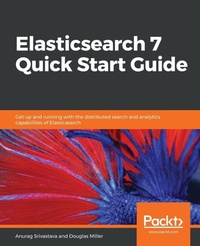
Elasticsearch 7 Quick Start Guide
Get up and running with the distributed search and analytics capabilities of Elasticsearch
Published on 24. October 2019
Book
Paperback/Softback
186 pages
978-1-78980-332-7 (ISBN)
Description
Get the most out of Elasticsearch 7's new features to build, deploy, and manage efficient applications
Key Features
Discover the new features introduced in Elasticsearch 7
Explore techniques for distributed search, indexing, and clustering
Gain hands-on knowledge of implementing Elasticsearch for your enterprise
Book DescriptionElasticsearch is one of the most popular tools for distributed search and analytics. This Elasticsearch book highlights the latest features of Elasticsearch 7 and helps you understand how you can use them to build your own search applications with ease.
Starting with an introduction to the Elastic Stack, this book will help you quickly get up to speed with using Elasticsearch. You'll learn how to install, configure, manage, secure, and deploy Elasticsearch clusters, as well as how to use your deployment to develop powerful search and analytics solutions. As you progress, you'll also understand how to troubleshoot any issues that you may encounter along the way. Finally, the book will help you explore the inner workings of Elasticsearch and gain insights into queries, analyzers, mappings, and aggregations as you learn to work with search results.
By the end of this book, you'll have a basic understanding of how to build and deploy effective search and analytics solutions using Elasticsearch.What you will learn
Install Elasticsearch and use it to safely store data and retrieve it when needed
Work with a variety of analyzers and filters
Discover techniques to improve search results in Elasticsearch
Understand how to perform metric and bucket aggregations
Implement best practices for moving clusters and applications to production
Explore various techniques to secure your Elasticsearch clusters
Who this book is forThis book is for software developers, engineers, data architects, system administrators, and anyone who wants to get up and running with Elasticsearch 7. No prior experience with Elasticsearch is required.
Key Features
Discover the new features introduced in Elasticsearch 7
Explore techniques for distributed search, indexing, and clustering
Gain hands-on knowledge of implementing Elasticsearch for your enterprise
Book DescriptionElasticsearch is one of the most popular tools for distributed search and analytics. This Elasticsearch book highlights the latest features of Elasticsearch 7 and helps you understand how you can use them to build your own search applications with ease.
Starting with an introduction to the Elastic Stack, this book will help you quickly get up to speed with using Elasticsearch. You'll learn how to install, configure, manage, secure, and deploy Elasticsearch clusters, as well as how to use your deployment to develop powerful search and analytics solutions. As you progress, you'll also understand how to troubleshoot any issues that you may encounter along the way. Finally, the book will help you explore the inner workings of Elasticsearch and gain insights into queries, analyzers, mappings, and aggregations as you learn to work with search results.
By the end of this book, you'll have a basic understanding of how to build and deploy effective search and analytics solutions using Elasticsearch.What you will learn
Install Elasticsearch and use it to safely store data and retrieve it when needed
Work with a variety of analyzers and filters
Discover techniques to improve search results in Elasticsearch
Understand how to perform metric and bucket aggregations
Implement best practices for moving clusters and applications to production
Explore various techniques to secure your Elasticsearch clusters
Who this book is forThis book is for software developers, engineers, data architects, system administrators, and anyone who wants to get up and running with Elasticsearch 7. No prior experience with Elasticsearch is required.
More details
Language
English
Place of publication
Birmingham
United Kingdom
Target group
Professional and scholarly
US School Grade: College Graduate Student
Dimensions
Height: 235 mm
Width: 191 mm
Thickness: 10 mm
Weight
359 gr
ISBN-13
978-1-78980-332-7 (9781789803327)
Copyright in bibliographic data and cover images is held by Nielsen Book Services Limited or by the publishers or by their respective licensors: all rights reserved.
Schweitzer Classification
Other editions
Additional editions
Anurag Srivastava | Douglas Miller
Elasticsearch 7 Quick Start Guide
Get up and running with the distributed search and analytics capabilities of Elasticsearch
E-Book
09/2024
Packt Publishing
€22.49
Available for download
Persons
Anurag Srivastava is a senior technical lead in a multinational software company. He has more than 12 years' experience in web-based application development. He is proficient in designing architecture for scalable and highly available applications. He has handled development teams and multiple clients from all over the globe over the past 10 years of his professional career. He has significant experience with the Elastic Stack (Elasticsearch, Logstash, and Kibana) for creating dashboards using system metrics data, log data, application data, and relational databases. He has authored three other booksMastering Kibana 6.x, and Kibana 7 Quick Start Guide, and Learning Kibana 7 - Second Edition, all published by Packt. Douglas Miller is an expert in helping fast-growing companies to improve performance and stability, and in building search platforms using Elasticsearch. Clients (including Walgreens, Nike, Boeing, and Dish Networks) have seen sales increase, fast performance times, and lower overall costs in terms of the total costs of ownership for their Elasticsearch clusters.
Content
Table of Contents
Introducing Elastic Stack
Installing Elasticsearch
Many as One
Prepping Your Data
Let's Do a Search!
Performance Tuning
Aggregating Datasets
Best Practices
Introducing Elastic Stack
Installing Elasticsearch
Many as One
Prepping Your Data
Let's Do a Search!
Performance Tuning
Aggregating Datasets
Best Practices