

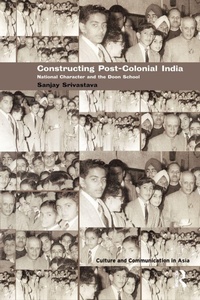
Constructing Post-Colonial India
National Character and the Doon School
1st Edition
Published on 1. October 1998
Book
Paperback/Softback
272 pages
978-0-415-17856-3 (ISBN)
Description
An interdisciplinary and engaging book which looks at the nature of Indian society since Independence and unpacks what post-colonialism means to Indian citizens. Using the case study of the Doon School, a famous boarding school for boys, and one of the leading educational institutions in India, the author argues that to be post-colonial in India is to be modern, rational, secular and urban. In placing post-colonialism in this concrete social context, and analysing how it is constructed, the author renders a complex and often rather abstract subject accessible.
Reviews / Votes
'Going far beyond the "sociology of education" framework, the study marks a noteworthy intervention in the academic debate on India's tryst with modernity ... an important contribution.' - The Australian Journal of AnthropologyMore details
Series
Language
English
Place of publication
London
United Kingdom
Publishing group
Taylor & Francis Ltd
Target group
College/higher education
Professional and scholarly
Dimensions
Height: 229 mm
Width: 152 mm
Thickness: 15 mm
Weight
402 gr
ISBN-13
978-0-415-17856-3 (9780415178563)
Copyright in bibliographic data and cover images is held by Nielsen Book Services Limited or by the publishers or by their respective licensors: all rights reserved.
Schweitzer Classification
Other editions
Additional editions

E-Book
09/2005
Routledge
€72.49
Available for download

E-Book
09/2005
Routledge
€72.49
Available for download
Book
10/1998
1st Edition
Routledge
€206.60
Shipment within 15-20 days
Person
Sanjay Srivastava trained as a social anthropologist and is presently senior lecturer in the School of Literary and Communication Studies at Deakin University, Melbourne, Australia.
Content
Introduction: the seductions of capital 1 Practical minds, solid builders, and sane opinions 2 The marble mirage: constructing the Orient 3 The garden of rational delights 4 Secularism, the citizen, and Hindu contextualism 5 The management of water: capitalism, class, and science 6 The order of men: sentiments of the metropolis, settlements of civil society 7 Conclusion: 'post-coloniality', national identity, globalisation, and the simulacra of the real