

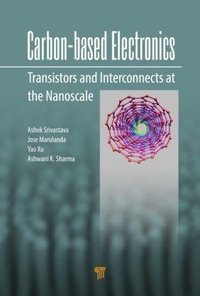
Carbon-Based Electronics
Transistors and Interconnects at the Nanoscale
1st Edition
Published on 19. March 2015
Book
Hardback
156 pages
978-981-4613-10-1 (ISBN)
Description
Discovery of one-dimensional material carbon nanotubes in 1991 by the Japanese physicist Dr. Sumio Iijima has resulted in voluminous research in the field of carbon nanotubes for numerous applications, including possible replacement of silicon used in the fabrication of CMOS chips. One interesting feature of carbon nanotubes is that these can be metallic or semiconducting with a bandgap depending on their diameter. In search of non-classical devices and related technologies, both carbon nanotube-based field-effect transistors and metallic carbon nanotube interconnects are being explored extensively for emerging logic devices and very large-scale integration. Although various models for carbon nanotube-based transistors and interconnects have been proposed in the literature, an integrated approach to make them compatible with the present simulators is yet to be achieved. This book makes an attempt in this direction for the carbon-based electronics through fundamentals of solid-state physics and devices.
More details
Language
English
Place of publication
Singapore
Singapore
Target group
College/higher education
Professional and scholarly
Academic and Postgraduate
Product notice
sewn/stitched
Cloth over boards
Illustrations
39 s/w Abbildungen, 16 farbige Abbildungen
16 Illustrations, color; 39 Illustrations, black and white
Dimensions
Height: 229 mm
Width: 155 mm
Thickness: 13 mm
Weight
408 gr
ISBN-13
978-981-4613-10-1 (9789814613101)
Copyright in bibliographic data and cover images is held by Nielsen Book Services Limited or by the publishers or by their respective licensors: all rights reserved.
Schweitzer Classification
Other editions
Additional editions
Ashok Srivastava | Jose Mauricio Marulanda | Yao Xu
Carbon-Based Electronics
Transistors and Interconnects at the Nanoscale
E-Book
03/2015
Pan Stanford Publishing Pte Ltd
€51.49
Available for download
Persons
Ashok Srivastava is Wilbur D. and Camille V. Fugler Jr. Professor of Electrical and Computer Engineering, Louisiana State University (LSU), USA. He received his MTech and PhD in solid-state physics and semiconductor electronics from the Indian Institute of Technology, Delhi in 1970 and 1975, respectively. Before joining LSU, he worked at several academic institutions and R&D laboratories, where his main areas of research were VLSI design and technology and emerging logic devices. His current research interests include low-power VLSI circuit design and testability, carbon nanotubes, graphene, and other 2D material-based device electronics for nano-CMOS and post-CMOS integrated circuit design. Prof. Srivastava has authored and coauthored more than 150 research papers in journals and conferences and supervised 40 graduate students. He also holds one US patent.
Jose Mauricio Marulanda is a senior design engineer at Intel Corporation, USA. He is responsible for RF SOC design collaterals. He received his BS, MS, and PhD in electrical engineering in 2001, 2002, and 2008, respectively, from Louisiana State University. His research interests include VLSI, RF design, carbon nanotubes, and nanotechnology.
Yao Xu is an application engineer in Berkeley Design Automation, Inc., USA. He received his BS and MS in photoelectronics from Tsinghua University, China, and the Chinese Academy of Sciences in 2000 and 2003, respectively, and his MS and PhD in electrical engineering from Louisiana State University in 2008 and 2011, respectively. Dr. Xu's current research interests include nanoelectronic devices and circuits with focus on carbon nanotubes and low-power VLSI circuit design.
Ashwani K. Sharma is a research professor at the Department of Electrical and Computer Engineering, University of New Mexico, USA, and a research scientist at Air Force Research Laboratory, Kirtland AFB, USA. He received his PhD in electrical engineering in 2004 from the University of New Mexico, and his research interests include physics of nanoscale devices for low-power-high-speed applications. Dr. Sharma has authored and coauthored more than 60 journal and conference papers.
Jose Mauricio Marulanda is a senior design engineer at Intel Corporation, USA. He is responsible for RF SOC design collaterals. He received his BS, MS, and PhD in electrical engineering in 2001, 2002, and 2008, respectively, from Louisiana State University. His research interests include VLSI, RF design, carbon nanotubes, and nanotechnology.
Yao Xu is an application engineer in Berkeley Design Automation, Inc., USA. He received his BS and MS in photoelectronics from Tsinghua University, China, and the Chinese Academy of Sciences in 2000 and 2003, respectively, and his MS and PhD in electrical engineering from Louisiana State University in 2008 and 2011, respectively. Dr. Xu's current research interests include nanoelectronic devices and circuits with focus on carbon nanotubes and low-power VLSI circuit design.
Ashwani K. Sharma is a research professor at the Department of Electrical and Computer Engineering, University of New Mexico, USA, and a research scientist at Air Force Research Laboratory, Kirtland AFB, USA. He received his PhD in electrical engineering in 2004 from the University of New Mexico, and his research interests include physics of nanoscale devices for low-power-high-speed applications. Dr. Sharma has authored and coauthored more than 60 journal and conference papers.
Content
Photonic structures in the animal kingdom: valuable inspirations for bio-mimetic applications. Moth eye-type anti-reflecting nanostructures by an electron cyclotron resonance plasma. Plasma-processed biomimetic nano/microstructures. Wetting properties of natural and plasma processed biomimetic surfaces. Biomimetic superhydrophobic surface by plasma processing. Biomimetic interfaces of plasma modified titanium alloy.