

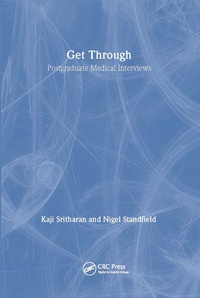
Get Through Postgraduate Medical Interviews
1st Edition
Will be published approx. on 2. June 2008
Book
Paperback/Softback
152 pages
978-1-85315-816-2 (ISBN)
Description
Get Through Postgraduate Medical Interviews aims to forearm candidates with practical advice on how to maximise their chances of success in the postgraduate medical interview. Following short-listing, the interview is the final and often the toughest hurdle standing between a candidate and their career path of choice. For many candidates there will only be 'one shot' and competition is likely to be fierce.
Formatted in a style that lends itself to easy reading and information access, this book systematically and logically examines the entire interview process from start to finish, dispelling common myths and advising the candidate on how to prepare, what to expect and what will be expected of them. It gives guidance on commonly encountered 'hot interview topics' and advice on ways to approach the 'awkward' interview question. It also gives guidance on constructing a portfolio as well as a CV and tips on how to sell your best attributes and maximise your chances of success.
Get Through Postgraduate Medical Interviews is an essential text for all junior doctors to help them through this very stressful time.
Formatted in a style that lends itself to easy reading and information access, this book systematically and logically examines the entire interview process from start to finish, dispelling common myths and advising the candidate on how to prepare, what to expect and what will be expected of them. It gives guidance on commonly encountered 'hot interview topics' and advice on ways to approach the 'awkward' interview question. It also gives guidance on constructing a portfolio as well as a CV and tips on how to sell your best attributes and maximise your chances of success.
Get Through Postgraduate Medical Interviews is an essential text for all junior doctors to help them through this very stressful time.
More details
Series
Language
English
Place of publication
London
United Kingdom
Publishing group
Taylor & Francis Ltd
Target group
Professional and scholarly
Professional Training
Dimensions
Height: 234 mm
Width: 156 mm
Weight
272 gr
ISBN-13
978-1-85315-816-2 (9781853158162)
Copyright in bibliographic data and cover images is held by Nielsen Book Services Limited or by the publishers or by their respective licensors: all rights reserved.
Schweitzer Classification
Other editions
Additional editions
Kaji Sritharan | Nigel Standfield
Get Through Postgraduate Medical Interviews
E-Book
06/2008
1st Edition
Royal Society of Medicine Press Ltd
€63.49
Available for download
Kaji Sritharan | Nigel Standfield
Get Through Postgraduate Medical Interviews
E-Book
06/2008
1st Edition
CRC Press
€63.49
Available for download
Persons
Kaji Sritharan MBBS BSc MRCS (Eng)
Specialist Registrar in General Surgery, Northwest Thames Rotation, London & Honorary Clinical Research Fellow, Division of Surgery, Oncology, Reproductive Biology and Anaesthetics, Imperial College London
Nigel Standfield MBBS FRCS FRCS (Ed.)
Head of the London School of Surgical Specialties, London Deanery; and Consultant Vascular Surgeon & Honorary Clinical Senior Lecturer, Imperial Academic Health Sciences Centre, London
Specialist Registrar in General Surgery, Northwest Thames Rotation, London & Honorary Clinical Research Fellow, Division of Surgery, Oncology, Reproductive Biology and Anaesthetics, Imperial College London
Nigel Standfield MBBS FRCS FRCS (Ed.)
Head of the London School of Surgical Specialties, London Deanery; and Consultant Vascular Surgeon & Honorary Clinical Senior Lecturer, Imperial Academic Health Sciences Centre, London
Content
Preface
1. INTRODUCTION
The purpose of the interview
What is MMC?
The application process
Recruitment in 2008
Run-through training and the transition
Closed versus open interviews National selection
What are speciality schools?
What is the National Recruitment Office for general practice training?
Assessing the competition
Overseas graduates
Academic clinical fellowships
Deferred entry
Flexible training
2. BEFORE THE INTERVIEW
Deciding level of entry into speciality training
Your application form
The process of selection
Getting ahead
3. YOUR PORTFOLIO
What is a portfolio?
Your curriculum vitae
Logbooks
Exam certificates
Presentations and posters presented at learned meetings
Abstracts, papers and audit projects
Your personal development plan or educational contract
A statement of personal values and aims
Records of in-training assessment
Work place based assessments
Reflective logs of activities and experience
4. THE INTERVIEW
What to take
What to expect and interview styles
General interview tips for on the day
Common interview myths
5. HOT INTERVIEW TOPICS
Academic research, publications and teaching
Clinical governance, audit and management
Clinical experience, motivation and personality
6. Difficult interview questions
7. OTHER TYPES OF INTERVIEW
Portfolio-based interviews
Assessment of communication skills at interview
Assessment of practical skills at interview
Assessing presentation skills at interview
8. AFTER THE INTERVIEW
So you got the job aEUR|
So you didnaEUR (TM)t get the job aEUR|
Index
1. INTRODUCTION
The purpose of the interview
What is MMC?
The application process
Recruitment in 2008
Run-through training and the transition
Closed versus open interviews National selection
What are speciality schools?
What is the National Recruitment Office for general practice training?
Assessing the competition
Overseas graduates
Academic clinical fellowships
Deferred entry
Flexible training
2. BEFORE THE INTERVIEW
Deciding level of entry into speciality training
Your application form
The process of selection
Getting ahead
3. YOUR PORTFOLIO
What is a portfolio?
Your curriculum vitae
Logbooks
Exam certificates
Presentations and posters presented at learned meetings
Abstracts, papers and audit projects
Your personal development plan or educational contract
A statement of personal values and aims
Records of in-training assessment
Work place based assessments
Reflective logs of activities and experience
4. THE INTERVIEW
What to take
What to expect and interview styles
General interview tips for on the day
Common interview myths
5. HOT INTERVIEW TOPICS
Academic research, publications and teaching
Clinical governance, audit and management
Clinical experience, motivation and personality
6. Difficult interview questions
7. OTHER TYPES OF INTERVIEW
Portfolio-based interviews
Assessment of communication skills at interview
Assessment of practical skills at interview
Assessing presentation skills at interview
8. AFTER THE INTERVIEW
So you got the job aEUR|
So you didnaEUR (TM)t get the job aEUR|
Index