

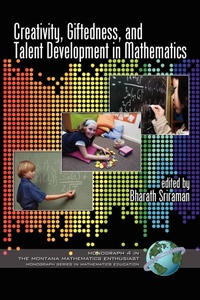
Creativity, Giftedness, and Talent Development in Mathematics
Will be published approx. on 9. July 2008
Book
Paperback/Softback
312 pages
978-1-59311-977-5 (ISBN)
Description
Our innovative spirit and creativity lies beneath the comforts and security of today's technologically evolved society. Scientists, inventors, investors, artists and leaders play a vital role in the advancement and transmission of knowledge. Mathematics, in particular, plays a central role in numerous professions and has historically served as the gatekeeper to numerous other areas of study, particularly the hard sciences, engineering and business. Mathematics is also a major component in standardized tests in the U.S., and in university entrance exams in numerous parts of world.
Creativity and imagination is often evident when young children begin to develop numeric and spatial concepts, and explore mathematical tasks that capture their interest. Creativity is also an essential ingredient in the work of professional mathematicians. Yet, the bulk of mathematical thinking encouraged in the institutionalized setting of schools is focused on rote learning, memorization, and the mastery of numerous skills to solve specific problems prescribed by the curricula or aimed at standardized testing. Given the lack of research based perspectives on talent development in mathematics education, this monograph is specifically focused on contributions towards the constructs of creativity and giftedness in mathematics. This monograph presents new perspectives for talent development in the mathematics classroom and gives insights into the psychology of creativity and giftedness. The book is aimed at classroom teachers, coordinators of gifted programs, math contest coaches, graduate students and researchers interested in creativity, giftedness, and talent development in mathematics.
Creativity and imagination is often evident when young children begin to develop numeric and spatial concepts, and explore mathematical tasks that capture their interest. Creativity is also an essential ingredient in the work of professional mathematicians. Yet, the bulk of mathematical thinking encouraged in the institutionalized setting of schools is focused on rote learning, memorization, and the mastery of numerous skills to solve specific problems prescribed by the curricula or aimed at standardized testing. Given the lack of research based perspectives on talent development in mathematics education, this monograph is specifically focused on contributions towards the constructs of creativity and giftedness in mathematics. This monograph presents new perspectives for talent development in the mathematics classroom and gives insights into the psychology of creativity and giftedness. The book is aimed at classroom teachers, coordinators of gifted programs, math contest coaches, graduate students and researchers interested in creativity, giftedness, and talent development in mathematics.
More details
Series
Language
English
Place of publication
Charlotte
United States
Publishing group
Emerald Publishing Inc
Target group
Professional and scholarly
College/higher education
Dimensions
Height: 234 mm
Width: 156 mm
Thickness: 17 mm
Weight
477 gr
ISBN-13
978-1-59311-977-5 (9781593119775)
Copyright in bibliographic data and cover images is held by Nielsen Book Services Limited or by the publishers or by their respective licensors: all rights reserved.
Schweitzer Classification
Other editions
Additional editions
Bharath Sriraman
Creativity, Giftedness, and Talent Development in Mathematics
E-Book
09/2008
1st Edition
Information Age Publishing
from
€62.33
Available for download
Content
Table of Contents.
Preface; Bharath Sriraman.
Chapter 1. The Characteristics of Mathematical Creativity; Bharath Sriraman.
Chapter 2. Mathematical Giftedness, Problem-Solving and the Ability to Formulate Generalizations; Bharath Sriraman.
Chapter 3. Gifted Ninth Graders' Notions of Proof: Investigating Parallels in Approaches of Mathematically Gifted Students and Professional Mathematicians; Bharath Sriraman.
Chapter 4. Are Mathematical Giftedness and Mathematical Creativity Synonyms? A Theoretical Analysis of Constructs; Bharath Sriraman.
Chapter 5. Does Mathematics Gifted Education Need a Working Philosophy of Creativity?; Viktor Freiman and Bharath Sriraman.
Chapter 6. Designing Opportunities for All Students to Demonstrate Mathematical Prowess; Sylvia Bulgar.
Chapter 7. Problems to Discover and to Boost Mathematical Talent in Early Grades: A Challenging Situations Approach; Viktor Freiman.
Chapter 8. Mathematical Problem Solving Processes of Thai Gifted Students; Supattra Pattivisan and Margaret L. Niess.
Chapter 9. Knowledge as a Manifestation of Talent: Creating Opportunities for the Gifted; Alexander Karp.
Chapter 10. An Ode to Imre Lakatos: Bridging the Ideal and Actual Mathematics Classrooms; Bharath Sriraman.
Chapter 11. Mathematically Gifted Korean Elementary Students' Revisiting of Euler's Polyhedron Theorem; Jaehoon Yim, Sanghun Song, and Jiwon Kim.
Chapter 12. Mathematically Promising Students from the Space Age to the Information Age; Linda Sheffield.
Chapter 13. Revisiting the Needs of the Gifted Mathematics Students: Are Students Surviving or Thriving?; Alan Zollman.
Chapter 14. Playing with Powers; Bharath Sriraman and Pawel Strzelecki.
Preface; Bharath Sriraman.
Chapter 1. The Characteristics of Mathematical Creativity; Bharath Sriraman.
Chapter 2. Mathematical Giftedness, Problem-Solving and the Ability to Formulate Generalizations; Bharath Sriraman.
Chapter 3. Gifted Ninth Graders' Notions of Proof: Investigating Parallels in Approaches of Mathematically Gifted Students and Professional Mathematicians; Bharath Sriraman.
Chapter 4. Are Mathematical Giftedness and Mathematical Creativity Synonyms? A Theoretical Analysis of Constructs; Bharath Sriraman.
Chapter 5. Does Mathematics Gifted Education Need a Working Philosophy of Creativity?; Viktor Freiman and Bharath Sriraman.
Chapter 6. Designing Opportunities for All Students to Demonstrate Mathematical Prowess; Sylvia Bulgar.
Chapter 7. Problems to Discover and to Boost Mathematical Talent in Early Grades: A Challenging Situations Approach; Viktor Freiman.
Chapter 8. Mathematical Problem Solving Processes of Thai Gifted Students; Supattra Pattivisan and Margaret L. Niess.
Chapter 9. Knowledge as a Manifestation of Talent: Creating Opportunities for the Gifted; Alexander Karp.
Chapter 10. An Ode to Imre Lakatos: Bridging the Ideal and Actual Mathematics Classrooms; Bharath Sriraman.
Chapter 11. Mathematically Gifted Korean Elementary Students' Revisiting of Euler's Polyhedron Theorem; Jaehoon Yim, Sanghun Song, and Jiwon Kim.
Chapter 12. Mathematically Promising Students from the Space Age to the Information Age; Linda Sheffield.
Chapter 13. Revisiting the Needs of the Gifted Mathematics Students: Are Students Surviving or Thriving?; Alan Zollman.
Chapter 14. Playing with Powers; Bharath Sriraman and Pawel Strzelecki.