

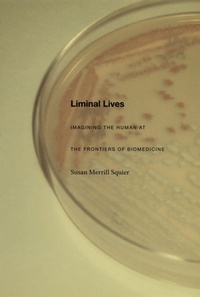
Liminal Lives
Imagining the Human at the Frontiers of Biomedicine
Will be published approx. on 7. December 2004
Book
Hardback
368 pages
978-0-8223-3381-4 (ISBN)
Description
Embryo adoptions, stem cells capable of transforming into any cell in the human body, intra- and inter-species organ transplantation-these and other biomedical advances have unsettled ideas of what it means to be human, of when life begins and ends. In the first study to consider the cultural impact of the medical transformation of the entire human life span, Susan Merrill Squier argues that fiction-particularly science fiction-serves as a space where worries about ethically and socially charged scientific procedures are worked through. Indeed, she demonstrates that in many instances fiction has anticipated and paved the way for far-reaching biomedical changes. Squier uses the anthropological concept of liminality-the state of being on the threshold of change, no longer one thing yet not quite another-to explore how, from the early twentieth century forward, fiction and science together have altered not only the concept of the human being but the contours of human life.Drawing on archival materials of twentieth-century biology; little-known works of fiction and science fiction; and twentieth- and twenty-first century U.S. and U.K. government reports by the National Institutes of Health, the Parliamentary Advisory Group on the Ethics of Xenotransplantation, and the President's Council on Bioethics, she examines a number of biomedical changes as each was portrayed by scientists, social scientists, and authors of fiction and poetry. Among the scientific developments she considers are the cultured cell, the hybrid embryo, the engineered intrauterine fetus, the child treated with human growth hormone, the process of organ transplantation, and the elderly person rejuvenated by hormone replacement therapy or other artificial means. Squier shows that in the midst of new phenomena such as these, literature helps us imagine new ways of living. It allows us to reflect on the possibilities and perils of our liminal lives.
Reviews / Votes
"Liminal Lives offers very strong and important theoretical insights into relationships between scientific knowledge and practice and literary production. Its innovative methodology creates possibilities for better communication and exchange between scientific, literary, and social scientific knowledge in a way that will be very useful to others interested in interdisciplinary science studies."-Catherine Waldby, author of AIDS and The Body Politic: Biomedicine and Sexual Difference "A brilliant and provocative exploration of how biomedicine and literature, particularly science fiction, are together reconfiguring the very shape of the entire life span, producing adoptable embryos, giant babies, interspecies pregnancies, and regenerated old bodies-all in the context of a new and grim bio-economy in which hearts and kidneys are for sale and earrings are fabricated out of fetal remains."-Kathleen Woodward, author of Aging and Its Discontents: Freud and Other Fictions "Susan Merrill Squier's Liminal Lives is compelling, timely, imaginative, and wonderfully provocative."-Priscilla Wald, author of Constituting Americans: Cultural Anxiety and Narrative FormMore details
Language
English
Place of publication
North Carolina
United States
Target group
Professional and scholarly
Product notice
Cloth over boards
Illustrations
17 b&w photos, 24 illus.
Dimensions
Height: 234 mm
Width: 150 mm
Thickness: 28 mm
Weight
635 gr
ISBN-13
978-0-8223-3381-4 (9780822333814)
Copyright in bibliographic data and cover images is held by Nielsen Book Services Limited or by the publishers or by their respective licensors: all rights reserved.
Schweitzer Classification
Other editions
Additional editions
E-Book
12/2004
1st Edition
De Gruyter
€208.99
Available for download
Person
Susan Merrill Squier is Brill Professor of Women's Studies and English at The Pennsylvania State University. She is author of Babies in Bottles: Twentieth-Century Visions of Reproductive Technology; editor of Communities of the Air: Radio Century, Radio Culture (published by Duke University Press); and coeditor of Playing Dolly: Technocultural Formations, Fantasies, and Fictions of Assisted Reproduction and Arms and the Woman: War, Gender, and Literary Representation. She is past president and Executive Board Member of the Society for Literature and Science.
Content
List of Illustrations xi
Acknowledgments xiii
Introduction: Networking Liminality 1
1. The Uses of Literature for Feminist Science Studies: Tracing Liminal Lives 25
2. The Cultured Cell: Life and Death at Strangeways 58
3. The Hybrid Embryo and Xenogenic Desire 89
4. Giant Babies: Graphing Growth in the Early Twentieth Century 112
5. Incubabies and Rejuvenates: The Traffic between Technologies of Reproduction and Age Extension 146
6. Transplant Medicine and Transformative Narrative 168
7. Liminal Performances of Aging: From Replacement to Regeneration 214
Coda: The Pluripotent Discourse of Stem Cells: Liminality, Reflexivity, and Literature 253
Notes 281
Works Cited 315
Index 335
Acknowledgments xiii
Introduction: Networking Liminality 1
1. The Uses of Literature for Feminist Science Studies: Tracing Liminal Lives 25
2. The Cultured Cell: Life and Death at Strangeways 58
3. The Hybrid Embryo and Xenogenic Desire 89
4. Giant Babies: Graphing Growth in the Early Twentieth Century 112
5. Incubabies and Rejuvenates: The Traffic between Technologies of Reproduction and Age Extension 146
6. Transplant Medicine and Transformative Narrative 168
7. Liminal Performances of Aging: From Replacement to Regeneration 214
Coda: The Pluripotent Discourse of Stem Cells: Liminality, Reflexivity, and Literature 253
Notes 281
Works Cited 315
Index 335