

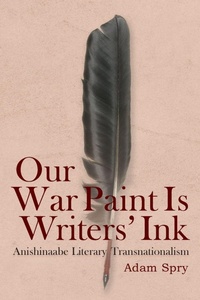
Our War Paint Is Writers' Ink
Anishinaabe Literary Transnationalism
Published on 2. January 2019
Book
Paperback/Softback
254 pages
978-1-4384-6882-2 (ISBN)
Description
Explores a little-known history of exchange between Anishinaabe and American writers, showing how literature has long been an important venue for debates over settler colonial policy and indigenous rights.
For the Anishinaabeg-the indigenous peoples of the Great Lakes-literary writing has long been an important means of asserting their continued existence as a nation, with its own culture, history, and sovereignty. At the same time, literature has also offered American writers a way to make the Anishinaabe Nation disappear, often by relegating it to a distant past. In this book, Adam Spry puts these two traditions in conversation with one another, showing how novels, poetry, and drama have been the ground upon which Anishinaabeg and Americans have clashed as representatives of two nations contentiously occupying the same land. Focusing on moments of contact, appropriation, and exchange, Spry examines a diverse range of texts in order to reveal a complex historical network of Native and non-Native writers who read and adapted each other's work across the boundaries of nation, culture, and time.
By reconceiving the relationship between the United States and the Anishinaabeg as one of transnational exchange, Our War Paint Is Writers' Ink offers a new methodology for the study of Native American literatures, capable of addressing a long history of mutual cultural influence while simultaneously arguing for the legitimacy, and continued necessity, of indigenous nationhood. In addition, the author reexamines several critical assumptions-about authenticity, identity, and nationhood itself-that have become common wisdom in both Native American and US literary studies.
For the Anishinaabeg-the indigenous peoples of the Great Lakes-literary writing has long been an important means of asserting their continued existence as a nation, with its own culture, history, and sovereignty. At the same time, literature has also offered American writers a way to make the Anishinaabe Nation disappear, often by relegating it to a distant past. In this book, Adam Spry puts these two traditions in conversation with one another, showing how novels, poetry, and drama have been the ground upon which Anishinaabeg and Americans have clashed as representatives of two nations contentiously occupying the same land. Focusing on moments of contact, appropriation, and exchange, Spry examines a diverse range of texts in order to reveal a complex historical network of Native and non-Native writers who read and adapted each other's work across the boundaries of nation, culture, and time.
By reconceiving the relationship between the United States and the Anishinaabeg as one of transnational exchange, Our War Paint Is Writers' Ink offers a new methodology for the study of Native American literatures, capable of addressing a long history of mutual cultural influence while simultaneously arguing for the legitimacy, and continued necessity, of indigenous nationhood. In addition, the author reexamines several critical assumptions-about authenticity, identity, and nationhood itself-that have become common wisdom in both Native American and US literary studies.
More details
Series
Language
English
Place of publication
Albany, NY
United States
Target group
Professional and scholarly
US School Grade: College Graduate Student and over
Product notice
Paperback (trade)
Illustrations
2 Figures; 3 Illustrations, black and white
Dimensions
Height: 229 mm
Width: 152 mm
Thickness: 15 mm
Weight
421 gr
ISBN-13
978-1-4384-6882-2 (9781438468822)
Copyright in bibliographic data and cover images is held by Nielsen Book Services Limited or by the publishers or by their respective licensors: all rights reserved.
Schweitzer Classification
Other editions
Additional editions
E-Book
02/2018
1st Edition
De Gruyter
from
€84.99
Available for download
Person
Adam Spry is Assistant Professor of Writing, Literature, and Publishing at Emerson College.
Content
List of Illustrations
Acknowledgments
Miigwech
Ozhibii'ige
Introduction: Whence These Legends and Traditions?
1. Revolutionary in Character: Translating Anishinaabe Place and Time in the Progress
2. Englishman, Your Color Is Deceitful: Unsettling the North Woods in Janet Lewis's The Invasion
3. What Is This I Promise You?: The Translation of Anishinaabe Song in the Twentieth Century
4. A Tribe of Pressed Trees: Representations of the State in the Fiction of Louise Erdrich
Conclusion
Notes
Index
Acknowledgments
Miigwech
Ozhibii'ige
Introduction: Whence These Legends and Traditions?
1. Revolutionary in Character: Translating Anishinaabe Place and Time in the Progress
2. Englishman, Your Color Is Deceitful: Unsettling the North Woods in Janet Lewis's The Invasion
3. What Is This I Promise You?: The Translation of Anishinaabe Song in the Twentieth Century
4. A Tribe of Pressed Trees: Representations of the State in the Fiction of Louise Erdrich
Conclusion
Notes
Index