

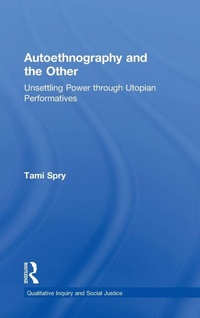
Autoethnography and the Other
Unsettling Power through Utopian Performatives
1st Edition
Published on 24. March 2016
Book
Hardback
222 pages
978-1-61132-859-2 (ISBN)
Description
Challenging the critique of autoethnography as overly focused on the self, Tami Spry calls for a performative autoethnography that both unsettles the "I" and represents the Other with equal commitment. Expanding on her popular book Body, Paper, Stage, Spry uses a variety of examples, literary forms, and theoretical traditions to reframe this research method as transgressive, liberatory, and decolonizing for both self and Other. Her book
draws on her own autoethnographic work with jazz musicians, shamans, and other groups;
outlines a utopian performative methodology to spur hope and transformation;
provides concrete guidance on how to implement this innovative methodological approach.
draws on her own autoethnographic work with jazz musicians, shamans, and other groups;
outlines a utopian performative methodology to spur hope and transformation;
provides concrete guidance on how to implement this innovative methodological approach.
More details
Series
Language
English
Place of publication
Walnut Creek
United States
Target group
Professional and scholarly
Dimensions
Height: 235 mm
Width: 157 mm
Thickness: 17 mm
Weight
479 gr
ISBN-13
978-1-61132-859-2 (9781611328592)
Copyright in bibliographic data and cover images is held by Nielsen Book Services Limited or by the publishers or by their respective licensors: all rights reserved.
Schweitzer Classification
Other editions
Additional editions
E-Book
03/2016
Routledge
€60.49
Available for download
E-Book
03/2016
Routledge
€60.49
Available for download
Book
03/2016
1st Edition
Left Coast Press Inc
€67.20
Shipment within 3-4 weeks
Person
Tami Spry is a Professor of Performance Studies in the Communication Studies Department at St. Cloud State University (SCSU) in Minnesota. Spry's performance work, publications, directing, and pedagogy focus on the development of cultural critique that engenders dialogue about difficult sociocultural issues; specifically, her work engages issues of race, sexual assault, grief, shamanism, and mental illness.
Content
Preface
Introduction: Who Are "We" in Autoethnography?
Chapter One: The Inappropriate/d Other
Chapter Two: The Unsettled-I
Chapter Three: The Willful Embodiment of "We": Embodying Utopian Performatives
Chapter Four: Utopian Reflexivities of Hope
Chapter Five: Performing Collaborations with Others: Group Performance of Autoethnography
Chapter Six: Willful Choices
References
Index
Introduction: Who Are "We" in Autoethnography?
Chapter One: The Inappropriate/d Other
Chapter Two: The Unsettled-I
Chapter Three: The Willful Embodiment of "We": Embodying Utopian Performatives
Chapter Four: Utopian Reflexivities of Hope
Chapter Five: Performing Collaborations with Others: Group Performance of Autoethnography
Chapter Six: Willful Choices
References
Index