

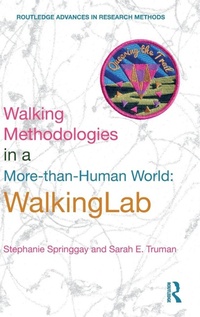
Walking Methodologies in a More-than-human World
WalkingLab
1st Edition
Published on 11. January 2018
Book
Hardback
164 pages
978-1-138-29376-2 (ISBN)
Description
As a research methodology, walking has a diverse and extensive history in the social sciences and humanities, underscoring its value for conducting research that is situated, relational, and material. Building on the importance of place, sensory inquiry, embodiment, and rhythm within walking research, this book offers four new concepts for walking methodologies that are accountable to an ethics and politics of the more-than-human: Land and geos, affect, transmaterial and movement. The book carefully considers the more-than-human dimensions of walking methodologies by engaging with feminist new materialisms, posthumanisms, affect theory, trans and queer theory, Indigenous theories, and critical race and disability scholarship. These more-than-human theories rub frictionally against the history of walking scholarship and offer crucial insights into the potential of walking as a qualitative research methodology in a more-than-human world. Theoretically innovative, the book is grounded in examples of walking research by WalkingLab, an international research network on walking (www.walkinglab.org).
The book is rich in scope, engaging with a wide range of walking methods and forms including: long walks on hiking trails, geological walks, sensory walks, sonic art walks, processions, orienteering races, protest and activist walks, walking tours, derives, peripatetic mapping, school-based walking projects, and propositional walks. The chapters draw on WalkingLab's research-creation events to examine walking in relation to settler colonialism, affective labour, transspecies, participation, racial geographies and counter-cartographies, youth literacy, environmental education, and collaborative writing. The book outlines how more-than-human theories can influence and shape walking methodologies and provokes a critical mode of walking-with that engenders solidarity, accountability, and response-ability.
This volume will appeal to graduate students, artists, and academics and researchers who are interested in Education, Cultural Studies, Queer Studies, Affect Studies, Geography, Anthropology, and (Post)Qualitative Research Methods.
The book is rich in scope, engaging with a wide range of walking methods and forms including: long walks on hiking trails, geological walks, sensory walks, sonic art walks, processions, orienteering races, protest and activist walks, walking tours, derives, peripatetic mapping, school-based walking projects, and propositional walks. The chapters draw on WalkingLab's research-creation events to examine walking in relation to settler colonialism, affective labour, transspecies, participation, racial geographies and counter-cartographies, youth literacy, environmental education, and collaborative writing. The book outlines how more-than-human theories can influence and shape walking methodologies and provokes a critical mode of walking-with that engenders solidarity, accountability, and response-ability.
This volume will appeal to graduate students, artists, and academics and researchers who are interested in Education, Cultural Studies, Queer Studies, Affect Studies, Geography, Anthropology, and (Post)Qualitative Research Methods.
Reviews / Votes
"The argument throughout is clearly and thoroughly informed by a strong theoretical and methodological framework. It highlights a wide range of ways in which one can practice walking as research and the many ways in which this can be recorded, captured, translated and activated through relational interventions and events. This book is a real asset, particularly if you have already engaged with these methods and want to open up and challenge your methodological horizon."-Magali Peyrefitte, Brunel University
More details
Series
Language
English
Place of publication
London
United Kingdom
Publishing group
Taylor & Francis Ltd
Target group
College/higher education
Dimensions
Height: 240 mm
Width: 161 mm
Thickness: 14 mm
Weight
438 gr
ISBN-13
978-1-138-29376-2 (9781138293762)
Copyright in bibliographic data and cover images is held by Nielsen Book Services Limited or by the publishers or by their respective licensors: all rights reserved.
Schweitzer Classification
Other editions
Additional editions
Book
05/2019
1st Edition
Routledge
€66.00
Shipment within 15-20 days
E-Book
12/2017
Routledge
€69.99
Available for download
E-Book
12/2017
Routledge
€69.99
Available for download
Persons
Stephanie Springgay is an Associate Professor in the Department of Curriculum, Teaching, and Learning at the Ontario Institute for Studies in Education, University of Toronto. She is a leader in research-creation methodologies, with a particular interest in theories of matter, movement and affect. With Sarah E. Truman she co-directs WalkingLab. Her research-creation projects are documented at: www.thepedagogicalimpulse.com, www.walkinglab.org, and www.artistsoupkitchen.com. Stephanie has published widely in academic journals and is the co-editor of M/othering a Bodied Curriculum: Emplacement, Desire, Affect; co-editor of Curriculum and the Cultural Body; and author of Body Knowledge and Curriculum: Pedagogies of Touch in Youth and Visual Culture.
Sarah E. Truman is Postdoctoral Research Fellow at Melbourne Graduate School of Education, University of Melbourne, Australia. Her research focuses on reading and writing speculative fiction in high schools. She also conducts ongoing research on walking methodologies and public pedagogy, and co-directs WalkingLab with Stephanie Springgay. Sarah's research is informed by the feminist new materialisms with a particular interest in theories of affect, queer theory, and speculative pragmatism. Sarah is co-editor of Pedagogical Matters: New Materialism and Curriculum Studies; and author of Searching for Guan Yin. Her research is detailed at www.sarahetruman.com and www.walkinglab.org
Sarah E. Truman is Postdoctoral Research Fellow at Melbourne Graduate School of Education, University of Melbourne, Australia. Her research focuses on reading and writing speculative fiction in high schools. She also conducts ongoing research on walking methodologies and public pedagogy, and co-directs WalkingLab with Stephanie Springgay. Sarah's research is informed by the feminist new materialisms with a particular interest in theories of affect, queer theory, and speculative pragmatism. Sarah is co-editor of Pedagogical Matters: New Materialism and Curriculum Studies; and author of Searching for Guan Yin. Her research is detailed at www.sarahetruman.com and www.walkinglab.org
Content
PART I Overview
1. WalkingLab: Walking Methodologies in a More-than-human World
2. Affective Transmaterialities and the Primacy of Movement
PART II Aberrant Case Studies in Walking Research:
3. Stone Walks: Archives of Feeling and Queer Political Imaginaries
4. Edible Matters: Taste Tours and Food Forays on Foot
5. Emergent Publics: Collective Movement and Minor "p" Politics with Youth
6. Towards a Rhythmic Account of Working Together and Taking Part
7. "Wood Land School:" Critical Negotiation of Land and Indigenous Realities
PART III Speculative Probings
8. Propositions for the Future of Walking Research in Three Parts
1. WalkingLab: Walking Methodologies in a More-than-human World
2. Affective Transmaterialities and the Primacy of Movement
PART II Aberrant Case Studies in Walking Research:
3. Stone Walks: Archives of Feeling and Queer Political Imaginaries
4. Edible Matters: Taste Tours and Food Forays on Foot
5. Emergent Publics: Collective Movement and Minor "p" Politics with Youth
6. Towards a Rhythmic Account of Working Together and Taking Part
7. "Wood Land School:" Critical Negotiation of Land and Indigenous Realities
PART III Speculative Probings
8. Propositions for the Future of Walking Research in Three Parts