

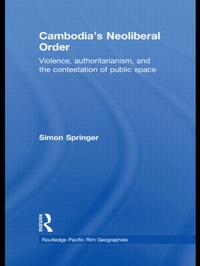
Cambodia's Neoliberal Order
Violence, Authoritarianism, and the Contestation of Public Space
1st Edition
Published on 24. June 2010
Book
Hardback
224 pages
978-0-415-56819-7 (ISBN)
Description
Neoliberal economics have emerged in the post-Cold War era as the predominant ideological tenet applied to the development of countries in the global south. For much of the global south, however, the promise that markets will bring increased standards of living and emancipation from tyranny has been an empty one. Instead, neoliberalisation has increased the gap between rich and poor and unleashed a firestorm of social ills.
This book deals with the post-conflict geographies of violence and neoliberalisation in Cambodia. Applying a geographical analysis to contemporary Cambodian politics, the author employs notions of neoliberalism, public space, and radical democracy as the most substantive components of its theoretical edifice. He argues that the promotion of unfettered marketisation is the foremost causal factor in the country's inability to consolidate democracy following a United Nations sponsored transition. The book demonstrates Cambodian perspectives on the role of public space in Cambodia's process of democratic development and explains the implications of violence and its relationship with neoliberalism.
Taking into account the transition from war to peace, authoritarianism to democracy, and command economy to a free market, this book offers a critical appraisal of the political economy in Cambodia.
This book deals with the post-conflict geographies of violence and neoliberalisation in Cambodia. Applying a geographical analysis to contemporary Cambodian politics, the author employs notions of neoliberalism, public space, and radical democracy as the most substantive components of its theoretical edifice. He argues that the promotion of unfettered marketisation is the foremost causal factor in the country's inability to consolidate democracy following a United Nations sponsored transition. The book demonstrates Cambodian perspectives on the role of public space in Cambodia's process of democratic development and explains the implications of violence and its relationship with neoliberalism.
Taking into account the transition from war to peace, authoritarianism to democracy, and command economy to a free market, this book offers a critical appraisal of the political economy in Cambodia.
More details
Series
Language
English
Place of publication
London
United Kingdom
Publishing group
Taylor & Francis Ltd
Target group
College/higher education
Illustrations
10 s/w Tabellen, 1 s/w Abbildung, 1 s/w Zeichnung
10 Tables, black and white; 1 Line drawings, black and white; 1 Illustrations, black and white
Dimensions
Height: 234 mm
Width: 156 mm
Weight
570 gr
ISBN-13
978-0-415-56819-7 (9780415568197)
Copyright in bibliographic data and cover images is held by Nielsen Book Services Limited or by the publishers or by their respective licensors: all rights reserved.
Schweitzer Classification
Other editions
Additional editions
Simon Springer
Cambodia's Neoliberal Order
Violence, Authoritarianism, and the Contestation of Public Space
Book
04/2012
1st Edition
Routledge
€89.43
Shipment within 15-20 days
Simon Springer
Cambodia's Neoliberal Order
Violence, Authoritarianism, and the Contestation of Public Space
E-Book
07/2010
Routledge
€77.99
Available for download
Simon Springer
Cambodia's Neoliberal Order
Violence, Authoritarianism, and the Contestation of Public Space
E-Book
07/2010
Routledge
€77.99
Available for download
Person
Simon Springer is Assistant Professor in the Department of Geography at the National University of Singapore. His ongoing research focuses on the intersections between neoliberalism and violence.
Content
1. Introduction: Setting the Stage for Neoliberalisation 2. Caught in the Headlights of Culture and Neoliberalism: Public Space as a Vision for Democracy and Development from Below in the Global South 3. From Genocide to Elections to Coup d'Etat: Public Space in Cambodia's Transitional Political Economy 4. Cambodia's Battle for Public Space: The Neoliberal Doctrine or Order versus the Democratic Expression of the People's Will 5. Conclusion: Sowing the Seeds of a New Revolution?