

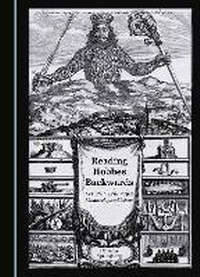
Reading Hobbes Backwards
Leviathan, the Papal Monarchy and Islam
Published on 18. October 2024
Book
Hardback
534 pages
978-1-0364-0918-0 (ISBN)
Description
Reading Hobbes Backwards treats Thomas Hobbes (1588-1679) as a peace theorist, who from early manuscripts of his system made by disciples in England and France, to the late Historia Ecclesiastica, saw sectarianism and Trinitarian doctrines supporting the papal monarchy as the ultimate cause of the punishing religious wars of the post-Reformation. But Hobbes was also indebted to scholasticism and the millennia-old Aristotle commentary tradition, Greek, Byzantine, Jewish and Islamic, surviving in the universities of Paris and Oxford, naming his 'English Politiques' Leviathan after the scaly monster of the Book of Job, perhaps as a decoy. Politically connected through Cavendish circles and the Virginia Company, Hobbes was a courtier's client who, until Leviathan, could not speak in his own voice. Adept at 'political surrogacy', he authored satires and burlesques which he could own or disown, while promoting the moral education of classical civic humanism against sectarianism. The Appendix provides a synopsis of his relatively inaccessible Latin Church History, an exercise in 'clandestine philosophy' from which Hobbes's intentions in Leviathan can be read off. Chapters are referenced and cross-referenced to be read independently, serving both as reference work and text-book.
Reviews / Votes
'Reading Hobbes Backwards is a captivating and pathbreaking account of Hobbes's view of peace, why it was urgent, how difficult it was to achieve, and that it could never be realised without addressing the problem of religious fanaticism. Patricia Springborg has written another brilliant book that will fascinate intellectual historians everywhere.'Richard WhatmoreProfessor of Modern History, St. Andrews University, UK, Editor of Global Intellectual History Patricia Springborg is one of the leading scholars of Hobbes' philosophy and in this ground-breaking work she offers a 'backwards reading' of his Leviathan, showing the extent to which it was dependent on the work of his predecessors, most notably, those who translated Aristotle into Arabic and then from Arabic into Latin, and the Oxford 'Calculators' of the fourteenth century. Now that philosophers in the West are finally waking up to the rich plurality of philosophical traditions on which their 'canonical' figures drew, this provides an extraordinarily detailed case study of the hitherto unrecognized influences on Hobbes.'Michael BeaneyRegius Chair of Logic, Aberdeen University, UK, Professor of the History of Analytic Philosophy, Humboldt University, Berlin, Germany. 'Patricia Springborg's latest book underlines the coherence of her interpretation of Hobbes's works. Hobbes lived in troubled times and could not speak his mind explicitly. He had recourse to various kinds of dissimulation like many of his European contemporaries. After her ground-breaking edition of Hobbes's Historia Ecclesiastica, Patricia Springborg here illustrates Hobbes's acute understanding of political surrogacy in his attempt to resolve the problem of sectarianism.'Antony McKennaEmeritus Professor University of Saint-Etienne, France, Director of Champion, Paris, series on Free Thought and Clandestine LiteratureMore details
Edition
Unabridged edition
Language
English
Place of publication
Newcastle upon Tyne
United Kingdom
Target group
Professional and scholarly
Edition type
Unabridged edition
Product notice
With dust jacket
Dimensions
Height: 212 mm
Width: 148 mm
ISBN-13
978-1-0364-0918-0 (9781036409180)
Copyright in bibliographic data and cover images is held by Nielsen Book Services Limited or by the publishers or by their respective licensors: all rights reserved.
Schweitzer Classification
Other editions
Additional editions

Book
07/2025
1st Edition
Cambridge Scholars Publishing
€67.03
Shipment within 15-20 days
E-Book
10/2024
1st Edition
Cambridge Scholars Publishing
€259.99
Available for download
Person
Patricia Springborg (DPhil Oxon) was lecturer and Professor of Political Theory at the University of Sydney, Australia (1974-2005) and most recently Guest Professor in the Centre for British Studies of the Humboldt University in Berlin, Germany (2013-22). She has taught in the USA at the University of Pennsylvania, and UC Berkeley and has been a stipendiary fellow at Institutes for Advanced Study in Washington DC, Berlin, Oxford and Uppsala. She has authored some 80 refereed articles and 8 authored or co-authored books, including The Cambridge Companion to Hobbes's Leviathan (2007) and the first English translation and critical edition of Hobbes's Historia Ecclesiastica (2008).