

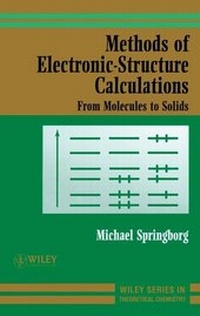
Methods of Electronic-Structure Calculations
From Molecules to Solids
Published on 30. May 2000
Book
Hardback
XIV, 502 pages
978-0-471-97975-3 (ISBN)
Description
Methods of Electronic-Structure Calculations From Molecules to Solids Michael Springborg Department of Chemistry, University of Konstanz, Germany Electronic-structure calculations of the properties of specific materials have become increasingly important over the last 30 years. Although several books on the subject have been published, it is rare to find one that covers in detail both the traditional quantum chemistry and the solid-state physics methods of electronic-structure calculations. This title bridges that gap, focusing equally on both types of method, including density-functional and Hartree-Fock-based approaches. The book is aimed at final-year undergraduate and postgraduate students of both chemistry and of physics. It describes in detail the fundamentals behind the various methods that are used in calculating electronic properties of materials, and that to some extent are commercially available. It should also be of interest to professional scientists working in related theoretical or experimental fields.
More details
Series
Edition
1. Auflage
Language
English
Place of publication
New York
United States
Target group
College/higher education
Professional and scholarly
Product notice
sewn/stitched
Cloth over boards
Dimensions
Height: 238 mm
Width: 156 mm
Thickness: 32 mm
Weight
826 gr
ISBN-13
978-0-471-97975-3 (9780471979753)
Schweitzer Classification
Other editions
Additional editions
Book
05/2000
Wiley
€161.50
Shipment within 10-20 days
Person
Dr. Michael Springborg heads up of the three groups in Physical Chemistry at the University of Saarland where the main activities concentrate on teaching and research.
Content
Introduction; Operators; Eigenvalues and eigen funtions; Factorization, time- and spin-dependence; Variational principle, Lagrange multipliers; Perturbation theory; Symmetry and group theory; The Schrödinger equation and the Born-Oppenheimer approximation; The Hartree, Hartree-Fock and Hartree-Fock-Roothaan methods; Basis Sets; Semiempirical methods; Creation and annihilation operators; Correlation effects; Where are the electrons and atoms?; Density functional theory; Some simplifications and technical details; Green's Function; Acidity and basicity, hardness and softness; Periodicity and band structures; Structure and forces; Vibrations; Electronic excitations; Relativistic Effects; Molecules and solids in electromagnetic fields; Impurities; Surface and interfaces; Non-periodic, extended systems; Phase diagrams; Clusters; Macromolecules; Interactions; Solvation; Relativistic effects;