

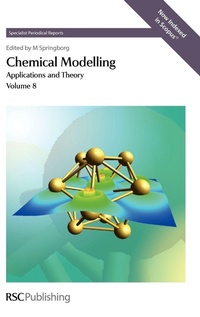
Chemical Modelling
Applications and Theory Volume 8
Published on 9. September 2011
Book
Hardback
186 pages
978-1-84973-153-9 (ISBN)
Description
Chemical Modelling: Applications and Theory comprises critical literature reviews of all aspects of molecular modelling. Molecular modelling in this context refers to modelliing the structure, properties and reactions of atoms, molecules and materials. Each chapter provides a selective review of recent literature, incorporating sufficient historical perspective for the non-specialist to gain an understanding. With chemical modelling covering such a wide range of subjects, this Specialist Periodical Report serves as the first port of call to any chemist, biochemist, materials scientist or molecular physicist needing to acquaint themselves with major developments in the area.
More details
Series
Language
English
Place of publication
Cambridge
United Kingdom
Target group
College/higher education
Product notice
Unsewn / adhesive bound
Dimensions
Height: 234 mm
Width: 156 mm
Thickness: 13 mm
Weight
441 gr
ISBN-13
978-1-84973-153-9 (9781849731539)
Copyright in bibliographic data and cover images is held by Nielsen Book Services Limited or by the publishers or by their respective licensors: all rights reserved.
Schweitzer Classification
Other editions
Additional editions
E-Book
09/2011
1st Edition
Royal Society of Chemistry
€413.99
Available for download
Persons
Prof. Dr. Michael Springborg heads up of the three groups in Physical Chemistry at the University of Saarland where the main activities concentrate on teaching and research. The major part of Prof. Dr. Michael Springborg's research concentrates on the development and application of theoretical methods, including accompanying computer programs, for the determination of materials properties. Quantum theory forms the theoretical foundation for most of our work. The materials of the group's interest range from atoms, via clusters and polymers, to solids. They study their structural, electronic, energetic, and opitcal properties.
Content
Towards novel boron nanostructural materials;
Aromaticity and conceptual density functional theory;
Mechanically induced chemistry: first principles simulation;
Inorganic nanotubes;
Numerical methods in chemistry
Aromaticity and conceptual density functional theory;
Mechanically induced chemistry: first principles simulation;
Inorganic nanotubes;
Numerical methods in chemistry