

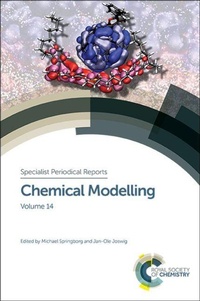
Chemical Modelling
Volume 14
Will be published approx. on 21. February 2018
Book
Hardback
264 pages
978-1-78801-004-7 (ISBN)
Description
Chemical modelling covers a wide range of hot topics and active areas in computational chemistry and related fields. With the increase in volume, velocity and variety of information, researchers can find it difficult to keep up to date with the literature in these areas. Containing both comprehensive and critical reviews, this book is the first stop for any materials scientist, biochemist, chemist or molecular physicist wishing to acquaint themselves with major developments in the applications and theory of chemical modelling.
More details
Series
Language
English
Place of publication
Cambridge
United Kingdom
Target group
Professional and scholarly
Product notice
Unsewn / adhesive bound
Dimensions
Height: 234 mm
Width: 156 mm
Thickness: 16 mm
Weight
558 gr
ISBN-13
978-1-78801-004-7 (9781788010047)
Copyright in bibliographic data and cover images is held by Nielsen Book Services Limited or by the publishers or by their respective licensors: all rights reserved.
Schweitzer Classification
Other editions
Additional editions
E-Book
02/2018
1st Edition
Royal Society of Chemistry
€433.99
Available for download
E-Book
02/2018
1st Edition
Royal Society of Chemistry
€433.99
Available for download
Persons
Content
Theoretical studies as a tool for understanding the aromatic character of porphyrinoid compounds;
Atomistic modeling for molecular electronics and spintronics: successes and challenges;
Recent progress on fermionic exchange symmetry;
Dynamics and electronic structure of atomic clusters;
Clusters as catalysts: advantages and challenges;
Modeling the oxidation mechanism of pyrite and arsenopyrite - connection to acid rock drainage;
Energetic processing of PAHs: isomerisation and dissociation;
From graphene to borophene the fascinating 2D materials
Atomistic modeling for molecular electronics and spintronics: successes and challenges;
Recent progress on fermionic exchange symmetry;
Dynamics and electronic structure of atomic clusters;
Clusters as catalysts: advantages and challenges;
Modeling the oxidation mechanism of pyrite and arsenopyrite - connection to acid rock drainage;
Energetic processing of PAHs: isomerisation and dissociation;
From graphene to borophene the fascinating 2D materials