

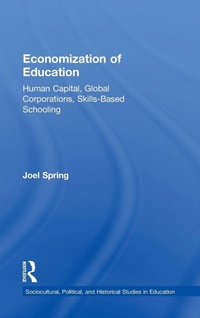
Economization of Education
Human Capital, Global Corporations, Skills-Based Schooling
1st Edition
Published on 10. April 2015
Book
Hardback
168 pages
978-1-138-84460-5 (ISBN)
Description
In this timely, cogent analysis of trends and powerful forces shaping global educational policy today, Joel Spring focuses on how economization is making economic growth and increased productivity the main goals of schools, and the ways these goals are achieved-including measuring educational policies by their costs and economic benefits, shaping family life to ensure productive workers and high-achieving students, introducing entrepreneurship education into curricula from preschool through higher education, and increasing the involvement of economists in educational policy analysis. Close attention is given to the Organization for Economic Cooperation and Development (OECD), the World Bank, the World Economic Forum, and multinational corporations, which, as advocates of economization, want schools to focus on teaching hard and soft skills needed by the global labor market.
Economization raises questions about the effects of economically driven agendas for schools: Will education policies advocated by global organizations and multinational businesses corporatize and standardize human personalities and families? What type of global worker is being sought by global organizations and multinational corporations? What education programs are supported to educate the ideal global worker? What is the ideal family life for economic growth and development? Detailing and analyzing the politics and motivations driving economization, the book concludes with an assessment of the impacts of the confluence of business interests, economic theories, governments, and educators.
Economization raises questions about the effects of economically driven agendas for schools: Will education policies advocated by global organizations and multinational businesses corporatize and standardize human personalities and families? What type of global worker is being sought by global organizations and multinational corporations? What education programs are supported to educate the ideal global worker? What is the ideal family life for economic growth and development? Detailing and analyzing the politics and motivations driving economization, the book concludes with an assessment of the impacts of the confluence of business interests, economic theories, governments, and educators.
More details
Series
Language
English
Place of publication
London
United Kingdom
Publishing group
Taylor & Francis Ltd
Target group
College/higher education
Postgraduate and Undergraduate
Dimensions
Height: 235 mm
Width: 157 mm
Thickness: 14 mm
Weight
406 gr
ISBN-13
978-1-138-84460-5 (9781138844605)
Copyright in bibliographic data and cover images is held by Nielsen Book Services Limited or by the publishers or by their respective licensors: all rights reserved.
Schweitzer Classification
Other editions
Additional editions
Book
03/2015
1st Edition
Routledge
€76.40
Shipment within 10-20 days
E-Book
03/2015
Routledge
€69.99
Available for download
E-Book
03/2015
Routledge
€69.99
Available for download
Person
Joel Spring is Professor at Queens College/City University of New York and the Graduate Center of the City University of New York, USA.
Content
Chapter 1 Economization and Corporatization of Education. Chapter 2 OECD: The Economization of Test Scores. Chapter 3 Skills: The New Global Currency. Chapter 4 World Bank: "Our Dream Is a World Free of Poverty". Chapter 5 The World Economic Forum: Partnerships and Entrepreneurship Education for Global Businesses. Chapter 6 Economization of the Family and Childhood: Educating the Corporate Personality. Chapter 7 The Confluence of Business Interests, Economic Theories, Governments and Educators: Go to School to Learn Job Skills.