

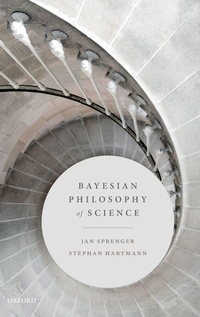
Bayesian Philosophy of Science
Published on 23. August 2019
Book
Hardback
414 pages
978-0-19-967211-0 (ISBN)
Description
How should we reason in science? Jan Sprenger and Stephan Hartmann offer a refreshing take on classical topics in philosophy of science, using a single key concept to explain and to elucidate manifold aspects of scientific reasoning. They present good arguments and good inferences as being characterized by their effect on our rational degrees of belief. Refuting the view that there is no place for subjective attitudes in 'objective science', Sprenger and Hartmann explain the value of convincing evidence in terms of a cycle of variations on the theme of representing rational degrees of belief by means of subjective probabilities (and changing them by Bayesian conditionalization). In doing so, they integrate Bayesian inference--the leading theory of rationality in social science--with the practice of 21st century science. Bayesian Philosophy of Science thereby shows how modeling such attitudes improves our understanding of causes, explanations, confirming evidence, and scientific models in general. It combines a scientifically minded and mathematically sophisticated approach with conceptual analysis and attention to methodological problems of modern science, especially in statistical inference, and is therefore a valuable resource for philosophers and scientific practitioners.
Reviews / Votes
For anyone with a serious interest in formal methods in the philosophy of science, this book is essential reading. * James Wilson, Metascience * Bayesian Philosophy of Science gradually raises and broaches important and fascinating questions concerning the status, foundations, and limits of Bayesianism and Bayesian inference. Reading the entirety of this rich and stimulating book, which is both accomplished and forward-looking, is therefore rewarding and highly recommended. * Isabelle Drouet, OEconomia * Sprenger and Hartmann's Bayesian Philosophy of Science promises to become the new reference manual for all things Bayesian in the philosophy of science...For anyone with a serious interest in formal methods in the philosophy of science, this book is essential reading. * James Wilson, Metascience * Detractors will read Sprenger and Hartmann's (hereafter S & H) Bayesian Philosophy of Science, because to my knowledge there is no other book that so effectively demonstrates the power and versatility of the Bayesian approach...The authors manage to cover a great deal of material, including material not typically discussed in introductions to Bayesian philosophy, such as the minimum divergence approach to probabilistic updating. * Olav Benjamin Vassend, Erkenntnis *More details
Language
English
Place of publication
Oxford
United Kingdom
Target group
College/higher education
Dimensions
Height: 240 mm
Width: 161 mm
Thickness: 29 mm
Weight
863 gr
ISBN-13
978-0-19-967211-0 (9780199672110)
Copyright in bibliographic data and cover images is held by Nielsen Book Services Limited or by the publishers or by their respective licensors: all rights reserved.
Schweitzer Classification
Other editions
Additional editions

Jan Sprenger | Stephan Hartmann
Bayesian Philosophy of Science
Book
08/2021
Oxford University Press
€30.95
The article will not be published
Jan Sprenger | Stephan Hartmann
Bayesian Philosophy of Science
E-Book
08/2019
1st Edition
OUP eBook
€66.49
Available for download
Persons
Jan Sprenger is Professor of Philosophy of Science at the University of Turin. After completing an undergraduate degree in mathematics, he obtained his PhD in Philosophy at the University of Bonn in 2008. He then took up a post at Tilburg University, first working as Assistant Professor (2008-13) and subsequently as Full Professor (2014-17). He also directed the Tilburg Center for Logic, Ethics and Philosophy of Science (TiLPS). Sprenger's research and publications span a wide range of topics, mainly in philosophy of science and uncertain reasoning, but also in logic, group decision-making, and empirical work on human cognition.
Stephan Hartmann is Professor of Philosophy of Science at LMU Munich, Alexander von Humboldt Professor, and Co-Director of the Munich Center for Mathematical Philosophy (MCMP). Between 2007 and 2012 he worked at Tilburg University, where he was Chair in Epistemology and Philosophy of Science and Director of the Tilburg Center for Logic and Philosophy of Science (TiLPS). Prior to this, he was Professor of Philosophy at the London School of Economics and Director of its Centre for Philosophy of Natural and Social Science. He was President of the European Philosophy of Science Association (2013-17) and President of the European Society for Analytic Philosophy (2014-17). Hartmann's primary research and teaching areas are philosophy of science, philosophy of physics, formal epistemology, and social epistemology. His current interests also include the philosophy and psychology of reasoning and argumentation.
Stephan Hartmann is Professor of Philosophy of Science at LMU Munich, Alexander von Humboldt Professor, and Co-Director of the Munich Center for Mathematical Philosophy (MCMP). Between 2007 and 2012 he worked at Tilburg University, where he was Chair in Epistemology and Philosophy of Science and Director of the Tilburg Center for Logic and Philosophy of Science (TiLPS). Prior to this, he was Professor of Philosophy at the London School of Economics and Director of its Centre for Philosophy of Natural and Social Science. He was President of the European Philosophy of Science Association (2013-17) and President of the European Society for Analytic Philosophy (2014-17). Hartmann's primary research and teaching areas are philosophy of science, philosophy of physics, formal epistemology, and social epistemology. His current interests also include the philosophy and psychology of reasoning and argumentation.
Content
1: Theme: Bayesian Philosophy of Science
2: Variation 1: Confirmation and Induction
3: Variation 2: The No Alternatives Argument
4: Variation 3: Scientific Realism and the No Miracles Argument
5: Variation 4: Learning Conditional Evidence
6: Variation 5: The Problem of Old Evidence
7: Variation 6: Causal Strength
8: Variation 7: Explanatory Power
9: Variation 8: Intertheoretic Reduction
10: Variation 9: Hypothesis Testing and Corroboration
11: Variation 10: Simplicity and Model Selection
12: Variation 11: Scientific Objectivity
13: Variation 12: Models, Idealizations and Objective Chance
Conclusion: The Theme Revisited
2: Variation 1: Confirmation and Induction
3: Variation 2: The No Alternatives Argument
4: Variation 3: Scientific Realism and the No Miracles Argument
5: Variation 4: Learning Conditional Evidence
6: Variation 5: The Problem of Old Evidence
7: Variation 6: Causal Strength
8: Variation 7: Explanatory Power
9: Variation 8: Intertheoretic Reduction
10: Variation 9: Hypothesis Testing and Corroboration
11: Variation 10: Simplicity and Model Selection
12: Variation 11: Scientific Objectivity
13: Variation 12: Models, Idealizations and Objective Chance
Conclusion: The Theme Revisited