

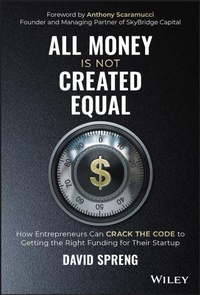
All Money Is Not Created Equal
Description
Too often, thanks to multiple rounds of equity investment, company founders wind up with only a small fraction of the businesses they start. But this situation isn't inevitable. The intelligent use of a variety of financing options-including debt financing-can help to maintain, or even grow, a founder's stake.
In All Money Is Not Created Equal: The Entrepreneur's Guide to Finding the Right Funding for Your Business, renowned Silicon Valley veteran David Spreng delivers an expert guide for entrepreneurs and founders seeking to maintain as much ownership stake as possible in the companies they create as they move through the various stages of the financing process. The book draws on the author's decades of experience as a venture capitalist, venture debt lender, and CEO of a publicly traded company in Silicon Valley, as well as interviews with entrepreneurs, board members, investors, and bankers.
Readers will also find:
A well-rounded and insightful perspective on the financing process informed by industry veterans
An informal and accessible exploration of a complex topic that remains critical to the success of entrepreneurs and founders
Discussions of alternatives to equity financing, including debt financing, in the growth phase of startups
An essential handbook for startup founders, entrepreneurs, and managers, All Money Is Not Created Equal also deserves a place in the hands of company board members, venture capitalists, investors, and investment bankers interested in the company financing process.
<b>Finance your company's growth without losing your stake in it</b>
Too often, thanks to multiple rounds of equity investment, company founders wind up with only a small fraction of the businesses they start. But this situation isn't inevitable. The intelligent use of a variety of financing options-including debt financing-can help to maintain, or even grow, a founder's stake.
In <i>All Money Is Not Created Equal: The Entrepreneur's Guide to Finding the Right Funding for Your Business</i>, renowned Silicon Valley veteran David Spreng delivers an expert guide for entrepreneurs and founders seeking to maintain as much ownership stake as possible in the companies they create as they move through the various stages of the financing process. The book draws on the author's decades of experience as a venture capitalist, venture debt lender, and CEO of a publicly traded company in Silicon Valley, as well as interviews with entrepreneurs, board members, investors, and bankers.
Readers will also find:
<ul><li>A well-rounded and insightful perspective on the financing process informed by industry veterans</li><li>An informal and accessible exploration of a complex topic that remains critical to the success of entrepreneurs and founders</li><li>Discussions of alternatives to equity financing, including debt financing, in the growth phase of startups</li></ul>An essential handbook for startup founders, entrepreneurs, and managers, <i>All Money Is Not Created Equal</i> also deserves a place in the hands of company board members, venture capitalists, investors, and investment bankers interested in the company financing process.
More details
Other editions
Additional editions
Content
Foreword
Acknowledgments
Introduction
Comp: Part One is book page 1
Part One: Setting the Stage
1. A Tale of Two Companies
2. All About Growth: My Journey from Venture Capital to Venture Debt
Part Two: Startups: Understanding the Arena
3. The Stages of a Startup
4. Geography Matters - to a Point
5. The Startup Ecosystem
Part Three: Getting the Money
6. Your First Outside Investors
7. What Kind of Money Is Right for Your Business?
8. The Ins and Outs of Venture Capital
9. Debt Is Not a Four-Letter Word
10. What a Deal with Debt Looks Like
11. Making the Most of Debt
12. Exit Options
Part Four: Making the Best Use of Your Money
13. Bullshitters, Liars, and Jerks, Part 1
14. Bullshitters, Liars, and Jerks, Part 2
15. Your Team: Getting the Right People in the Right Jobs
16. Founder versus CEO
17. Getting the Most from Your Board
18. The Moral Contract
Part Five: Going Forward
19. Runway's Story of Going Public
20. Conclusion
Appendix
Index