

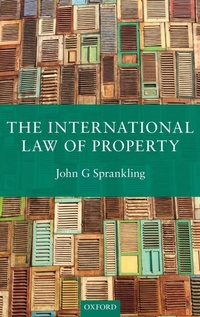
The International Law of Property
Published on 1. May 2014
Book
Hardback
424 pages
978-0-19-965454-3 (ISBN)
Description
Does a right to property exist under international law? The traditional answer to this question is no: a right to property can only arise under the domestic law of a particular nation. But the view that property rights are exclusively governed by national law is obsolete. Identifiable areas of property law have emerged at the international level, and the foundation is now arguably being laid for a comprehensive international regime. This book provides a detailed investigation into this developing international property law. It demonstrates how the evolution of international property law has been influenced by major economic, political, and technological changes: the embrace of private property by former socialist states after the end of the Cold War; the globalization of trade; the birth of new technologies capable of exploiting the global commons; the rise of digital property; and the increasing recognition of the human right to property.
The first part of the book analyzes how international law impacts rights in specific types of property. In some situations, international law creates property rights, such as rights in aboriginal lands, deep seabed minerals, and satellite orbits. In other areas, it harmonizes property rights that arise at the national level, such as rights in intellectual property, rights in foreign investments, and security interests in personal property. Finally, it restricts property rights that may be recognized at the national level, such as rights in celestial bodies, contraband, and slaves. The second part of the book explores the thesis that a global right to property should be recognized as a general matter, not merely as a moral precept but rather as an entitlement that all nations must honour. It establishes the components of such a right, arguing that the right to property at the international level should be seen in the context of five key components of ownership: acquisition, use, destruction, exclusion, and transfer. This highly innovative book makes an important contribution to how we conceptualize the protection of property and to the understanding that much of this protection now takes place at the international level.
The first part of the book analyzes how international law impacts rights in specific types of property. In some situations, international law creates property rights, such as rights in aboriginal lands, deep seabed minerals, and satellite orbits. In other areas, it harmonizes property rights that arise at the national level, such as rights in intellectual property, rights in foreign investments, and security interests in personal property. Finally, it restricts property rights that may be recognized at the national level, such as rights in celestial bodies, contraband, and slaves. The second part of the book explores the thesis that a global right to property should be recognized as a general matter, not merely as a moral precept but rather as an entitlement that all nations must honour. It establishes the components of such a right, arguing that the right to property at the international level should be seen in the context of five key components of ownership: acquisition, use, destruction, exclusion, and transfer. This highly innovative book makes an important contribution to how we conceptualize the protection of property and to the understanding that much of this protection now takes place at the international level.
More details
Language
English
Place of publication
Oxford
United Kingdom
Target group
College/higher education
Professional and scholarly
Dimensions
Height: 240 mm
Width: 161 mm
Thickness: 27 mm
Weight
798 gr
ISBN-13
978-0-19-965454-3 (9780199654543)
Copyright in bibliographic data and cover images is held by Nielsen Book Services Limited or by the publishers or by their respective licensors: all rights reserved.
Schweitzer Classification
Other editions
Additional editions
John G. Sprankling
The International Law of Property
E-Book
05/2014
1st Edition
OUP eBook
€83.99
Available for download
John G. Sprankling
The International Law of Property
E-Book
05/2014
1st Edition
OUP eBook
€83.99
Available for download
Person
John G. Sprankling is an authority on property law and a Distinguished Professor of Law at the University of the Pacific, McGeorge School of Law. His books on property law have been used by scholars, attorneys, and students around the world; two have been translated into Chinese. He has also taught at Stanford Law School, UC Hastings College of Law, and law schools in Austria, China, and Russia. At Pacific McGeorge, he has served as Interim Dean and as Associate Dean for Academic Affairs. He has also served as the Chair of the Property Law Section of the Association of American Law Schools.
Content
PART I: INTRODUCTION ; 1. The Concept of International Property Law ; 2. The Human Right to Property ; PART II: PRINCIPLES OF INTERNATIONAL PROPERTY LAW ; 3. Chattels ; 4. Intangible Property ; 5. Land ; 6. Oceans ; 7. Atmosphere ; PART III: COMPONENTS OF INTERNATIONAL PROPERTY LAW ; 8. Toward Global Property Rights ; 9. The Right to Acquire ; 10. The Right to Possess and Use ; 11. The Right to Destroy ; 12. The Right to Exclude ; 13. The Right to Transfer ; PART IV: OUTLOOK ; 14. The Future of International Property Law