

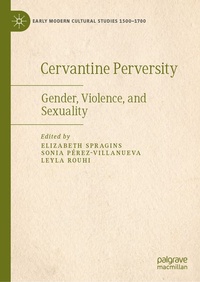
Cervantine Perversity
Description
This volume offers a bold re-examination of the representation of women in the work of Miguel de Cervantes by highlighting the role of perversity. Bringing together historicist, psychoanalytic, feminist, and queer perspectives, the essays analyze how Cervantes' narratives construct scenes of sexual violence, objectification, and female suffering while perversely inviting the reader's complicity in their consumption. Through readings of Don Quijote , the Novelas ejemplares , and other works, contributors challenge the long-standing view of Cervantes as a proto-feminist author. Instead, they reveal how his fiction often transforms women's vulnerability into narrative spectacle, exposing the troubling dynamics of power, gender, and pleasure embedded in the Cervantine aesthetic.
Reviews / Votes
"Cervantes has long been celebrated for his sensitivity to the sexual trauma of women. This collection remedies that errant assessment, offering entry points into perversity through which narrators and readers find pleasure in the degradation and violence against women. Featuring nine essays by established Cervantes scholars, Cervantine Perversity covers an impressive range of theoretical approaches, from incels to sex work to witchcraft to sheep-herding. This courageous collection indicts the author and acknowledges the complex, often unsettling relationship between his writings and readers." (Sherry Velasco, University of Southern California, United States)
"This volume approaches sexual violence in Cervantes through the lens of "perversity," demanding a critical reckoning with Cervantes' normalizing of the obscene pleasures of male characters and readers. Attuned both to the historical specificity of Cervantes' early modernity and to the urgent problems of our contemporary moment, Cervantine Perversity bids incandescent adieu to the hagiographical celebration of Cervantes as proto-feminist." (Prof. Chad Leahy, University of Denver, United States)
More details
Persons
Elizabeth Spragins is Associate Professor in Spanish at the College of the Holy Cross, USA. Her research focuses on authority and identity in early modern Mediterranean narrative and has appeared in La coro´nica , ConSecuencias , Medieval Encounters , and postmedieval .
Sonia Pérez-Villanueva , originally from the Basque Country in Spain, is a scholar of early modern Iberian historical, literary, and visual cultures. Her research explores gender, violence, and representation across texts, images, and archival materials. She is currently working on a monograph on the violence of the Inquisition and the cultural histories of crypto-Jewish women. She is Vice Provost for Liberal Arts & Business and Professor of Spanish and Literature in Translation at Lesley University in Cambridge, MA.
Leyla Rouhi teaches at Williams College, USA. She has published numerous articles and chapters on medieval and early modern Iberia as well as Middle Eastern culture. She is the author of Mediation and Love as well as co-editor and contributing author of collected volumes on early modern Spain and gender studies. Her teaching includes Spanish language and Peninsular history, culture and literature.
Content
Chapter 1: Introduction.- Chapter 2: Cervantes, per Verse: Misogynist Poetics of Pastoral Incels.- Chapter 3: Perverse Agency in "La Fuerza de la Sangre": Leocadia and the Third Space.- Chapter 4: Feminists Writing with and against Cervantes.- Chapter 5: Perversion and Witchcraft in Cervantes: Deconstruction, Reversal, and Parody in the "Coloquio de los perros.- Chapter 6: The Perversity of Angelica: On Maritornes, Altisidora, and Sexual Assault in Cervantes's .- Chapter 7:Believe Dorotea: Intersectional Sexual Violence in Don Quixote.- Chapter 8: Cervantes's Women and the Perversity of Fortune.- Chapter 9: Preciosa as Hook(er): The Promise of Perversion in Cervantes's "La gitanilla".- Chapter 10: Seemingly Unimportant: Female Perversity through Elliptical Lenses.