

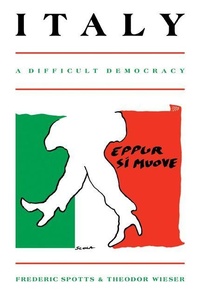
Italy
A Difficult Democracy: A Survey of Italian Politics
Published on 30. April 1986
Book
Paperback/Softback
344 pages
978-0-521-31511-1 (ISBN)
Description
Italy is the world's sixth economic power, lies in a key geopolitical position, and was a founding member of NATO and the European Community. Yet of all the major European states Italy is the least understood and studied. This book provides the only up-to-date survey of the Italian political scene during the forty years since World War II. It describes the inner-dynamics of the political parties, the day-to-day functioning of the governing institutions, and the interaction of the country's economic, social, and political life. It shows how a political system, riven with difficulties and seemingly in a continual crisis, survives and prospers - in some ways more successfully than its purportedly better-governed neighbours. Based on the authors' first-hand observations of Italian politics, the book offers a valuable insight into a subtle and complex, but fascinating political world.
Reviews / Votes
"...A solid, clearly written guide to contemporary Italy." Patrick McCarthy, The Review of PoliticsMore details
Language
English
Place of publication
Cambridge
United Kingdom
Target group
College/higher education
Product notice
Paperback (trade)
Illustrations
Worked examples or Exercises
Dimensions
Height: 229 mm
Width: 152 mm
Thickness: 20 mm
Weight
559 gr
ISBN-13
978-0-521-31511-1 (9780521315111)
Copyright in bibliographic data and cover images is held by Nielsen Book Services Limited or by the publishers or by their respective licensors: all rights reserved.
Schweitzer Classification
Other editions
Additional editions
Book
03/1986
Cambridge University Press
€55.71
Article exhausted; check for reprint
Previous edition
Book
03/1986
Cambridge University Press
€55.71
Article exhausted; check for reprint
Content
1. the Political Context; 2. The Christian Democrats: The Indispensable center; 3. The Communists' struggle for legitimacy and acceptance; 4. The ambiguous role of the Socialists; 5. The small parties: The lay forces and the extremes; 6. Parliament, prime minister and president; 7. Public administration and sottogoverno; 8. The administration of justice; 9. Dangers to the state: Plots, terrorism, and the mafia; 10. Economic and social transformation; 11.