

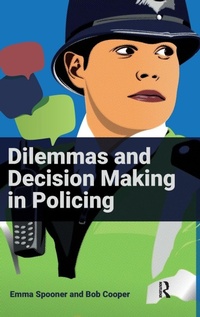
Dilemmas and Decision Making in Policing
1st Edition
Published on 31. March 2025
Book
Hardback
128 pages
978-1-041-05511-2 (ISBN)
Description
Explores how policing students and police officers might apply theory to tackle dilemmas demonstrated through true to life scenarios.
Relevant for those undertaking the Professional Policing degree, Apprenticeships or the Degree Holder Entry Programme, as well as their academic and work-based educators, it examines the complexities faced on a daily basis by frontline officers.
A range of fictional realistic case studies are presented in order to highlight contemporary challenges in the modern policing landscape. These are unpicked through discussion and reflective questions, exploring how decisions are made based on theoretical understanding and practical considerations in context. Key themes within these scenarios include procedural justice, legitimacy, organisational culture, prioritisation of workload, objectivity and neutrality, human rights and values. The book provides students and their educators with the opportunities to discuss policing dilemmas and decision-making in a safe space.
Relevant for those undertaking the Professional Policing degree, Apprenticeships or the Degree Holder Entry Programme, as well as their academic and work-based educators, it examines the complexities faced on a daily basis by frontline officers.
A range of fictional realistic case studies are presented in order to highlight contemporary challenges in the modern policing landscape. These are unpicked through discussion and reflective questions, exploring how decisions are made based on theoretical understanding and practical considerations in context. Key themes within these scenarios include procedural justice, legitimacy, organisational culture, prioritisation of workload, objectivity and neutrality, human rights and values. The book provides students and their educators with the opportunities to discuss policing dilemmas and decision-making in a safe space.
More details
Series
Language
English
Place of publication
London
United Kingdom
Publishing group
Taylor & Francis Ltd
Target group
College/higher education
Undergraduate Core
Dimensions
Height: 240 mm
Width: 161 mm
Thickness: 12 mm
Weight
367 gr
ISBN-13
978-1-041-05511-2 (9781041055112)
Copyright in bibliographic data and cover images is held by Nielsen Book Services Limited or by the publishers or by their respective licensors: all rights reserved.
Schweitzer Classification
Other editions
Additional editions
Emma Spooner | Bob Cooper
Dilemmas and Decision Making in Policing
E-Book
02/2025
Routledge
€27.49
Available for download
Emma Spooner | Bob Cooper
Dilemmas and Decision Making in Policing
E-Book
02/2025
Routledge
€27.49
Available for download
Emma Spooner | Bob Cooper
Dilemmas and Decision Making in Policing
Book
09/2023
1st Edition
Critical Publishing Ltd
€33.10
Shipment within 3-4 weeks
Persons
Emma Spooner is a lecturer at the University of Sunderland delivering work-based learning programmes to practitioners involved in investigative practice and policing. She draws on 21 years of policing experience as a front-line practitioner working across the spectrum of volume and priority crime, serious and complex crime and major crime investigation to help to de-mystify the research process and contextualise it into daily working practices. Helping students to embrace research and understand its application to professional practice and workplace development lies at the heart of her teaching.
Bob Cooper was a detective for 25 years. During that time he worked as a mentor to his colleagues and delivered numerous training events both to internal and external parties around aspects of investigative practice including decision making. He has a passion for understanding investigative decision making and has used this to underpin discussions with frontline colleagues to help them to develop and maintain standards within the workplace.
Bob Cooper was a detective for 25 years. During that time he worked as a mentor to his colleagues and delivered numerous training events both to internal and external parties around aspects of investigative practice including decision making. He has a passion for understanding investigative decision making and has used this to underpin discussions with frontline colleagues to help them to develop and maintain standards within the workplace.
Content
Introduction Section 1 - Policing by Consent: Decision Making and Public Accountability Chapter 1 Legitimacy and control: Stop and search Chapter 2 The role of the police: Policing protests and demonstrations Section 2 - Managing Risk and Safeguarding: Complex Decision Making Chapter 3 Identifying and managing risk: Stalking and harassment Chapter 4 Prosecuting or safeguarding: Juveniles involved in criminality Section 3 - Mindset, Choices and Priorities: Investigative Decision Making Chapter 5 Achieving best evidence: Assault of Elderly Male Chapter 6 Getting off to the right start: Responding to sexual assault Chapter 7 Prioritising Workloads: Investigation Planning Conclusion Index References