

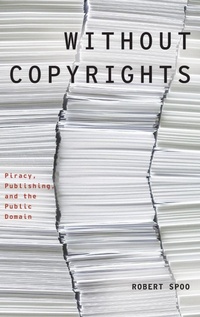
Without Copyrights
Piracy, Publishing, and the Public Domain
Published on 5. September 2013
Book
Hardback
374 pages
978-0-19-992787-6 (ISBN)
Description
This book tells the story of how the notoriously protectionist American copyright law impacted transatlantic modernism by encouraging the piracy of works published abroad. From its inception in 1790, U.S. copyright law withheld protection from foreign authors, creating an aggressive public domain that claimed works just as soon as they were published abroad. When Congress finally extended protection to foreign works, legal technicalities caused many authors to continue to lose their copyrights.
The American public domain made vast numbers of foreign works freely available to American publishers. In order to avert ruinous competition for these unprotected resources, publishers evolved "trade courtesy," whereby the first house to announce plans to issue a foreign work acquired informal rights in the work-a kind of makeshift copyright grounded on unwritten norms and elaborate professional etiquette. Courtesy was a form of order without law that safeguarded publishers' interests, punished deviants from the code, and remunerated foreign authors for the exploitation of their works.
Drawing on previously undiscovered archives, this book reveals the convergence of law, piracy, and courtesy in the dissemination of transatlantic modernism in the United States. The chief actors are James Joyce, Ezra Pound, and the New York pirate-pornographer Samuel Roth, with their very different attitudes toward intellectual property. Joyce's growing reputation in America, Pound's proposals for copyright reform, Roth's activities as purveyor of a hybrid modernism compounded of verbal experiment and entertainment for men-these and other developments cannot be understood apart from the contemporaneous American law and the voracious public domain it created.
The book also tells the untold legal stories behind key events of modernism. When Roth reprinted the uncopyrighted Ulysses without permission, Joyce retaliated by drawing upon the punitive dimension of trade courtesy and by filing a lawsuit seeking damages for Roth's exploitation of his valuable name. Later, the courtesy tradition enabled Joyce to enjoy informal protection for Ulysses after Random House published the authorized American edition in 1934. Publishing norms, not copyright, kept pirates from Ulysses.
The American public domain made vast numbers of foreign works freely available to American publishers. In order to avert ruinous competition for these unprotected resources, publishers evolved "trade courtesy," whereby the first house to announce plans to issue a foreign work acquired informal rights in the work-a kind of makeshift copyright grounded on unwritten norms and elaborate professional etiquette. Courtesy was a form of order without law that safeguarded publishers' interests, punished deviants from the code, and remunerated foreign authors for the exploitation of their works.
Drawing on previously undiscovered archives, this book reveals the convergence of law, piracy, and courtesy in the dissemination of transatlantic modernism in the United States. The chief actors are James Joyce, Ezra Pound, and the New York pirate-pornographer Samuel Roth, with their very different attitudes toward intellectual property. Joyce's growing reputation in America, Pound's proposals for copyright reform, Roth's activities as purveyor of a hybrid modernism compounded of verbal experiment and entertainment for men-these and other developments cannot be understood apart from the contemporaneous American law and the voracious public domain it created.
The book also tells the untold legal stories behind key events of modernism. When Roth reprinted the uncopyrighted Ulysses without permission, Joyce retaliated by drawing upon the punitive dimension of trade courtesy and by filing a lawsuit seeking damages for Roth's exploitation of his valuable name. Later, the courtesy tradition enabled Joyce to enjoy informal protection for Ulysses after Random House published the authorized American edition in 1934. Publishing norms, not copyright, kept pirates from Ulysses.
Reviews / Votes
Robert Spoo takes us into a pioneering, novel, fascinating and challenging historical journey in which he imbues new life into past copyright conflicts that were told from a very specific, and rather limited, perspectives. Spoo opens a new debate that some would argue was closed decades ago--a debate reminding them that authors do not create in a social vacuum, that authors are nurtured by society, other authors and their works, and that without these resources no person could reach the status of an 'author'...I am confident that readers of Spoo's tour-de-froce will agree that he has rigorously reminded us of the many flaws we tend to cherish, and of the long-needed rethinking process of the public domain in contmeporary copyright traditions. * Lior Seemer, Radzyner School of Lawm Interdisciplinary Centre, Herzliya * Spoo commands a comprehensive understanding of both copyright law and the delicate structure of informal courtesies-- not laws--that for decades governed the publication of books written overseas yet read and often printed in the United States. * Common Knowledge *More details
Series
Language
English
Place of publication
New York
United States
Target group
College/higher education
Professional and scholarly
Dimensions
Height: 240 mm
Width: 161 mm
Thickness: 25 mm
Weight
725 gr
ISBN-13
978-0-19-992787-6 (9780199927876)
Copyright in bibliographic data and cover images is held by Nielsen Book Services Limited or by the publishers or by their respective licensors: all rights reserved.
Schweitzer Classification
Other editions
Additional editions
Book
03/2016
Oxford University Press Inc
€43.60
Shipment within 15-20 days
E-Book
08/2013
1st Edition
OUP eBook
€16.49
Available for download
E-Book
07/2013
1st Edition
OUP eBook
€14.49
Available for download
Person
Robert Spoo is Professor of Law at the University of Tulsa. A former editor of James Joyce Quarterly, he is the author of James Joyce and the Language of History (Oxford UP, 1994; net sales: 880).
Content
Introduction ; Chapter 1: "The American Public Domain and the Courtesy of the Trade in the Nineteenth Century" ; Chapter 2: "Transatlantic Modernism and the American Public Domain." ; Chapter 3: "Ezra Pound's Copyright Statute: Perpetual Rights and Unfair Competition with the Dead." ; Chapter 4: "James Joyce's Ulysses and American Copyright Protectionism." ; Chapter 5: "James Joyce v. Samuel Roth and Two Worlds Publishing Company." ; Chapter 6: "The 1934 Random House Ulysses: Copyright and Trade Courtesy. ; Epilogue