

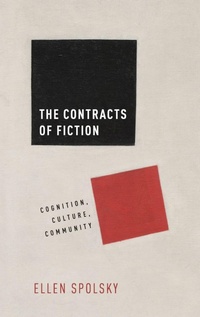
The Contracts of Fiction
Cognition, Culture, Community
Published on 21. May 2015
Book
Hardback
320 pages
978-0-19-023214-6 (ISBN)
Description
The Contracts of Fiction reconnects our fictional worlds to the rest of our lives. Countering the contemporary tendency to dismiss works of imagination as enjoyable but epistemologically inert, the book considers how various kinds of fictions construct, guide, and challenge institutional relationships within social groups. The contracts of fiction, like the contracts of language, law, kinship, and money, describe the rules by which members of a group toggle between tokens and types, between their material surroundings - the stuff of daily life - and the abstractions that give it value. Rethinking some familiar literary concepts such as genre and style from the perspective of recent work in the biological, cognitive, and brain sciences, the book displays how fictions engage bodies and minds in ways that help societies balance continuity and adaptability. Being part of a community means sharing the ways its members use stories, pictures, plays and movies, poems and songs, icons and relics, to generate usable knowledge about the people, objects, beliefs and values in their environment.
Exposing the underlying structural and processing homologies among works of imagination and life processes such as metabolism and memory, Ellen Spolsky demonstrates the seamless connection of life to art by revealing the surprising dependence of both on disorder, imbalance, and uncertainty. In early modern London, for example, reformed religion, expanding trade, and changed demographics made the obsolescent courts a source of serious inequities. Just at that time, however, a flood of wildly popular revenge tragedies, such as Hamlet, by their very form, by their outrageous theatrical grotesques, were shouting the need for change in the justice system. A sustained discussion of the genre illustrates how biological homeostasis underpins the social balance that we maintain with difficulty, and how disorder itself incubates new understanding.
Exposing the underlying structural and processing homologies among works of imagination and life processes such as metabolism and memory, Ellen Spolsky demonstrates the seamless connection of life to art by revealing the surprising dependence of both on disorder, imbalance, and uncertainty. In early modern London, for example, reformed religion, expanding trade, and changed demographics made the obsolescent courts a source of serious inequities. Just at that time, however, a flood of wildly popular revenge tragedies, such as Hamlet, by their very form, by their outrageous theatrical grotesques, were shouting the need for change in the justice system. A sustained discussion of the genre illustrates how biological homeostasis underpins the social balance that we maintain with difficulty, and how disorder itself incubates new understanding.
Reviews / Votes
Why do all people everywhere of all ages in all societies over all history and throughout the entire world invest nearly inconceivable resources in imaginative fiction-dreams, daydreams, simulations, counterfactual scenarios, possibilities, reveries, poems, plays, films, cartoons, tragedies, comedies, dramas? The scientific question is open, grand, and fundamental. Ellen Spolsky's cognitive defense of fiction is a major contribution. * Mark Turner, Institute Professor and Professor of Cognitive Science, Case Western Reserve University * Instability, failure, and representational hunger afford individuals and societies 'the freedom to reimagine and change direction,' while art and literature are the protected spaces for such reimagining. To explain how this works, Spolsky brings together cutting-edge research in evolutionary biology, social and legal history, and literary criticism. Brilliant, witty, reader-friendly, The Contracts of Fiction is the gold standard of cognitive literary studies. This is the scholarship of the future. * Lisa Zunshine, editor of The Oxford Handbook of Cognitive Literary Studies * Extending the author's pioneering efforts to foster dialogue between literary studies and the cognitive sciences, Ellen Spolsky's The Contracts of Fiction shows how a range of artifacts * poetry as well as drama, narratives as well as static imagescan both illuminate and be illuminated by research concerned with culture, communities, and cognition, including evolutionary psychology, categorization theory, memory research, accounts of embodied and socially distributed cognition, and work on the biology of conscious life more generally.David Herman, author of Storytelling and the Sciences of the Mind * The Contracts of Fiction asks why we invest so much energy producing, consuming, and sharing fictions despite their evident lack of truth value. Deftly recruiting concepts from the biological and cognitive sciences to the aid of literary theory, Ellen Spolsky produces the most compelling synthesis to date of cognitive, evolutionary, and literary understandings of the human imagination. * Alan Richardson, author of The Neural Sublime *More details
Language
English
Place of publication
New York
United States
Target group
College/higher education
Professional and scholarly
Illustrations
26 halftones
Dimensions
Height: 240 mm
Width: 161 mm
Thickness: 22 mm
Weight
640 gr
ISBN-13
978-0-19-023214-6 (9780190232146)
Copyright in bibliographic data and cover images is held by Nielsen Book Services Limited or by the publishers or by their respective licensors: all rights reserved.
Schweitzer Classification
Other editions
Additional editions
E-Book
03/2015
1st Edition
OUP eBook
€34.99
Available for download
E-Book
03/2015
1st Edition
OUP eBook
€44.99
Available for download
Person
Ellen Spolsky is Professor of English Emeritus at Bar-Ilan University in Israel. Her previous books include Word vs. Image: Cognitive Hunger in Shakespeare's England (Palgrave Macmillan, 2007) and Gaps in Nature: Literary Interpretation and the Modular Mind (SUNY Press, 1993).
Content
Table of Contents ; Preface: An Invitation ; Chapter 1: Embodiment and its Entailments ; Chapter 2: Lyrics and their Frames ; Chapter 3: Genre Change and Narrative Recovery (Maybe) ; Chapter 4: Intelligence on a Communal Scale: An Enriched Theory of Distributed Cognition ; Chapter 5: Distributed Misunderstanding ; Chapter 6: Affording Justice through sinderesis: an early modern embodiment theory ; Chapter 7: Balance and Imbalance ; Chapter 8: The Skepticism of Grotesques: 'Between the Known and the Unknown' ; Chapter 9: Detach and Reuse ; Notes ; References ; Index