

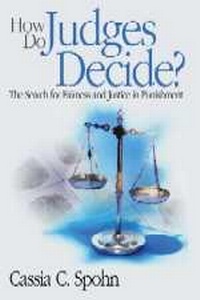
How Do Judges Decide?
The Search for Fairness and Justice in Punishment
1st Edition
Published on 6. November 2002
Book
Paperback/Softback
352 pages
978-0-7619-8760-4 (ISBN)
Description
The appropriate amount of punishment for a given crime is an issue that has been debated by scholars, philosophers and legal professionals since the beginning of civilizations. This book seeks to address this issue in all of its complexity by providing a comprehensive overview of the sentencing process in the United States.
The book begins by discussing the overall concept of punishment and then proceeds to dissect individual aspects of punishment. Topics include: the sentencing process; responsibility of the judge; disparity and discrimination in sentencing; and sentencing reform.
This book is an ideal text for introductory courses on the judicial system, criminal law, law and society. It will be an essential resource to help students understand patterns in the wide discretion and latitude given to judges when determining punishments within the framework of the United States judicial system.
The book begins by discussing the overall concept of punishment and then proceeds to dissect individual aspects of punishment. Topics include: the sentencing process; responsibility of the judge; disparity and discrimination in sentencing; and sentencing reform.
This book is an ideal text for introductory courses on the judicial system, criminal law, law and society. It will be an essential resource to help students understand patterns in the wide discretion and latitude given to judges when determining punishments within the framework of the United States judicial system.
More details
Language
English
Place of publication
Thousand Oaks
United States
Target group
College/higher education
Dimensions
Height: 229 mm
Width: 152 mm
Weight
449 gr
ISBN-13
978-0-7619-8760-4 (9780761987604)
Copyright in bibliographic data and cover images is held by Nielsen Book Services Limited or by the publishers or by their respective licensors: all rights reserved.
Schweitzer Classification
Other editions
New editions
Book
02/2009
2nd Edition
SAGE Publications Inc
€118.30
Shipment within 10-20 days
Person
Cassia Spohn is School Director and Foundation Professor of Criminal Justice at Arizona State University. She is the author of several books, including The Color of Justice: Race, Ethnicity, and Crime in America (with Sam Walker and Miriam DeLone) and How Do Judges Decide? The Search for Fairness and Equity in Sentencing. She has published a number of articles examining prosecutors' charging decisions in sexual assault cases and exploring the effect of race/ethnicity on charging and sentencing decisions. Her current research interests include the effect of race and gender on court processing decisions, victim characteristics and case outcomes in sexual assault cases, judicial decision making, sentencing of drug offenders, and the deterrent effect of imprisonment. In 1999, she was awarded the University of Nebraska Outstanding Research and Creative Activity Award.
Content
Acknowledgments
Preface
1. The Goals of Sentencing
Why Punish?
How Much to Punish?
Theories of Punishment and Judges' Sentencing Decisions
Conclusion
2. Sentencing Options and the Sentencing Process
The Judge's Options at Sentencing
Sentencing as a Collaborative Exercise
The Sentencing Process
3. How do Judges Decide
Modeling the Sentencing Process
How Do Judges Decide?
4. Sentencing Disparity and Discrimination
Disparity and Discrimination
Gender and Sentencing
Focus on an Issue: Should Men and Women Be Treated the Same
Disparity and Discrimination in Sentencing
5. Sentencing Disparity and Discrimination:
Racial Disparity in Sentencing
Race and Imprisonment: Evidence of Disproportionality
Race and Judges' Sentencing Decisions
Focus on an Issue: Race and Sentencing for Drug Offenses: Punishment and Prejudice?
Race and the Death Penalty: A Failed Experiment?
Justice From the Bench?
6. Thirty Years of Sentencing Reform
The Sentencing Reform Movement
Structured Sentencing Reforms
Mandatory Minimum Sentencing Statutes
Focus on an Issue: Sentencing Drug Offenders: Incarceration or Treatment--What Works?
Three-Strikes-and-You're-Out Laws
Truth-In-Sentencing Laws
Three Decades of Reform
7. The Impact of the Sentencing Reform Movement
Have Sentencing Reforms Led to More Punitive Sentences?
Have Sentencing Reforms Led to a Reduction in Crime?
Have Sentencing Reforms Reduced Disparity and Discrimination?
Assessing the Impact of the Sentencing Reform Movement
References
Index
About the Author
Preface
1. The Goals of Sentencing
Why Punish?
How Much to Punish?
Theories of Punishment and Judges' Sentencing Decisions
Conclusion
2. Sentencing Options and the Sentencing Process
The Judge's Options at Sentencing
Sentencing as a Collaborative Exercise
The Sentencing Process
3. How do Judges Decide
Modeling the Sentencing Process
How Do Judges Decide?
4. Sentencing Disparity and Discrimination
Disparity and Discrimination
Gender and Sentencing
Focus on an Issue: Should Men and Women Be Treated the Same
Disparity and Discrimination in Sentencing
5. Sentencing Disparity and Discrimination:
Racial Disparity in Sentencing
Race and Imprisonment: Evidence of Disproportionality
Race and Judges' Sentencing Decisions
Focus on an Issue: Race and Sentencing for Drug Offenses: Punishment and Prejudice?
Race and the Death Penalty: A Failed Experiment?
Justice From the Bench?
6. Thirty Years of Sentencing Reform
The Sentencing Reform Movement
Structured Sentencing Reforms
Mandatory Minimum Sentencing Statutes
Focus on an Issue: Sentencing Drug Offenders: Incarceration or Treatment--What Works?
Three-Strikes-and-You're-Out Laws
Truth-In-Sentencing Laws
Three Decades of Reform
7. The Impact of the Sentencing Reform Movement
Have Sentencing Reforms Led to More Punitive Sentences?
Have Sentencing Reforms Led to a Reduction in Crime?
Have Sentencing Reforms Reduced Disparity and Discrimination?
Assessing the Impact of the Sentencing Reform Movement
References
Index
About the Author