

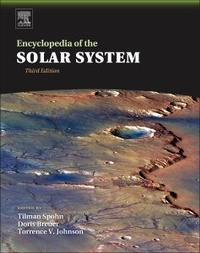
Encyclopedia of the Solar System
3rd Edition
Published on 24. April 2014
Book
Hardback
1336 pages
978-0-12-415845-0 (ISBN)
Description
The Encyclopedia of the Solar System, Third Edition-winner of the 2015 PROSE Award in Cosmology & Astronomy from the Association of American Publishers-provides a framework for understanding the origin and evolution of the solar system, historical discoveries, and details about planetary bodies and how they interact-with an astounding breadth of content and breathtaking visual impact. The encyclopedia includes the latest explorations and observations, hundreds of color digital images and illustrations, and over 1,000 pages. It stands alone as the definitive work in this field, and will serve as a modern messenger of scientific discovery and provide a look into the future of our solar system.
New additions to the third edition reflect the latest progress and growth in the field, including past and present space missions to the terrestrial planets, the outer solar systems and space telescopes used to detect extrasolar planets.
New additions to the third edition reflect the latest progress and growth in the field, including past and present space missions to the terrestrial planets, the outer solar systems and space telescopes used to detect extrasolar planets.
Reviews / Votes
"Huge efforts have been made to explain observations and theories clearly and succinctly and to bring the reader up to date. I recommend the book without reservation." --The Observatory"This exciting summation of more than 50 years of continuing space exploration will appeal to scientists and enthusiasts alike. Summing Up: Highly recommended." --Choice
"Everything you want to know about the solar system is here. ...This is the perfect reference book, lavishly illustrated and well-written." --From the Foreword by Wesley T. Huntress, JR., Carnegie Institute of Washington
"The authors succeed brilliantly at combining the latest results from spacecraft missions and Earth-based observations with thoughtful interpretations of the processes." --Maria T. Zuber, Massachusetts Institute of Technology
More details
Edition
3rd edition
Language
English
Place of publication
United States
Target group
Professional and scholarly
Scientists, teachers, interested laypeople, and students of planetary science, astronomy, astrophysics, planetary geology, meteorology, and atmospheric and magnetospheric sciences.
Dimensions
Height: 276 mm
Width: 216 mm
Weight
2890 gr
ISBN-13
978-0-12-415845-0 (9780124158450)
Copyright in bibliographic data and cover images is held by Nielsen Book Services Limited or by the publishers or by their respective licensors: all rights reserved.
Schweitzer Classification
Other editions
Additional editions
Tilman Spohn | Doris Breuer | Torrence Johnson
Encyclopedia of the Solar System
E-Book
05/2014
3rd Edition
Elsevier
€137.00
Available for download
Previous edition
Lucy-Ann McFadden | Torrence Johnson | Paul Weissman
Encyclopedia of the Solar System
Book
12/2006
2nd Edition
Academic Press
€95.32
Withdrawn from sale
Persons
Tilman Spohn is director of the Institute of Planetary Research of the German Aerospace Center (DLR) in Berlin, Germany and Professor of Planetology at theWestfa?lische Wilhelms-University Mu?nster, Germany. He specializes in the Thermodynamics of Planetary Interiors and in physical problems of Astrobiology and has written 140 papers for scientific journals and books. He is a Principal Investigator (PI) for MUPUS on the Rosetta Lander Philae, for BELA on BepiColombo, and the instrument PI for HP3 on the InSight mission. Spohn has served as member and chairperson of ESA scientific working and advisory groups and is presently a member of ESA's HISPAC. He is the chairman of the science committee of the international Space Science Institute and has served as editor for Earth and Planetary Science Letters, Reviews of Geophysics, and the Treatise on Geophysics. He is the recipient of the 2013 EGU Runcorn-Florensky Medal and a fellow of the American Geophysical Union. Doris Breuer is Head of the Department of Planetary Physics at the Institute of Planetary Research of the German Aerospace Center (DLR) in Berlin, Germany and an Associate Professor at the Institute de Physique du Globe de Paris, France. She specializes in the interior dynamics, thermo-chemical evolution and interior structure of terrestrial bodies. She has published over 60 articles in refereed journals, has been coinvestigator on ESA's BepiColombo mission and has served on several ESA science definition teams and on the ESA Solar System Working Group. Torrence V. Johnson is a specialist on icy satellites in the solar system. He has written over 130 publications for scientific journals. He received a Ph.D. in planetary science from the California Institute of Technology and is now the Chief Scientist for Solar System Exploration at the Jet Propulsion Laboratory. He was the Project Scientist for the Galileo mission and is currently an investigator on the Cassini mission. He is the recipient of two NASA Exceptional Scientific Achievement Medals and the NASA Outstanding Leadership Medal and has an honorary doctorate from the University of Padua, where Galileo made his first observations of the solar system.
Editor
director of the Institute of Planetary Research of the German Aerospace Center (DLR) in Berlin, Germany and Professor of Planetology at theWestfa?lische Wilhelms-University Mu?nster, Germany.
Head of the Department of Planetary Physics at the Institute of Planetary Research of the German Aerospace Center (DLR) in Berlin, Germany and an Associate Professor at the Institute de Physique du Globe de Paris, France.
Chief Scientist for Solar System Exploration at the Jet Propulsion Laboratory.
Content
I: The Solar System
II: Fundamental Planetary Processes and Properties
III: The Sun
IV: Earthlike Planets
V: Earth and Moon as Planets
VI: Asteroids and Comets
VII: Giant Planets and their Satellites
VIII: Beyond the Planets
IX: Exploring the Solar System
II: Fundamental Planetary Processes and Properties
III: The Sun
IV: Earthlike Planets
V: Earth and Moon as Planets
VI: Asteroids and Comets
VII: Giant Planets and their Satellites
VIII: Beyond the Planets
IX: Exploring the Solar System