

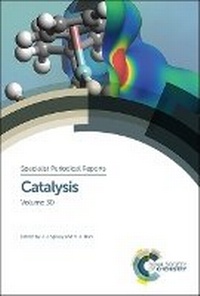
Catalysis
Volume 30
Will be published approx. on 9. May 2018
Book
Hardback
248 pages
978-1-78801-151-8 (ISBN)
Description
Catalysts are required for a variety of applications. Industrialists and academics are increasingly challenged to find cost effective and environmentally benign catalysts to use. This volume looks at modern approaches to catalysis and critically reviews the extensive literature on areas such as catalysts derived from waste materials, determining the pore structure of activated carbon by nitrogen gas adsorption and a new tool to explore catalytic reaction mechanisms - the catalytic shock tube. With an emphasis on interdisciplinary content, this book is aimed at catalytic science and engineering research communities.
More details
Series
Language
English
Place of publication
Cambridge
United Kingdom
Target group
Professional and scholarly
Product notice
Unsewn / adhesive bound
Dimensions
Height: 234 mm
Width: 156 mm
Thickness: 14 mm
Weight
523 gr
ISBN-13
978-1-78801-151-8 (9781788011518)
DOI
10.1039/9781788013048
Copyright in bibliographic data and cover images is held by Nielsen Book Services Limited or by the publishers or by their respective licensors: all rights reserved.
Schweitzer Classification
Other editions
Persons
Content
Catalysts derived from waste materials;
Ligand-free subnanometre gold metal clusters and their applications;
Determining the pore structure of activated carbon by nitrogen gas adsorption;
Catalytic aftertreatment systems for trucks fueled by biofuels - aspects on the impact of fuel quality on catalyst deactivation;
Deactivation mechanisms in methanol-tohydrocarbons chemistry;
The catalytic shock tube: a new tool to explore catalytic reaction mechanisms;
Recent advances on the conversion of glycerol to acrolein, 1,3-propanediol, propanol and propylene using acidic heterogeneous catalysts
Ligand-free subnanometre gold metal clusters and their applications;
Determining the pore structure of activated carbon by nitrogen gas adsorption;
Catalytic aftertreatment systems for trucks fueled by biofuels - aspects on the impact of fuel quality on catalyst deactivation;
Deactivation mechanisms in methanol-tohydrocarbons chemistry;
The catalytic shock tube: a new tool to explore catalytic reaction mechanisms;
Recent advances on the conversion of glycerol to acrolein, 1,3-propanediol, propanol and propylene using acidic heterogeneous catalysts