

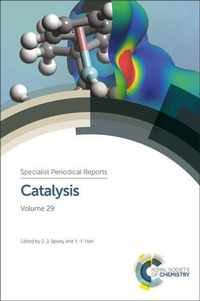
Catalysis
Volume 29
Published on 27. February 2017
Book
Hardback
365 pages
978-1-78262-956-6 (ISBN)
Description
Catalysts are required for a variety of applications and industrialists and academics are increasingly challenged to find cost effective and environmentally benign catalysts to use. This volume looks at modern approaches to catalysis and reviews the extensive literature on areas such as electrochemical promotion of catalysis, biodiesel-based metals on emission control devices, deoxygenation of fatty acids and transitioning rationally designed catalytic materials to real world catalysts produced on a commercial scale.
More details
Series
Language
English
Place of publication
Cambridge
United Kingdom
Target group
Professional and scholarly
Product notice
Unsewn / adhesive bound
Dimensions
Height: 234 mm
Width: 156 mm
Thickness: 24 mm
Weight
704 gr
ISBN-13
978-1-78262-956-6 (9781782629566)
Copyright in bibliographic data and cover images is held by Nielsen Book Services Limited or by the publishers or by their respective licensors: all rights reserved.
Schweitzer Classification
Other editions
Persons
Content
Advances in methanation catalysis;
Recent advances in electrochemical promotion of catalysis;
Mixed metal oxides and catalytic redox cycles;
Heterogeneous electrocatalysts for CO2 reduction;
Production and use of H2O2 for atom-efficient functionalization of hydrocarbons and small molecules;
Transitioning rationally designed catalytic materials to real "working" catalysts produced at commercial scale: nanoparticle materials;
Dehydrogenation of long chain n-paraffins to olefins - a perspective;
Investigations of the impact of biodiesel metal contaminants on emissions control devices
Recent advances in electrochemical promotion of catalysis;
Mixed metal oxides and catalytic redox cycles;
Heterogeneous electrocatalysts for CO2 reduction;
Production and use of H2O2 for atom-efficient functionalization of hydrocarbons and small molecules;
Transitioning rationally designed catalytic materials to real "working" catalysts produced at commercial scale: nanoparticle materials;
Dehydrogenation of long chain n-paraffins to olefins - a perspective;
Investigations of the impact of biodiesel metal contaminants on emissions control devices