

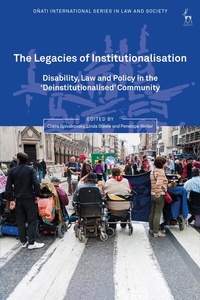
The Legacies of Institutionalisation
Disability, Law and Policy in the 'Deinstitutionalised' Community
Published on 9. July 2020
Book
Hardback
272 pages
978-1-5099-3073-9 (ISBN)
Description
This is the first collection to examine the legal dynamics of deinstitutionalisation. It considers the extent to which some contemporary laws, policies and practices affecting people with disabilities are moving towards the promised end point of enhanced social and political participation in the community, while others may instead reinstate, continue or legitimate historical practices associated with this population's institutionalisation. Bringing together 20 contributors from the UK, Canada, Australia, Spain and Indonesia, the book speaks to overarching themes of segregation and inequality, interlocking forms of oppression and rights-based advancements in law, policy and practice. Ultimately this collection brings forth the possibilities, limits and contradictions in the roles of law and policy in processes of institutionalisation and deinstitutionalisation, and directs us towards a more nuanced and sustained scholarly and political engagement with these issues.
More details
Series
Language
English
Place of publication
Oxford
United Kingdom
Publishing group
Bloomsbury Publishing PLC
Target group
College/higher education
Dimensions
Height: 234 mm
Width: 156 mm
Weight
558 gr
ISBN-13
978-1-5099-3073-9 (9781509930739)
Copyright in bibliographic data and cover images is held by Nielsen Book Services Limited or by the publishers or by their respective licensors: all rights reserved.
Schweitzer Classification
Other editions
Additional editions
Claire Spivakovsky | Linda Steele | Penelope Weller
The Legacies of Institutionalisation
Disability, Law and Policy in the 'Deinstitutionalised' Community
E-Book
07/2020
1st Edition
Hart Publishing
€37.49
Available for download
Persons
Claire Spivakovsky is Senior Lecturer in Criminology at the University of Melbourne.
Linda Steele is Senior Lecturer at the Faculty of Law, University of Technology Sydney.
Penelope Weller is Professor at the Graduate School of Business and Law, RMIT University.
Linda Steele is Senior Lecturer at the Faculty of Law, University of Technology Sydney.
Penelope Weller is Professor at the Graduate School of Business and Law, RMIT University.
Content
Introduction: The Lasting Legacies of Institutionalisation: Questioning Law's Roles in the Emancipation of People with Disabilities
Claire Spivakovsky, Linda Steele and Penelope Weller
Part One
Power Dynamics that Shape the Conditions and Possibilities of People With Disabilities Within and Beyond Sites of Physical Confinement
1. Navigating Mental Health Tribunals as a Mad-identified Layperson: An Autoethnographical Account of Liminality
Liz Brosnan
2. The 'Will to Empower' in Contemporary Mental Health Practice
Penelope Weller
3. The Biopolitics of Disability in Late Francoism and the Spanish Democratic Transition (1959-81)
Salvador Cayuela Sanchez
4. Disability Law in Spain: Moving Forward Towards Full Citizenship and Inclusion?
Eduardo Diaz Velazquez
5 Accommodation in the Academy: Working with Episodic Disabilities and Living In Between
Roxanne Mykitiuk
6. Disabling Solitary: An Anti-Carceral Critique of Canada's Solitary Confinement Litigation
Sheila Wildeman
Part Two
Complicated Alliances: The Confluence of Ableist, Sanist, Gendered, Classed and Racialised Logics in Law, Policy and Practice
7. Excavating Hostility and Rationalising Violence through Anti-immigrant Confluent Discourses of Racial Threat, Risk, Burden and Lack
Ameil Joseph
8. Disability-Indigenous Gendered Relations in Settler-Colonial Australia: Continuities, Trajectories and Enmeshments
Karen Soldatic
9. Disability, Gender and Institutions: An Examination of Australian Cases Involving Personality Disorders
Isabel Karpin and Karen O'Connell
10. Reconciling Cognitive Disability and Corrosive Social Disadvantage: Identity, Transgression and Debility
Leanne Dowse
11. Fixated Persons Units: A Disability Studies and Critical Race Theory (DisCrit) Analysis
Fleur Beaupert and Shelley Bielefeld
Part Three
Institutionalisation and Human Rights: The Role of the CRPD in the Emancipation
of People with Disabilities
12. A Matter of Engagement: Analysing the Submissions to the CRPD Committee on General Comment #1
Peter Barlett
13. Making Sense of Cheshire West
Lucy Series
14. The Production of 'Dependent Individuals' Within the Application of Spanish Law 39/2006 on Personal Autonomy and Dependent Carein Andalusia, Basque Country and Madrid
Melania Moscoso Perez and R Lucas Platero
15. To Use or Not to Use Physical Restraints in Paediatric Psychiatric Care: Should Health Professionals as Guarantors Use Coercive Measures to Protect from Potential Harm?
Elvira Pertega Andia
16. Scottish Mental Health and Capacity Law: Replacing the Old with the New or the Old in Policy, Law and Practice?
Jill Stavert
17. Diffabled People's Access to Indonesia's Criminal Justice System
Dio Ashar Wicaksana
Claire Spivakovsky, Linda Steele and Penelope Weller
Part One
Power Dynamics that Shape the Conditions and Possibilities of People With Disabilities Within and Beyond Sites of Physical Confinement
1. Navigating Mental Health Tribunals as a Mad-identified Layperson: An Autoethnographical Account of Liminality
Liz Brosnan
2. The 'Will to Empower' in Contemporary Mental Health Practice
Penelope Weller
3. The Biopolitics of Disability in Late Francoism and the Spanish Democratic Transition (1959-81)
Salvador Cayuela Sanchez
4. Disability Law in Spain: Moving Forward Towards Full Citizenship and Inclusion?
Eduardo Diaz Velazquez
5 Accommodation in the Academy: Working with Episodic Disabilities and Living In Between
Roxanne Mykitiuk
6. Disabling Solitary: An Anti-Carceral Critique of Canada's Solitary Confinement Litigation
Sheila Wildeman
Part Two
Complicated Alliances: The Confluence of Ableist, Sanist, Gendered, Classed and Racialised Logics in Law, Policy and Practice
7. Excavating Hostility and Rationalising Violence through Anti-immigrant Confluent Discourses of Racial Threat, Risk, Burden and Lack
Ameil Joseph
8. Disability-Indigenous Gendered Relations in Settler-Colonial Australia: Continuities, Trajectories and Enmeshments
Karen Soldatic
9. Disability, Gender and Institutions: An Examination of Australian Cases Involving Personality Disorders
Isabel Karpin and Karen O'Connell
10. Reconciling Cognitive Disability and Corrosive Social Disadvantage: Identity, Transgression and Debility
Leanne Dowse
11. Fixated Persons Units: A Disability Studies and Critical Race Theory (DisCrit) Analysis
Fleur Beaupert and Shelley Bielefeld
Part Three
Institutionalisation and Human Rights: The Role of the CRPD in the Emancipation
of People with Disabilities
12. A Matter of Engagement: Analysing the Submissions to the CRPD Committee on General Comment #1
Peter Barlett
13. Making Sense of Cheshire West
Lucy Series
14. The Production of 'Dependent Individuals' Within the Application of Spanish Law 39/2006 on Personal Autonomy and Dependent Carein Andalusia, Basque Country and Madrid
Melania Moscoso Perez and R Lucas Platero
15. To Use or Not to Use Physical Restraints in Paediatric Psychiatric Care: Should Health Professionals as Guarantors Use Coercive Measures to Protect from Potential Harm?
Elvira Pertega Andia
16. Scottish Mental Health and Capacity Law: Replacing the Old with the New or the Old in Policy, Law and Practice?
Jill Stavert
17. Diffabled People's Access to Indonesia's Criminal Justice System
Dio Ashar Wicaksana