

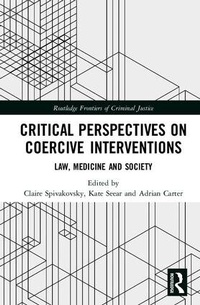
Critical Perspectives on Coercive Interventions
Law, Medicine and Society
1st Edition
Published on 8. May 2018
Book
Hardback
266 pages
978-1-138-06737-0 (ISBN)
Description
Coercive medico-legal interventions are often employed to prevent people deemed to be unable to make competent decisions about their health, such as minors, people with mental illness, disability or problematic alcohol or other drug use, from harming themselves or others. These interventions can entail major curtailments of individuals' liberty and bodily integrity, and may cause significant harm and distress. The use of coercive medico-legal interventions can also serve competing social interests that raise profound ethical, legal and clinical questions.
Examining the ethical, social and legal issues involved in coerced care, this book brings together the views and insights of leading researchers from a range of disciplines, including criminology, law, ethics, psychology and public health, as well as legal and medical practitioners, social-service 'consumers' and government officials. Topics addressed in this volume include: compulsory treatment and involuntary detention orders in civil mental health and disability law; mandatory alcohol and drug treatment programs and drug courts; community treatment orders; the use of welfare cards with Indigenous populations; mandated treatment of seriously ill minors; as well as adult guardianship and substituted decision-making regimes. These contributions attempt to shed light on why we use coercive interventions, whether we should, whether they are effective in achieving the benefits that are offered to justify their use, and the impact that they have on some of society's most vulnerable citizens in the names of 'justice' and 'treatment'.
This book is essential reading for clinicians, researchers and legal practitioners involved in the study and application of coerced care, as well as students and scholars in the fields of law, medicine, ethics and criminology. The collection asks important questions about the increasing use of coercive care that demand to be answered, and offers critical insights, guidance and recommendations for those working in the field.
Examining the ethical, social and legal issues involved in coerced care, this book brings together the views and insights of leading researchers from a range of disciplines, including criminology, law, ethics, psychology and public health, as well as legal and medical practitioners, social-service 'consumers' and government officials. Topics addressed in this volume include: compulsory treatment and involuntary detention orders in civil mental health and disability law; mandatory alcohol and drug treatment programs and drug courts; community treatment orders; the use of welfare cards with Indigenous populations; mandated treatment of seriously ill minors; as well as adult guardianship and substituted decision-making regimes. These contributions attempt to shed light on why we use coercive interventions, whether we should, whether they are effective in achieving the benefits that are offered to justify their use, and the impact that they have on some of society's most vulnerable citizens in the names of 'justice' and 'treatment'.
This book is essential reading for clinicians, researchers and legal practitioners involved in the study and application of coerced care, as well as students and scholars in the fields of law, medicine, ethics and criminology. The collection asks important questions about the increasing use of coercive care that demand to be answered, and offers critical insights, guidance and recommendations for those working in the field.
More details
Series
Language
English
Place of publication
London
United Kingdom
Publishing group
Taylor & Francis Ltd
Target group
Professional and scholarly
College/higher education
Dimensions
Height: 234 mm
Width: 156 mm
Weight
550 gr
ISBN-13
978-1-138-06737-0 (9781138067370)
Copyright in bibliographic data and cover images is held by Nielsen Book Services Limited or by the publishers or by their respective licensors: all rights reserved.
Schweitzer Classification
Other editions
Additional editions
Claire Spivakovsky | Kate Seear | Adrian Carter
Critical Perspectives on Coercive Interventions
Law, Medicine and Society
Book
03/2021
1st Edition
Routledge
€68.50
Shipment within 15-20 days
Claire Spivakovsky | Kate Seear | Adrian Carter
Critical Perspectives on Coercive Interventions
Law, Medicine and Society
E-Book
05/2018
1st Edition
Routledge
€61.99
Available for download
Claire Spivakovsky | Kate Seear | Adrian Carter
Critical Perspectives on Coercive Interventions
Law, Medicine and Society
E-Book
05/2018
1st Edition
Routledge
€61.99
Available for download
Persons
Dr Claire Spivakovsky is a Senior Lecturer in Criminology at Monash University.
Dr Kate Seear is an Associate Professor in Law at Monash University, an Australian Research Council DECRA Fellow, a practising lawyer, and an Adjunct Research Fellow at the National Drug Research Institute, Curtin University.
Associate Professor Adrian Carter is an NHMRC Career Development Fellow at the Monash Institute of Cognitive and Clinical Neurosciences and the School of Psychological Sciences, Monash University.
Dr Kate Seear is an Associate Professor in Law at Monash University, an Australian Research Council DECRA Fellow, a practising lawyer, and an Adjunct Research Fellow at the National Drug Research Institute, Curtin University.
Associate Professor Adrian Carter is an NHMRC Career Development Fellow at the Monash Institute of Cognitive and Clinical Neurosciences and the School of Psychological Sciences, Monash University.
Content
Introduction: Coercive Interventions in Law and Medicine: Setting the Scene, Claire Spivakovsky, Kate Seear and Adrian Carter, Part I: Examining Foundations for Coercive Interventions in Law and Medicine. 1. From Coerced to Compulsory Treatment of Addiction in The Patient's Best Interests: Is It Supported by The Evidence? Adrian Carter and Wayne Hall, 2. Community Treatment Orders: The Evidence and Ethical Implications, Lisa Brophy, Christopher James Ryan and Penelope Weller, 3. The Ambivalence of Addiction Medicine to the Concept of Involuntary Treatment is Costing Patients Dearly, Robert Batey, Part II: Lives, Bodies and Voices: The Material Impacts and Lived Effects of Coercion, 4. The Variable Treatment Of InCapacity in the Practical Operation of Victoria's Key Substituted Decision-Making Regimes: View from the Frontline, Eleanore Fritze, 5. Capacity Does Not Reside in Me, Cath Roper, 6. The Impossibilities Of 'Bearing Witness' to the Violence of Coercive Interventions in the Disability Sector, Claire Spivakovsky, Part III: Regulating the Production Of 'Good', 'Healthy' and 'Meaningful' Lives. 7. Making the Abject: Problem-Solving Courts, Addiction, Mental Illness and Impairment, Claire Spivakovsky and Kate Seear, 8. The Healthy Welfare Card: Indigenous Empowerment or 'Remote Control'? Stephen Gray, 9. Sterilisation, Disability and Well-Being: The Curative Imaginary of the 'Welfare Jurisdiction', Linda Steele, 10. Mandated Treatment for Seriously Ill Minors, Ian Freckelton, Part IV: Paternalistic Logics and Their Alternatives: Interventions in 'Risk' and 'Vulnerability'. 11. Mandated Treatment as Punishment: Exploring the Second Verdins Principle, Jamie Walvisch, 12. Containment Versus Rehabilitation: Managing High-Risk Offenders with Complex Needs, Bernadette McSherry, 13. Therapeutic Jurisprudence and Procedural Justice in Mental Health Practice: Responding To 'Vulnerability' Without Coercion, Penelope Weller, 14. Adult Guardianship and Its Alternatives in Australia, John Chesterman