

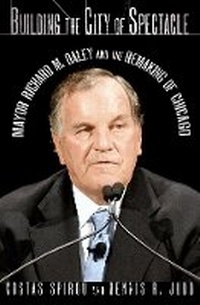
Building the City of Spectacle
Mayor Richard M. Daley and the Remaking of Chicago
Published on 27. October 2016
Book
Hardback
264 pages
978-1-5017-0047-7 (ISBN)
Description
By the time he left office on May 16, 2011, Mayor Richard M. Daley had served six terms and more than twenty-two years at the helm of Chicago's City Hall, making him the longest serving mayor in the city's history. Richard M. Daley was the son of the legendary machine boss, Mayor Richard J. Daley, who had presided over the city during the post-World War II urban crisis. Richard M. Daley led a period of economic restructuring after that difficult era by building a vibrant tourist economy. Costas Spirou and Dennis R. Judd focus on Richard M. Daley's role in transforming Chicago's economy and urban culture.
The construction of the "city of spectacle" required that Daley deploy leadership and vision to remake Chicago's image and physical infrastructure. He gained the resources and political power necessary for supporting an aggressive program of construction that focused on signature projects along the city's lakefront, including especially Millennium Park, Navy Pier, the Museum Campus, Northerly Island, Soldier Field, and two major expansions of McCormick Place, the city's convention center. During this period Daley also presided over major residential construction in the Loop and in the surrounding neighborhoods, devoted millions of dollars to beautification efforts across the city, and increased the number of summer festivals and events across Grant Park. As a result of all these initiatives, the number of tourists visiting Chicago skyrocketed during the Daley years.
Daley has been harshly criticized in some quarters for building a tourist-oriented economy and infrastructure at the expense of other priorities. Daley left his successor, Rahm Emanuel, with serious issues involving a long-standing pattern of police malfeasance, underfunded and uneven schools, inadequate housing opportunities, and intractable budgetary crises. Nevertheless, Spirou and Judd conclude, because Daley helped transform Chicago into a leading global city with an exceptional urban culture, he also left a positive imprint on the city that will endure for decades to come.
The construction of the "city of spectacle" required that Daley deploy leadership and vision to remake Chicago's image and physical infrastructure. He gained the resources and political power necessary for supporting an aggressive program of construction that focused on signature projects along the city's lakefront, including especially Millennium Park, Navy Pier, the Museum Campus, Northerly Island, Soldier Field, and two major expansions of McCormick Place, the city's convention center. During this period Daley also presided over major residential construction in the Loop and in the surrounding neighborhoods, devoted millions of dollars to beautification efforts across the city, and increased the number of summer festivals and events across Grant Park. As a result of all these initiatives, the number of tourists visiting Chicago skyrocketed during the Daley years.
Daley has been harshly criticized in some quarters for building a tourist-oriented economy and infrastructure at the expense of other priorities. Daley left his successor, Rahm Emanuel, with serious issues involving a long-standing pattern of police malfeasance, underfunded and uneven schools, inadequate housing opportunities, and intractable budgetary crises. Nevertheless, Spirou and Judd conclude, because Daley helped transform Chicago into a leading global city with an exceptional urban culture, he also left a positive imprint on the city that will endure for decades to come.
Reviews / Votes
... well-written histories both portray the travails of urban governance in the contemporary era... point to a fundamental flaw of the power structure dominant in Chicago, a one-party city where alternatives to Democratic Party control fall between the traditional liberal approach or the neoliberalism of Daley...(journal of the illinois state historical society)
More details
Language
English
Place of publication
Ithaca
United States
Product notice
Paper over boards
Illustrations
27 halftones, 1 table - 27 Halftones, black and white
Dimensions
Height: 216 mm
Width: 140 mm
Weight
454 gr
ISBN-13
978-1-5017-0047-7 (9781501700477)
Copyright in bibliographic data and cover images is held by Nielsen Book Services Limited or by the publishers or by their respective licensors: all rights reserved.
Schweitzer Classification
Other editions
Additional editions
Costas Spirou | Dennis R. Judd
Building the City of Spectacle
Mayor Richard M. Daley and the Remaking of Chicago
E-Book
10/2016
Cornell University Press
€26.49
Available for download
Persons
Costas Spirou is Professor and Chair of the Department of Government and Sociology at Georgia College & State University. He is the author of Urban Tourism and Urban Change: Cities in a Global Economy and coauthor of It's Hardly Sportin': Stadiums, Neighborhoods and the New Chicago. Dennis R. Judd is Professor Emeritus of Political Science at the University of Illinois at Chicago. He is coauthor of Restructuring the City: The Political Economy of Urban Redevelopment and coeditor most recently of The City, Revisited: Urban Theory from Chicago, Los Angeles, and New York.