

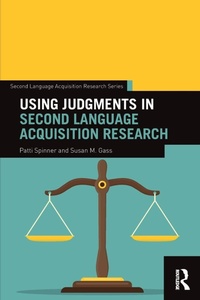
Using Judgments in Second Language Acquisition Research
1st Edition
Published on 25. February 2019
Book
Paperback/Softback
166 pages
978-1-138-20703-5 (ISBN)
Description
Synthesizing the theory behind and methodology for conducting judgment tests, Using Judgments in Second Language Acquisition Research aims to clarify the issues surrounding this method and to provide best practices in its use. The text is grounded on a balanced and comprehensive background of the usage of judgment data in the past up through its present-day applications. SLA researchers and graduate students will find useful a chapter serving as a "how-to" guide for a variety of situations to conduct research using judgments, including ways to optimize task design and examples from successful studies. Lucid and practical, Using Judgments in Second Language Acquisition Research offers guidance on a method widely used by SLA researchers, both old and new to the field.
Reviews / Votes
"[T]he book fills an existing gap in the literature of grammaticality judgment tasks. [...] It is commendable that the authors are well-seasoned in the relevant research and researchers can immensely benefit. [... T]he book can be taught at an MA level in applied linguistics programs." - Mohammad Salehi, Sharif University of Technology, in International Journal of Applied LinguisticsMore details
Series
Language
English
Place of publication
London
United Kingdom
Publishing group
Taylor & Francis Ltd
Target group
College/higher education
Illustrations
14 s/w Abbildungen, 1 s/w Photographie bzw. Rasterbild, 13 s/w Zeichnungen
13 Line drawings, black and white; 1 Halftones, black and white; 14 Illustrations, black and white
Dimensions
Height: 229 mm
Width: 152 mm
Thickness: 10 mm
Weight
273 gr
ISBN-13
978-1-138-20703-5 (9781138207035)
Copyright in bibliographic data and cover images is held by Nielsen Book Services Limited or by the publishers or by their respective licensors: all rights reserved.
Schweitzer Classification
Other editions
Additional editions
Patti Spinner | Susan M. Gass
Using Judgments in Second Language Acquisition Research
Book
02/2019
1st Edition
Routledge
€205.90
Shipment within 10-20 days
Patti Spinner | Susan M. Gass
Using Judgments in Second Language Acquisition Research
E-Book
02/2019
Routledge
€62.99
Available for download
Patti Spinner | Susan M. Gass
Using Judgments in Second Language Acquisition Research
E-Book
02/2019
1st Edition
Routledge
€63.49
Available for download
Persons
Patti Spinner is Associate Professor at Michigan State University. Her work focuses on the acquisition of grammar by second language learners. She has published numerous articles in journals such as Studies in Second Language Acquisition, Language Learning, Linguistic Approaches to Bilingualism, Applied Linguistics, and more.
Susan M. Gass is University Distinguished Professor at Michigan State University. She has published widely in the field of Second Language Acquisition, including the textbook Second Language Acquisition: An Introductory Course (Routledge), co-authored with Jennifer Behney and Luke Plonsky. She co-edits (with Alison Mackey) the Routledge series on Second Language Acquisition Research.
Susan M. Gass is University Distinguished Professor at Michigan State University. She has published widely in the field of Second Language Acquisition, including the textbook Second Language Acquisition: An Introductory Course (Routledge), co-authored with Jennifer Behney and Luke Plonsky. She co-edits (with Alison Mackey) the Routledge series on Second Language Acquisition Research.
Content
Table of Contents
Preface
Acknowledgments
Chapter 1: Judgment Data in Linguistic Research
1. Introduction
2. Judgment Data in Linguistics
3. Conclusion
Chapter 2: Judgment Data in L2 Research: Historical and Theoretical Perspectives
1. Introduction
2. Judgment Data in Second Language Research
3. L2 Judgment Data: A Brief History
4. What Knowledge is Being Measured?
5. What are Judgment Tasks Used for?
6. Intervening Variables
7. Conclusion
Chapter 3: Uses of Judgments in L2 Research
Introduction
Frameworks
3. Knowledge Types
4. Specific Constructs
5. Additional Research Areas
6. What languages Have Been Used?
7. Proficiency Levels
8.. Conclusion
Chapter 4: A Guide to Using Judgment Tasks in L2 Research
1. Introduction
2. Design Features
3. Other Considerations
4. Data Sharing
5. Conclusion
Chapter 5: Variations on Judgment Tasks
Introduction
Interpretation Tasks
3. Pragmatic Tasks
4. Preference Tasks
5. Error Correction Tasks
6. Multiple-Choice Tasks
7. Judgment Tasks in Combination With Psycholinguistic and Neurolinguistic Measures
8. Many Task Types in One
9. Conclusion
Chapter 6: Analyzing Judgment Data
Introduction
Cleaning the Data
3. Scoring Responses to Binary and Scalar Judgments
4. Scoring Corrections
5. Basic Inferential Statistics With Judgment Data
6. Reporting Individual Results
7. Rasch Analysis
8. Analyzing Likert Scale Data: z-Scores
9. Binary Judgments: d-Prime Scores
10. Analyzing Magnitude Estimation Scores
11. Using Response Time Data
12. Using Judgment Data Results in Conjunction With Other Measures
13. Conclusion
Preface
Acknowledgments
Chapter 1: Judgment Data in Linguistic Research
1. Introduction
2. Judgment Data in Linguistics
3. Conclusion
Chapter 2: Judgment Data in L2 Research: Historical and Theoretical Perspectives
1. Introduction
2. Judgment Data in Second Language Research
3. L2 Judgment Data: A Brief History
4. What Knowledge is Being Measured?
5. What are Judgment Tasks Used for?
6. Intervening Variables
7. Conclusion
Chapter 3: Uses of Judgments in L2 Research
Introduction
Frameworks
3. Knowledge Types
4. Specific Constructs
5. Additional Research Areas
6. What languages Have Been Used?
7. Proficiency Levels
8.. Conclusion
Chapter 4: A Guide to Using Judgment Tasks in L2 Research
1. Introduction
2. Design Features
3. Other Considerations
4. Data Sharing
5. Conclusion
Chapter 5: Variations on Judgment Tasks
Introduction
Interpretation Tasks
3. Pragmatic Tasks
4. Preference Tasks
5. Error Correction Tasks
6. Multiple-Choice Tasks
7. Judgment Tasks in Combination With Psycholinguistic and Neurolinguistic Measures
8. Many Task Types in One
9. Conclusion
Chapter 6: Analyzing Judgment Data
Introduction
Cleaning the Data
3. Scoring Responses to Binary and Scalar Judgments
4. Scoring Corrections
5. Basic Inferential Statistics With Judgment Data
6. Reporting Individual Results
7. Rasch Analysis
8. Analyzing Likert Scale Data: z-Scores
9. Binary Judgments: d-Prime Scores
10. Analyzing Magnitude Estimation Scores
11. Using Response Time Data
12. Using Judgment Data Results in Conjunction With Other Measures
13. Conclusion