

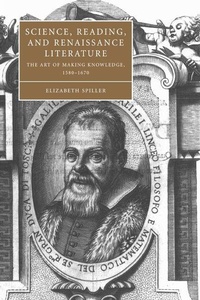
Science, Reading, and Renaissance Literature
The Art of Making Knowledge, 1580-1670
Published on 12. July 2007
Book
Paperback/Softback
232 pages
978-0-521-03768-6 (ISBN)
Description
Science, Reading, and Renaissance Literature brings together key works in early modern science and imaginative literature (from the anatomy of William Harvey and the experimentalism of William Gilbert to the fictions of Philip Sidney, Edmund Spenser and Margaret Cavendish). The book documents how what have become our two cultures of belief define themselves through a shared aesthetics that understands knowledge as an act of making. Within this framework, literary texts gain substance and intelligibility by being considered as instances of early modern knowledge production. At the same time, early modern science maintains strong affiliations with poetry because it understands art as a basis for producing knowledge. In identifying these interconnections between literature and science, this book contributes to scholarship in literary history, history of reading and the book, science studies and the history of academic disciplines.
Reviews / Votes
'Nowadays, we tend to think of science and literature as two cultures which have little in common, but Elizabeth Spiller's excellent study, Science, Reading, and Renaissance Literature, explores an age when these disciplines were united by a 'shared aesthetics of knowledge'. Spiller skilfully dismantles our current assumption that 'literature is fiction and science is fact', arguing that early modern writers understood that 'knowledge involves form as well as content ... Spiller's perceptive parallel readings of texts usually kept separate is a valuable addition to scholarship on the early modern period, as well as to the study of science and literature.' The Times Literary Supplement 'Original, learned and compelling. Spiller's superb discussion of Cavendish places her appropriately in very serious company.' Studies in English Literature '... richly-documented pages, written in a clear and pleasant style ...' Cahiers Elisabethains '... a rewarding contribution to the intersections between literature and natural philosophy. ... powerful and rewarding, in large part thanks to her striking combinations of authors within chapters and her vigorous readings of a wide range of texts.' Minerva '... she has opened the door to a complicated and complex area of study. Her linking of these radically different writers in seemingly disparate disciplines, her focus on sensory perception, and her discussion of the generation of knowledge are perceptive and illuminating ... the book is well worth the read.' Dr John Holmes, Lecturer in English, University of ReadingMore details
Series
Language
English
Place of publication
Cambridge
United Kingdom
Target group
Professional and scholarly
Product notice
Paperback (trade)
Illustrations
8 Halftones, unspecified
Dimensions
Height: 229 mm
Width: 152 mm
Thickness: 14 mm
Weight
383 gr
ISBN-13
978-0-521-03768-6 (9780521037686)
Copyright in bibliographic data and cover images is held by Nielsen Book Services Limited or by the publishers or by their respective licensors: all rights reserved.
Schweitzer Classification
Other editions
Additional editions
Elizabeth Spiller
Science, Reading, and Renaissance Literature
The Art of Making Knowledge, 1580-1670
E-Book
06/2006
1st Edition
Cambridge University Press
€44.49
Available for download
Elizabeth Spiller
Science, Reading, and Renaissance Literature
The Art of Making Knowledge, 1580-1670
Book
05/2004
Cambridge University Press
€129.10
Shipment within 15-20 days
Person
Elizabeth Spiller is Associate Professor and Director of Graduate Studies at the Department of English, Texas Christian University. She has published in a number of journals including Renaissance Quarterly, Criticism, Studies in English Literature, and Modern Language Quarterly.
Content
List of figures; Acknowledgements; Introduction: making early modern science and literature; 1. Model worlds: Philip Sidney, William Gilbert and the experiment of worldmaking; 2. From embryology to parthenogenesis: the birth of the writer in Edmund Spenser and William Harvey; 3. Reading through Galileo's telescope: Johannes Kepler's dream for reading knowledge; 4. Books written of the wonders of these glasses: Thomas Hobbes, Robert Hooke and Margaret Cavendish's theory of reading; Afterword: fiction and the Sokal hoax; Notes; Index.