

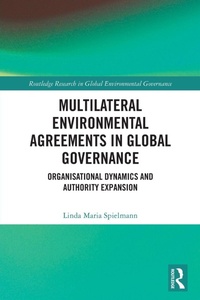
Multilateral Environmental Agreements in Global Governance
Organisational Dynamics and Authority Expansion
1st Edition
Will be published approx. on 20. July 2026
Book
Paperback/Softback
170 pages
978-1-032-98223-6 (ISBN)
Description
This book proposes a conceptualisation of Multilateral Environmental Agreements as a form of International Organisations, exploring the ways in which they have expanded over time by discussing the nuances of authority in global governance.
Multilateral Environmental Agreements are the key type of cooperation between states to address environmental concerns globally. While their activities regularly attract much attention from an academic and non-academic audience, their peculiar hybrid nature in-between treaties and full-fledged International Organisations, means they are often underestimated. This book proposes a new and innovative conceptualisation of Multilateral Environmental Agreements as a specific type of International Organisation which allows for a more accurate understanding of their dynamic nature, and uncovers expansive tendencies which have so far gone almost completely unnoticed. Based on a modern understanding of authority in global governance, the book shows how Multilateral Environmental Agreements represent a separate entity, and expand beyond the boundaries originally set by their member states. The book draws upon the neo-functionalist concept of spillover, as well as multiple other theoretical frameworks, to identify the two main drivers of expansion in Multilateral Environmental Agreements. To illustrate these drivers, the empirical chapters conduct six structured case studies, analysing specific cases of authority expansion in ozone and climate protection, including the Green Climate Fund under the UN Framework Convention on Climate Change. Overall, this book offers an invaluable contribution to the theoretical discussion on informal types of organisations, and provides new and extensive empirical insights into unexpected past and recent developments in global environmental governance.
As such, this book will be of great interest to students and scholars of International Relations and International Law who focus on informal types of cooperation and legislation, dynamic institutional development, and international environmental politics generally.
Multilateral Environmental Agreements are the key type of cooperation between states to address environmental concerns globally. While their activities regularly attract much attention from an academic and non-academic audience, their peculiar hybrid nature in-between treaties and full-fledged International Organisations, means they are often underestimated. This book proposes a new and innovative conceptualisation of Multilateral Environmental Agreements as a specific type of International Organisation which allows for a more accurate understanding of their dynamic nature, and uncovers expansive tendencies which have so far gone almost completely unnoticed. Based on a modern understanding of authority in global governance, the book shows how Multilateral Environmental Agreements represent a separate entity, and expand beyond the boundaries originally set by their member states. The book draws upon the neo-functionalist concept of spillover, as well as multiple other theoretical frameworks, to identify the two main drivers of expansion in Multilateral Environmental Agreements. To illustrate these drivers, the empirical chapters conduct six structured case studies, analysing specific cases of authority expansion in ozone and climate protection, including the Green Climate Fund under the UN Framework Convention on Climate Change. Overall, this book offers an invaluable contribution to the theoretical discussion on informal types of organisations, and provides new and extensive empirical insights into unexpected past and recent developments in global environmental governance.
As such, this book will be of great interest to students and scholars of International Relations and International Law who focus on informal types of cooperation and legislation, dynamic institutional development, and international environmental politics generally.
More details
Series
Language
English
Place of publication
London
United Kingdom
Publishing group
Taylor & Francis Ltd
Target group
College/higher education
Professional and scholarly
Academic and Postgraduate
Illustrations
1 s/w Tabelle, 4 s/w Zeichnungen, 4 s/w Abbildungen
1 Tables, black and white; 4 Line drawings, black and white; 4 Illustrations, black and white
Dimensions
Height: 234 mm
Width: 156 mm
ISBN-13
978-1-032-98223-6 (9781032982236)
Copyright in bibliographic data and cover images is held by Nielsen Book Services Limited or by the publishers or by their respective licensors: all rights reserved.
Schweitzer Classification
Other editions
Additional editions
Linda Maria Spielmann
Multilateral Environmental Agreements in Global Governance
Organisational Dynamics and Authority Expansion
E-Book
04/2025
Routledge
€60.49
Available for download
Linda Maria Spielmann
Multilateral Environmental Agreements in Global Governance
Organisational Dynamics and Authority Expansion
Book
04/2025
1st Edition
Routledge
€207.20
Shipment within 10-20 days
Linda Maria Spielmann
Multilateral Environmental Agreements in Global Governance
Organisational Dynamics and Authority Expansion
E-Book
04/2025
Routledge
€60.49
Available for download
Person
Linda Maria Spielmann is a senior consultant at the Association of Cooperatives Bavaria (GVB) and works with cooperative banks on sustainability and other topics. Previously, she was a senior consultant with the ESG Advisory Financial Services team at BDO. Before that, she was a research associate and Lecturer in International Relations at University of Bamberg, Germany.
Content
Introduction 1. Towards a New Understanding of MEAs 2. Redefining MEAs as Authoritative International Organisations 3. A Theoretical Framework for Informal MEA Authority Expansion 4. The Montreal Protocol on Substances that Deplete the Ozone Layer 5. The UN Framework Convention on Climate Change, the Kyoto Protocol, and the Paris Agreement Conclusion