

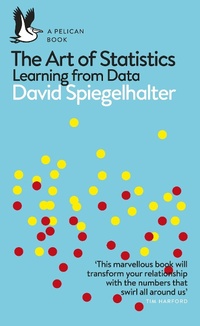
The Art of Statistics
Learning from Data
Published on 13. February 2020
Book
Paperback/Softback
448 pages
978-0-241-25876-7 (ISBN)
Description
'A statistical national treasure' Jeremy Vine, BBC Radio 2
'Required reading for all politicians, journalists, medics and anyone who tries to influence people (or is influenced) by statistics. A tour de force' Popular Science
Do busier hospitals have higher survival rates? How many trees are there on the planet? Why do old men have big ears? David Spiegelhalter reveals the answers to these and many other questions - questions that can only be addressed using statistical science.
Statistics has played a leading role in our scientific understanding of the world for centuries, yet we are all familiar with the way statistical claims can be sensationalised, particularly in the media. In the age of big data, as data science becomes established as a discipline, a basic grasp of statistical literacy is more important than ever.
In The Art of Statistics, David Spiegelhalter guides the reader through the essential principles we need in order to derive knowledge from data. Drawing on real world problems to introduce conceptual issues, he shows us how statistics can help us determine the luckiest passenger on the Titanic, whether serial killer Harold Shipman could have been caught earlier, and if screening for ovarian cancer is beneficial.
'Shines a light on how we can use the ever-growing deluge of data to improve our understanding of the world' Nature
'Required reading for all politicians, journalists, medics and anyone who tries to influence people (or is influenced) by statistics. A tour de force' Popular Science
Do busier hospitals have higher survival rates? How many trees are there on the planet? Why do old men have big ears? David Spiegelhalter reveals the answers to these and many other questions - questions that can only be addressed using statistical science.
Statistics has played a leading role in our scientific understanding of the world for centuries, yet we are all familiar with the way statistical claims can be sensationalised, particularly in the media. In the age of big data, as data science becomes established as a discipline, a basic grasp of statistical literacy is more important than ever.
In The Art of Statistics, David Spiegelhalter guides the reader through the essential principles we need in order to derive knowledge from data. Drawing on real world problems to introduce conceptual issues, he shows us how statistics can help us determine the luckiest passenger on the Titanic, whether serial killer Harold Shipman could have been caught earlier, and if screening for ovarian cancer is beneficial.
'Shines a light on how we can use the ever-growing deluge of data to improve our understanding of the world' Nature
Reviews / Votes
David Spiegelhalter is probably the greatest living statistical communicator; more than that, he's one of the great communicators in any field. This marvellous book will transform your relationship with the numbers that swirl all around us. Read it and learn. -- Tim Harford There is something in here for everyone ... A call to arms for greater societal data literacy ... Spiegelhalter's work serves as a reminder that there are passionate, self-aware statisticians who can argue eloquently that their discipline is needed now more than ever. * Financial Times * Shines a light on how we can use the ever-growing deluge of data to improve our understanding of the world . . . The Art of Statistics will serve students well. And it will be a boon for journalists eager to use statistics responsibly - along with anyone who wants to approach research and its reportage with healthy scepticism. * Nature * What David Spiegelhalter does here is provide a very thorough introductory grounding in statistics without making use of mathematical formulae. And it's remarkable. Spiegelhalter is warm and encouraging - it's a genuinely enjoyable read ... This book should be required reading for all politicians, journalists, medics and anyone who tries to influence people (or is influenced) by statistics. A tour de force. * Popular Science * The Art of Statistics is in the great educational tradition of its publishing imprint, Pelican Books: an attempt to get everyone up to speed with the practical uses of statistics, without pages of terrifying equations or Greek letters. In a series of spry, airy chapters, he succeeds fabulously ... Lucid and readable. In an age of scientific clickbait, 'big data' and personalised medicine, this is a book that nearly everyone would benefit from reading. * Spectator * Important and comprehensive -- Hannah Fry * New Yorker * This is an excellent book. Spiegelhalter is great at explaining difficult ideas . . . Yes, statistics can be difficult. But much less difficult if you read this book. * Evening Standard * Like the fictional investigator Sherlock Holmes, Spiegelhalter takes readers on a trail to challenge methodology and stats thrown at us by the media and others. But where other authors have attempted this and failed, he is inventive and clever in picking the right examples that spark the reader's interest to become active on their own. * Engineering and Technology * Do you trust headlines telling you . . . that bacon, ham and sausages carry the same cancer risk as cigarettes? No, nor do I. That is why we need a book like this that explains how such implausible nonsense arises in the first place. Written by a master of the subject . . . this book tells us to examine our assumptions. Bravo. * Standpoint *More details
Series
Language
English
Place of publication
London
United Kingdom
Publishing group
Penguin Books Ltd
Target group
Professional and scholarly
College/higher education
Dimensions
Height: 180 mm
Width: 112 mm
Thickness: 28 mm
Weight
260 gr
ISBN-13
978-0-241-25876-7 (9780241258767)
Copyright in bibliographic data and cover images is held by Nielsen Book Services Limited or by the publishers or by their respective licensors: all rights reserved.
Schweitzer Classification
Other editions
Additional editions
E-Book
03/2019
1st Edition
Pelican
€10.99
Available for download
Previous edition
Book
03/2019
Pelican
€41.03
Article exhausted; check for reprint
Person
Sir David John Spiegelhalter is a British statistician and Chair of the Winton Centre for Risk and Evidence Communication in the Statistical Laboratory at the University of Cambridge. Spiegelhalter is one of the most cited and influential researchers in his field, and was elected as President of the Royal Statistical Society for 2017-18.