

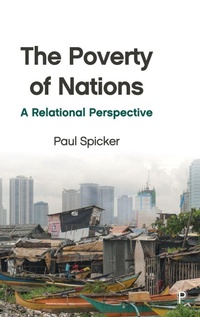
The Poverty of Nations
A Relational Perspective
1st Edition
Published on 11. March 2020
Book
Hardback
218 pages
978-1-4473-4332-5 (ISBN)
Description
In this persuasive study, social welfare and policy expert Paul Spicker makes a case for a relational view of poverty.
Poverty is much more than a lack of resources. It involves a complex set of social relationships, such as economic disadvantage, insecurity or a lack of rights. These relational elements tell us what poverty is - what it consists of, what poor people are experiencing, and what problems need to be addressed.
This book examines poverty in the context of the economy, society and the political community, considering how states can respond to issues of inequality, exclusion and powerlessness. Drawing on examples of social policy in both rich and poor countries, this is an accessible contribution to the debate about the nature of poverty and responses to it.
Poverty is much more than a lack of resources. It involves a complex set of social relationships, such as economic disadvantage, insecurity or a lack of rights. These relational elements tell us what poverty is - what it consists of, what poor people are experiencing, and what problems need to be addressed.
This book examines poverty in the context of the economy, society and the political community, considering how states can respond to issues of inequality, exclusion and powerlessness. Drawing on examples of social policy in both rich and poor countries, this is an accessible contribution to the debate about the nature of poverty and responses to it.
Reviews / Votes
"This thoughtful exploration of the contemporary landscape of poverty studies is especially valuable for those of us focused on human rights and social justice from the perspective of the Global South." * Camilo Perez-Bustillo, Stanford University * "The author provides fresh insights into a longstanding topic at the heart of development theory and practice. His multi-level and multi-disciplinary analysis which looks at poor and rich countries in tandem is an important contribution to current development debates in the era of the SDGs." * Katja Hujo, United Nations Research Institute for Social Development *More details
Edition
First Edition
Language
English
Place of publication
Bristol
United Kingdom
Publishing group
Bristol University Press
Target group
Professional and scholarly
Illustrations
3 s/w Abbildungen, 7 s/w Tabellen
7 Tables, black and white; 3 Illustrations, black and white
Dimensions
Height: 240 mm
Width: 161 mm
Thickness: 17 mm
Weight
499 gr
ISBN-13
978-1-4473-4332-5 (9781447343325)
Copyright in bibliographic data and cover images is held by Nielsen Book Services Limited or by the publishers or by their respective licensors: all rights reserved.
Schweitzer Classification
Other editions
Additional editions
Book
03/2020
1st Edition
Policy Press
€42.20
Shipment within 15-20 days

E-Book
03/2020
1st Edition
Policy Press
€41.99
Available for download

E-Book
03/2020
1st Edition
Policy Press
€231.99
Available for download
Person
Paul Spicker is Emeritus Professor of Public Policy at Robert Gordon University. He has been a consultant on social welfare for a range of agencies; his research includes studies of poverty, need and service delivery.
Content
Introduction: Representations of poverty
Part I ~ Poverty: economic and social relationships
Poverty
Poverty and the economy
Economic development
Inequality
Exclusion
Poverty and rights
Poverty and social policy
Part II ~ Rich and poor countries
Poverty in national perspective
Poverty and the state
Poverty in rich countries
Poor countries
Rich and poor countries
Responses to poverty
Conclusion: Poverty and social science
Part I ~ Poverty: economic and social relationships
Poverty
Poverty and the economy
Economic development
Inequality
Exclusion
Poverty and rights
Poverty and social policy
Part II ~ Rich and poor countries
Poverty in national perspective
Poverty and the state
Poverty in rich countries
Poor countries
Rich and poor countries
Responses to poverty
Conclusion: Poverty and social science