

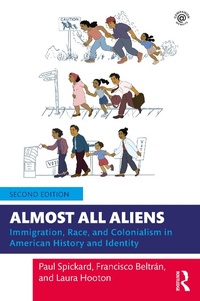
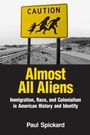
Almost All Aliens
Immigration, Race, and Colonialism in American History and Identity
2nd Edition
Published on 15. September 2022
Book
Paperback/Softback
516 pages
978-1-138-01770-2 (ISBN)
Description
Almost All Aliens offers a unique reinterpretation of immigration in the history of the United States. Setting aside the European migrant-centered melting-pot model of immigrant assimilation, Paul Spickard, Francisco Beltran, and Laura Hooton put forward a fresh and provocative reconceptualization that embraces the multicultural, racialized, and colonially inflected reality of immigration that has always existed in the United States. Their astute study illustrates the complex relationship between ethnic identity and race, slavery, and colonial expansion.
Examining the lives of those who crossed the Atlantic, as well as those who crossed the Pacific, the Caribbean, and the North American Borderlands, Almost All Aliens provides a distinct, inclusive, and critical analysis of immigration, race, and identity in the United States from 1600 until the present. The second edition updates Almost All Aliens through the first two decades of the twenty-first century, recounting and analyzing the massive changes in immigration policy, the reception of immigrants, and immigrant experiences that whipsawed back and forth throughout the era. It includes a new final chapter that brings the story up to the present day.
This book will appeal to students and researchers alike studying the history of immigration, race, and colonialism in the United States, as well as those interested in American identity, especially in the context of the early twenty-first century.
Examining the lives of those who crossed the Atlantic, as well as those who crossed the Pacific, the Caribbean, and the North American Borderlands, Almost All Aliens provides a distinct, inclusive, and critical analysis of immigration, race, and identity in the United States from 1600 until the present. The second edition updates Almost All Aliens through the first two decades of the twenty-first century, recounting and analyzing the massive changes in immigration policy, the reception of immigrants, and immigrant experiences that whipsawed back and forth throughout the era. It includes a new final chapter that brings the story up to the present day.
This book will appeal to students and researchers alike studying the history of immigration, race, and colonialism in the United States, as well as those interested in American identity, especially in the context of the early twenty-first century.
Reviews / Votes
Praise for the first edition:"Placing race at the center of his story, Spickard offers an important corrective to dominant immigrant narratives about European huddled masses and bountiful golden doors. As immigration debates rage, Almost All Aliens provides vital historical perspective.
-Thomas A. Guglielmo, Associate Professor and Chair of American Studies at GWU
"Almost All Aliens is simply stunning. Spickard powerfully connects the study of immigration to the histories of race, slavery, and the displacement of Native peoples. In doing so, he revises both immigration history and American history."
-Erika Lee, author of At America's Gates: Chinese Immigration During the Exclusion Era, 1882-1943 and The Making of Asian America or America for Americans.
"With Almost All Aliens Paul Spickard again demonstrates that he is one of our most skillful and innovative interpreters of race and ethnicity in American life. He challenges most of the assumptions made about the topic since Crevecoeur asked his fateful question and provides an exciting analytic narrative of our immigrant past."
-Roger Daniels, Charles Phelps Taft Professor Emeritus of History, University of Cincinnati
"Almost All Aliens is a stunning achievement! By combining the insights of the massive recent literature on immigration, race, and colonialism, Paul Spickard has produced a masterful new narrative of U.S. immigration history for the 21st century. Immensely readable and thoroughly provocative, it will delight students and scholars of immigration alike."
-George J. Sanchez, University of Southern California, author of Becoming Mexican American and Boyle Heights
"With this book, Paul Spickard has produced the best single-volume study of American immigration history available today."
- K. Scott Wong, Williams College
More details
Edition
2nd edition
Language
English
Place of publication
London
United Kingdom
Publishing group
Taylor & Francis Ltd
Target group
College/higher education
Edition type
New edition
Product notice
Paperback (trade)
Unsewn / adhesive bound
Illustrations
16 farbige Zeichnungen, 36 s/w Tabellen, 69 s/w Abbildungen, 16 farbige Abbildungen, 69 s/w Photographien bzw. Rasterbilder
36 Tables, black and white; 16 Line drawings, color; 69 Halftones, black and white; 16 Illustrations, color; 69 Illustrations, black and white
Dimensions
Height: 254 mm
Width: 178 mm
Thickness: 28 mm
Weight
925 gr
ISBN-13
978-1-138-01770-2 (9781138017702)
Copyright in bibliographic data and cover images is held by Nielsen Book Services Limited or by the publishers or by their respective licensors: all rights reserved.
Schweitzer Classification
Other editions
Additional editions
Paul Spickard | Laura Hooton | Francisco Beltran
Almost All Aliens
Immigration, Race, and Colonialism in American History and Identity
E-Book
09/2022
2nd Edition
Routledge
€52.49
Available for download
Paul Spickard | Francisco Beltran | Laura Hooton
Almost All Aliens
Immigration, Race, and Colonialism in American History and Identity
E-Book
09/2022
2nd Edition
Routledge
€52.49
Available for download
Paul Spickard | Francisco Beltran | Laura Hooton
Almost All Aliens
Immigration, Race, and Colonialism in American History and Identity
Book
09/2022
2nd Edition
Routledge
€236.30
Shipment within 10-20 days
Previous edition
Book
06/2007
1st Edition
Routledge
€73.22
Article exhausted; check for reprint
Persons
Paul Spickard is Distinguished Professor of History and several other fields at the University of California, Santa Barbara. He has held positions at 15 universities in the United States and abroad. Among his many books are Race in Mind: Critical Essays and Shape Shifters: Journeys Across Terrains of Race and Identity.
Francisco Beltran is Assistant Professor of History at Oklahoma State University, Stillwater, OK. Previously, he taught at San Francisco State University, the University of Michigan, and Reed College. His teaching and research interests include Chicanx and Latinx history, race and ethnicity, immigration, borderlands, and oral history.
Laura Hooton is Assistant Professor of History at Angelo State University, San Angelo, TX. She taught at the United States Military Academy at West Point for three years, where she founded the Black History Project. Her work appears in Farming Across Borders: A Transnational History of the North American West and California History.
Francisco Beltran is Assistant Professor of History at Oklahoma State University, Stillwater, OK. Previously, he taught at San Francisco State University, the University of Michigan, and Reed College. His teaching and research interests include Chicanx and Latinx history, race and ethnicity, immigration, borderlands, and oral history.
Laura Hooton is Assistant Professor of History at Angelo State University, San Angelo, TX. She taught at the United States Military Academy at West Point for three years, where she founded the Black History Project. Her work appears in Farming Across Borders: A Transnational History of the North American West and California History.
Content
1. Immigration, Race, Ethnicity, Colonialism / 2. Colliding Peoples in Eastern North America, 1600-1780 / 3. An Anglo-American Republic? Racial Citizenship, 1760-1860 / 4. The Border Crossed Us: Euro-Americans Take the Continent, 1830-1900 / 5. The Great Wave, 1870-1930 / 6. Cementing Hierarchy: Issues and Interpretations, 1870-1930 / 7. White People's America, 1924-1965 / 8. New Migrants From New Places: Since 1965 / 9. Redefining Membership Amid Multiplicity: Since 1965 / 10. The Return of White Supremacy? / 11. Epilogue / Appendix A