

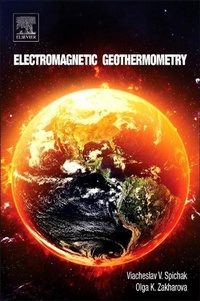
Electromagnetic Geothermometry
theory, modeling, practice
Published on 9. January 2015
Book
Paperback/Softback
196 pages
978-0-12-802210-8 (ISBN)
Description
Electromagnetic Geothermometry explores, presents and explains the new technique of temperature estimation within the Earth's interior; the Electromagnetic technique will identify zones of geothermal anomalies and thus provides locations for deep drilling. This book includes many case studies from geothermal areas such as Travale (Italy), Soultz-sous-Forets (France) and Hengill (Iceland), allowing the author and reader to draw conclusions regarding the dominating heat transfer mechanisms, location of its sources and to constrain the locations for drilling of the new boreholes.
Covering a topic that so far has very little coverage (due to its newness) Electromagnetic Geothermometry presents ground breaking information on the interpretation of MT signals. And as such, is similar to the work that was done to develop new generations of seismic inversion methods that have since come to dominate the oil industry.
Up until now geophysical methods have had difficulty resolving temperature differences which have been critical in the understanding of location and magnitude of geothermal resources
Covering a topic that so far has very little coverage (due to its newness) Electromagnetic Geothermometry presents ground breaking information on the interpretation of MT signals. And as such, is similar to the work that was done to develop new generations of seismic inversion methods that have since come to dominate the oil industry.
Up until now geophysical methods have had difficulty resolving temperature differences which have been critical in the understanding of location and magnitude of geothermal resources
Reviews / Votes
"The authors have done a commendable job to condense their large collection of prior publications into this short book. The writing is clear, the illustrations are informative, and each chapter contains an extensive bibliography." --The Leading EdgeMore details
Language
English
Place of publication
United States
Target group
Professional and scholarly
Exploration Geophysicists, Geoscientists working on applied electromagnetics and geothermics. Secondary Audience: The geothermal industry sector and the hydrocarbon exploration sector.
Product notice
Paperback (trade)
Unsewn / adhesive bound
Dimensions
Height: 228 mm
Width: 151 mm
Thickness: 12 mm
Weight
334 gr
ISBN-13
978-0-12-802210-8 (9780128022108)
Copyright in bibliographic data and cover images is held by Nielsen Book Services Limited or by the publishers or by their respective licensors: all rights reserved.
Schweitzer Classification
Other editions
Additional editions

E-Book
01/2015
Elsevier
€85.95
Available for download
Persons
With over 30 years' geophysics experience, Dr. Spichak's main research interests include joint interpretation of electromagnetic and other geophysical data, indirect estimation of the Earth's physical properties from the ground electromagnetic data, and computational electromagnetics. Spichak has authored and edited 8 books with Elsevier, including Electromagnetic Sounding of the Earth's Interior (2015). He is the winner of the Gamburtsev award for the monograph "Magnetotelluric fields in three-dimensional models of geoelectrics? (1999) and the Schmidt medal for outstanding achievements in Geophysics (2010).
Content
Part I. METHODOLOGY1. Electromagnetic sounding of geothermal areas2. Techniques used for estimating the temperature of the Earth's interior 4. Indirect electromagnetic geothermometer
Part II. CASE STUDIES5. Estimation of the deep temperature distribution in the Chu depression (northern Tien Shan) 6. Gaseous vs aqueous fluids: Travale (Italy) case study7. Estimating deep heat transfer mechanisms: Soultz-sous-Forets (France) case study8. A new conceptual model of the Icelandic crust: Hengill case study
Part II. CASE STUDIES5. Estimation of the deep temperature distribution in the Chu depression (northern Tien Shan) 6. Gaseous vs aqueous fluids: Travale (Italy) case study7. Estimating deep heat transfer mechanisms: Soultz-sous-Forets (France) case study8. A new conceptual model of the Icelandic crust: Hengill case study